Busy Pros: Email Prioritization Apps That Catch Costly Deadlines

For busy professionals, the best email prioritization app is the one that surfaces consequence, not volume. We recommend theNeedle: it flags deadlines, financial and contractual alerts, and urgent unanswered replies so they stand out from routine mail. It connects to your existing inboxes, and a free trial lets you test it before you pay for a monthly or annual plan.
TL;DR:
- Use batch cleanup for an old backlog, rule based filters for predictable sorting, and shared inbox software when several people must assign messages.
- During a trial, check whether the app explains each ranking and learns from corrections; opaque systems can hide important messages without your noticing.
- Connect every account you use, including older addresses, and confirm that rankings stay consistent across providers before relying on one priority view.
- During the trial, compare missed consequential messages, inbox time, and urgent flags against your usual routine; stop if results do not improve.
- Before paying, check which accounts the app can access, whether you can revoke permissions, what data it stores, and whether you can delete it.
Table of Contents
- Which kind of email prioritization app fits you?
- How do email prioritization apps actually work?
- Which features should an email prioritization app have?
- How do you choose the right app for your workflow?
- How did we evaluate these apps?
- How do you get started with theNeedle?
- How do the leading approaches compare, strengths and weaknesses included?
- What does real-world effectiveness look like?
- Why consequence-first beats inbox zero
- Stop letting the one email that matters get buried
- FAQ
- Sources
Which kind of email prioritization app fits you?
Most tools in this space fall into four families, and each one solves a different problem. Placing yourself in the right family can save you trial and error.
- Consequence-first apps read incoming mail for real-world stakes: due dates, charges, legal notices, refunds, and replies someone is waiting on. They suit people whose cost of a missed message is money, a missed deadline, or a damaged relationship.
- Rule and filter based cleaners sort mail by sender, subject, or schedule into smart folders. They suit people who mostly want low-value mail pushed out of the way and who are happy to maintain their own rules.
- Batch-cleanup tools work on the backlog: bulk actions by sender, date, or size. They suit someone staring at a large backlog of old messages who needs a one-time purge rather than daily triage.
- Team shared-inbox platforms route, assign, and track messages across several people. They suit support desks and small teams, not one person guarding a personal workload.
If you are a freelancer, manager, or specialist who gets a steady stream of mail where one buried message can cost real money, the first family is your fit. That is the job we built theNeedle to do, and it is why we recommend it for this audience. The other families are useful, but they reduce clutter. They do not tell you which message carries a consequence.
How do email prioritization apps actually work?
Under the hood, almost every prioritization app combines two ideas: deterministic rules and machine learning classification. Understanding the difference helps you judge marketing claims.
Rules are explicit and predictable. You say “mail from this sender goes here” and it does, every time. Their weakness is that you must anticipate every situation in advance. Machine learning classification looks at the content of a message and estimates how much it matters, which handles situations you never thought to write a rule for. Its weakness is opacity: if you cannot see why a message was ranked, you cannot trust the ranking.
That is why teachability matters. Microsoft’s own engineering team found that prioritization works better when the interface shows the reason for a ranking and lets people teach the system what they consider important. An app that explains itself and accepts your corrections gets better. One that silently hides mail gets worse in ways you may not notice until something slips.
Industry listings reflect the same direction. Capterra’s category overview describes email management software as combining rules, routing, archiving, and integrations with a growing layer of AI that learns user preferences.

Signals these apps commonly use
Different products weigh different clues, but the common ones are:
- Deadlines and dates mentioned in the text
- Monetary words such as invoice, refund, payment, or overdue
- Whether the message asks a question or expects a reply
- Sender reputation and your history with that sender
- Calendar references and meeting language
- Whether you replied to the thread before
Microsoft documents a similar approach in its Outlook feature, where Prioritize my inbox reviews arriving mail and assigns priority from a defined list of factors. The principle is the same across vendors; what differs is which factors count and how much control you get.
Accounts and integrations
Real inboxes are messy. A useful app works across providers, so mail from Gmail, Outlook, Microsoft accounts, Yahoo, and iCloud lands in one prioritized view rather than forcing you to check each separately. Ours connects to all of these. Multi-account behavior is worth testing early, because some tools prioritize well in one account and poorly in another.
The scale of the problem explains why this matters. By theNeedle’s own account, the average worker receives:
- 117 emails a day, which is the figure we use to frame the problem, not an independent study. At that volume, the question is not how to read everything but how to make sure the one message with a deadline or a charge never gets lost.
If you want the long-form reasoning behind that figure, our article on email management apps that catch the one critical message goes deeper.
Which features should an email prioritization app have?
A checklist beats a hunch. These are the capabilities that predict whether an app will actually protect you from missed messages, along with what to test during a trial.
- Consequence detection. The app should scan for deadlines, financial language, and contractual terms, not just sender names. Test it by forwarding yourself a few realistic messages, such as a bill with a due date and a renewal notice, and see whether they rise to the top.
- Teachability and feedback controls. You should see why something was ranked and be able to correct it. Mark three or four messages as wrong and check that similar mail behaves differently the next day.
- Follow-up and reminder tools. Surfacing mail is half the job. Look for a way to flag messages you sent that never got a reply, and to be reminded about them.
- Multi-account support. Connect every inbox you actually use and confirm they are treated consistently.
- A priority or triage view. A dedicated place showing only what needs action keeps you out of the main inbox, where distraction lives.
- Unsubscribe or block controls. Senders who keep coming back after you unsubscribe should be easy to silence permanently.
- Snooze and scheduling. Being able to push a message to a better moment prevents a mid-priority item from nagging you.
- One-item-at-a-time focus. A mode that shows a single message at a time is especially helpful for people with ADHD or anyone who freezes when faced with a long list.
Integration also matters. Check whether the app plays well with your calendar and to-do tools, and whether it supports the providers you use daily. A prioritization layer that cannot see one of your accounts has a blind spot exactly where you do not want one.
Pro Tip: Stack tools by function only when they do not duplicate effort. A bulk-cleanup tool for a one-time backlog purge plus a consequence-first app for daily triage works. Two apps that both reorder your inbox will fight each other.
That advice echoes a pattern in tool roundups. Comparative rundowns of email management tools group products by the job they do, whether AI triage, bulk cleanup, reminders, or team inbox management, and suggest combining specialized tools only when you genuinely need to.
How do you choose the right app for your workflow?
Start with diagnosis, then trial, then measure. Answer these questions honestly before you install anything:
- What does a missed email cost you? If the answer is money or a deadline, you need consequence detection, not just sender-based sorting.
- Do you have a backlog or an ongoing flow? A backlog calls for a cleanup tool first. A steady stream calls for continuous triage.
- Are you solo or part of a team? One person guarding a workload needs a personal prioritization app. A team handling shared mail needs routing and assignment.
- Do you need reminders for replies you are waiting on? If yes, make follow-up tracking a requirement, not a nice extra.
- How many accounts do you juggle? Count them all, including the old address you rarely check but still receives invoices.
- Can you review the app’s reasoning? If you cannot see why a message ranked high, treat the product as a black box and trust it less.
Once you pick a candidate, use the trial to test behavior rather than polish. Watch whether the app tells you why it flagged something, whether your corrections change later results, whether every connected account is treated consistently, and what permissions it asks for.
After testing the app, check these results:
- Missed consequential emails. Did anything with a deadline or charge slip past you? The goal is zero.
- Time spent in the inbox. You should be opening your mail fewer times for shorter stretches.
- Fewer urgent flags. If you are still seeing “urgent” on everything, the app is not discriminating well enough.
Finish with a quick privacy review. Confirm which accounts you granted access to, whether you can revoke access easily, what the app stores, and whether you can delete your data. An email tool sees nearly everything about your working life, so these settings deserve attention before you commit to a plan.
How did we evaluate these apps?
We built this shortlist around the job readers actually need done, which is catching the messages that matter. We judged apps on these axes:
- Consequence detection: does the app recognize deadlines, financial alerts, and contractual language?
- Teachability: can you see the reasoning and correct it?
- Multi-account support: are all your inboxes handled consistently?
- Reminders: does it track replies you are waiting on?
- Privacy: are permissions clear and revocable?
- Usability: does it reduce effort or add a new chore?
For practical testing, we install the app, connect one inbox, feed it a set of realistic incoming messages, then try teaching it and setting reminders to see whether behavior changes. Where we describe tools we do not sell, we are working from published category write-ups and support documentation rather than claiming head-to-head lab results.
You should also know where we stand. We publish this article and we compete in this category, so we present theNeedle as the recommended solution for the consequence-first job. We say so openly so you can weigh our recommendation accordingly.
How do you get started with theNeedle?
Setup lets you connect your inboxes. Our app connects to Gmail, Outlook, Microsoft, Yahoo, and iCloud accounts, and you grant the permissions needed to read incoming mail so it can rank by consequence.
From there, a handful of steps produces early wins:
- Connect your primary inbox first, then add the others once you trust the results.
- Review the consequence signals so the app knows to watch for deadlines, charges, and the kinds of notices you care about.
- Review a few rankings in the first days.
- Keep track of messages that need a reply.
- Try one-at-a-time focus mode if long lists make you stall.
At first, keep a simple routine: check the priority view once a day, set two follow-up reminders on threads you are waiting on, and review what the app flagged against what you would have caught yourself. Our walkthrough on prioritizing important emails by consequence covers the recommended configuration step by step.
How do the leading approaches compare, strengths and weaknesses included?
Rather than ranking vendors, it is more useful to compare the approaches readers actually choose between, since each solves a different problem and fails in a different way.
Consequence-first apps are strongest at protecting you from costly misses, because they reason about what a message means. Their weakness is that they ask you to trust a ranking, so the ability to see and correct reasoning matters. Rule and filter based tools are predictable and cheap to understand, but they only catch what you anticipated, so a surprise notice from an unfamiliar sender can slip through.
Batch-cleanup tools shine on backlog. Tool rundowns describe products such as SaneBox, Clean Email, and Mailstrom as filling distinct jobs like AI triage and bulk cleanup, and that split is a fair summary of the category. They are less helpful for ongoing protection, because clearing old mail does not tell you what matters in tomorrow’s flow. Team shared-inbox platforms excel at routing and accountability, yet they are built around groups and add overhead for one person.

Microsoft’s own tools show the middle ground. Its Focused Inbox separates likely-important mail from everything else and lets you move messages to train it. That is useful, but it sorts by likely importance, not by the concrete consequence attached to a message. For readers whose risk is a missed deadline or charge, that distinction is the whole point, and it is the gap we aim to close.
What does real-world effectiveness look like?
We do not have published customer testimonials or formal case studies to quote here, and we would rather say so than invent them. What we can offer is a way to produce your own evidence during a trial, which is more convincing than anyone else’s story.
Pick a short list of real situations from your own mail that matter to you: a renewal notice, an invoice nearing its due date, a reply you were expecting from a client, a refund or credit you are owed. Note whether you caught each one on time before you start. Then run the trial and compare.
The questions to ask are practical. Did the app surface the deadline email before you stumbled on it? Did it point out the reply you never answered? Did it spot an opportunity, such as a credit or refund, that you would otherwise have scrolled past? Did your time in the inbox shrink?
Keep a simple log with three columns: what the message was, whether you would have caught it unaided, and whether the app surfaced it. After the trial you will have a small, honest dataset about your own mail, which tells you far more than a marketing quote could. If the numbers do not show a clear improvement, the app is not right for your workflow, and that is a perfectly good thing to learn before paying for an annual plan.
Why consequence-first beats inbox zero
I have watched smart people spend years chasing an empty inbox, and I think the goal is aimed at the wrong target. Inbox zero measures how much mail you have processed. It says nothing about whether you handled the message that mattered. Even with a busy inbox, you can clear the whole pile and still bury the single notice that costs you money.
My view is that attention, not tidiness, is the scarce resource, and a good app should protect it. That means ranking by what happens if you ignore a message, not by how recently it arrived or who sent it. It also means accepting that most mail deserves no more than a glance.
A few habits make any tool work better:
- Schedule fixed triage windows instead of checking all day.
- Use reminders for replies you are owed, so they do not rely on memory.
- Review the priority view first, and the rest only if time allows.
My suggestion is to try a shortlist approach: start a trial of a consequence-first app and measure three things, missed consequential emails, time in the inbox, and the number of urgent flags. If those move in the right direction, you have your answer.
— Glen Bover
Stop letting the one email that matters get buried
If your inbox hides the messages that carry deadlines, charges, and replies people are waiting on, theNeedle is built for exactly that problem. We rank your mail by consequence, surface overdue and urgent messages, flag threads where a reply is still unhandled, and point out opportunities like credits or refunds, across all of your accounts in one place.
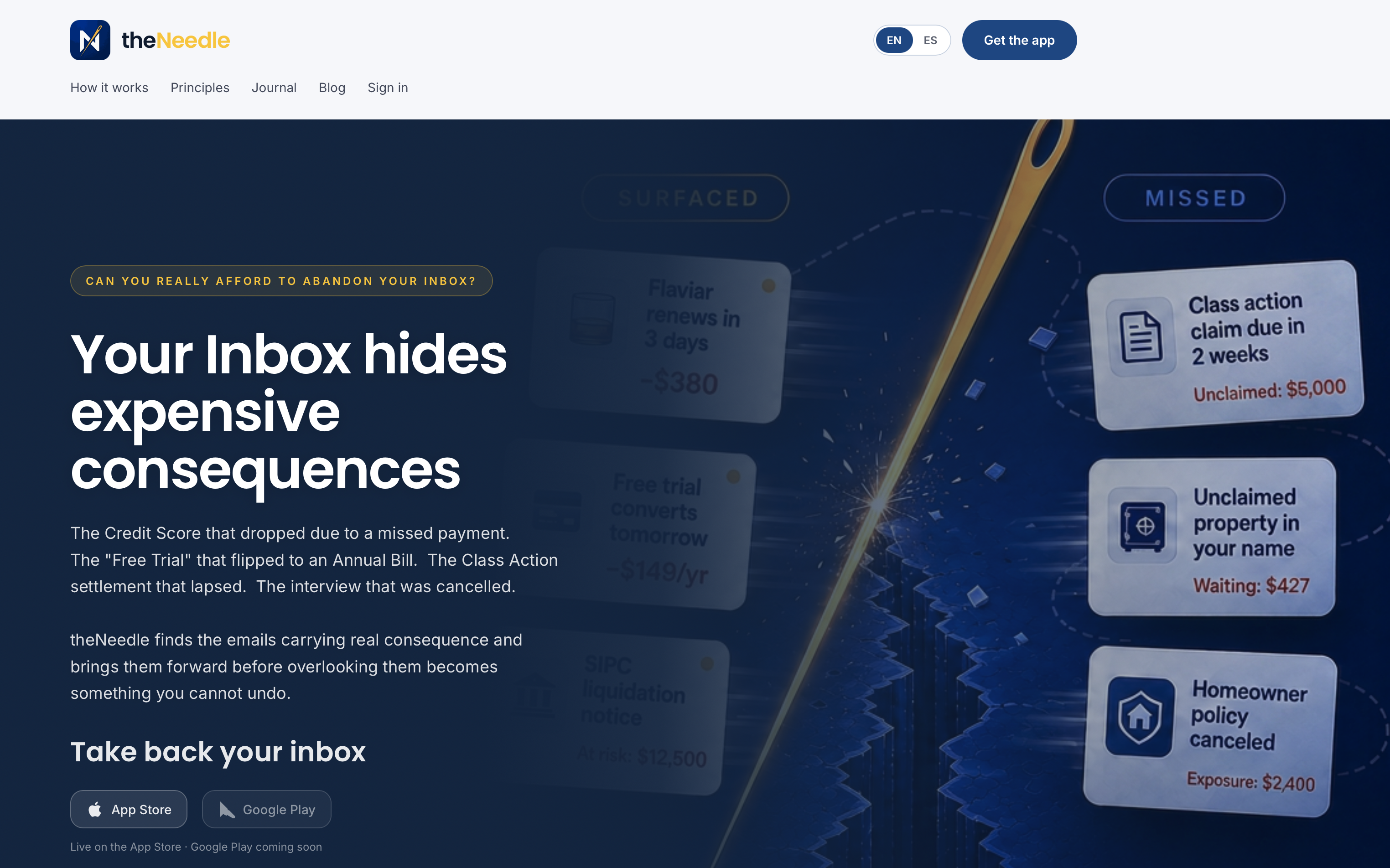
Here is what you get:
- Consequence-based ranking instead of volume-based sorting
- Connection to Gmail, Outlook, Microsoft, Yahoo, and iCloud accounts
- Follow-up tracking for replies that never came
- Built-in unsubscribe for senders who will not stop
- A one-at-a-time focus mode that is friendly to ADHD
We offer a free trial, and after it you choose a plan on our live product page: $9.99 per month, or $99.99 per year. Start the trial, connect your main inbox, and use our guide to organizing your inbox for productivity and calm to set up your first week. By the end of the trial, you will know whether the messages that matter are finally reaching you.
FAQ
What does the 3-21-0 email rule mean?
It is a personal inbox-habit shorthand, not a standard, and definitions vary between people who use it. Treat it as a prompt to set your own limits on how many messages you let sit and how often you check, then measure whether those limits reduce missed mail.
What is the best app for sorting emails?
It depends on the job. For catching deadlines, financial alerts, and urgent replies, a consequence-first app like ours is the best fit. For clearing a large backlog, a bulk-cleanup tool is usually the better first step.
What is the quick-triage habit for emails?
It is a speed-triage habit, and there is no single official version of it. The idea is to decide quickly whether a message needs action, a later look, or deletion, instead of rereading it repeatedly. Pairing that habit with an app that explains why a message is flagged keeps quick decisions accurate.
What is the best app for prioritizing tasks that arrive by email?
Look for an app that detects deadlines and expected replies and lets you set follow-up reminders. Those features turn messages into trackable actions, which is the core of the best email prioritization apps approach we recommend.
Sources
- Microsoft
- Best Email Management Software 2026 | Capterra
- Prioritize my inbox
- Email Management Software: 22 Best Tools Compared (2026)