Consequence First: Best Email Productivity Apps for Professionals

For professionals buried in daily messages, a consequence-based email prioritization tool can help by ranking emails by consequence rather than volume, catching overdue bills, deadlines, and unanswered requests that generic inbox tools bury under newsletters. That consequence-first logic cuts the time you spend triaging and keeps you from missing the one message that actually mattered. Below, we explain why that approach beats the alternatives and how to evaluate any email app before you commit.
TL;DR:
- For professionals handling several inboxes, theNeedle works across Gmail, Outlook, Microsoft, Yahoo, and iCloud, surfacing overdue messages, owed replies, and expiring credits or refunds.
- Choose a client that stores mail locally when speed and privacy matter more than cross device syncing or automatic consequence ranking.
- During a trial, connect your busiest inbox, allow a full workday for ranking to settle, and test a fake invoice against ten unrelated messages.
- theNeedle offers a $9.99 monthly plan or a $99.99 annual plan after its trial, so test a representative busy week before subscribing.
Table of Contents
- Why theNeedle Wins and What the Alternatives Actually Offer
- How to Evaluate and Choose an Email Productivity App
- What Each Major Feature Actually Means for Your Day
- How We Formed This Recommendation
- What Pricing and Free Plans Typically Look Like
- What to Expect from Support and the User Community
- How Speed and Performance Actually Compare
- Prioritization Beats Inbox Zero for Busy Professionals
- Try theNeedle: What to Test During Your Trial
- FAQ
- Sources
Why theNeedle Wins and What the Alternatives Actually Offer
Most email tools still sort by sender, date, or whether a message is “unread.” That works fine when your inbox holds a dozen messages a day. It falls apart once you’re fielding client requests, invoices, and internal threads all at once, because none of those sorting methods tell you which message carries a real deadline or financial consequence.
theNeedle takes a different starting point. Instead of asking “is this unread,” it asks “what happens if you ignore this.” That means it surfaces overdue and urgent messages first, flags unhandled replies you forgot you owed someone, tracks opportunities like credits or refunds before they expire, and includes a built-in unsubscribe function for senders who keep showing up uninvited. For professionals managing several accounts, that consequence layer sits on top of Gmail, Outlook, Microsoft, Yahoo, and iCloud, so you aren’t retraining yourself on a new interface, just changing what rises to the top.
This approach also happens to suit people who find traditional triage mentally exhausting. The one-at-a-time, consequence-ranked view is built with ADHD-friendly focus in mind, reducing the number of decisions you have to make just to figure out where to start.
That said, theNeedle isn’t the only category worth knowing about. Here’s how the realistic alternatives stack up:
- Built-in inbox features (priority inbox, tabs, smart labels): free and already installed, but these sort by sender and keyword patterns, not consequence, so a legal notice can sit next to a marketing email with equal visual weight.
- AI assistants layered onto webmail: can draft replies and summarize threads quickly, though reporting on AI adoption in email shows opinion is split. Some professionals gain real efficiency; others say the suggestions add noise they now have to filter out on top of the email itself.
- Local-first clients: index mail on your device rather than a server, which tends to mean faster search and fewer AI-driven interruptions, but you often lose cross-device sync convenience and consequence-based ranking entirely.
- Consolidated productivity suites: bundle email with calendar, tasks, and notes in one subscription, which can simplify billing, but the email piece is frequently the weakest part of the bundle because prioritization logic is an afterthought.
If you’re a consultant juggling five client inboxes, a multi-account handling and consequence ranking tool may save you more time than a suite that treats email as a secondary feature. If you’re a single-account manager who mostly needs faster search and don’t deal with financial or legal deadlines often, a local-first client might genuinely be enough.
Pro Tip: During any trial, forward yourself a fake invoice with a due date and see how fast the app surfaces it against ten unrelated messages. That single test tells you more than a feature list ever will.
How to Evaluate and Choose an Email Productivity App
Choosing the right tool means testing it against your actual inbox, not a demo account full of sample data. A structured evaluation during your trial period will tell you more in twenty minutes than a week of casual use.
Run through these criteria in order:
- Priority logic: Does the app distinguish a deadline or invoice from a routine update, or does it just sort by unread and sender?
- Multi-account handling: Can you view and triage several inboxes (Gmail, Outlook, Yahoo, iCloud) from one unified screen without switching tabs?
- Integrations: Does it connect to the calendar or task manager you already rely on, or does it ask you to adopt a new one?
- Search speed: How long does it take to find a specific message from three months ago while you’re mid-conversation with a client?
- Offline access and indexing: Does the app work when your connection drops, and how does it handle re-syncing afterward?
- Automation versus manual rules: Are you writing dozens of if-then rules yourself, or does the app learn what matters without constant tuning?
- Security and export: Can you export your data if you switch tools later, and what encryption or privacy standard does the provider state?
Pricing shapes matter just as much as features. A G2 analysis of pricing satisfaction found that users report higher satisfaction when a single subscription bundles multiple capabilities, compared to paying separately for several narrow single-purpose tools. Fragmented subscriptions tend to feel more expensive over time even when the combined cost is similar, simply because the switching and management overhead adds up.
Before you commit to anything, test it against your real workload with this checklist:
- Connect your busiest inbox, not a secondary one, so the app has enough volume to prove itself.
- Let a full workday pass before judging the priority ranking, since a single morning rarely reflects your typical message mix.
- Check mobile and desktop at the same time to confirm the ranking logic matches across devices.
- Try the unsubscribe or noise-reduction feature on at least one recurring sender you’ve been meaning to cut.
- Ask what happens to your data and your rules if you cancel.
Three decision rules cover most cases. Choose a consequence-first tool like theNeedle when your inbox mixes financial, legal, or deadline-driven messages with routine noise and you need the important ones surfaced automatically. Choose suite consolidation when email is a minor part of your workflow and you’d rather manage fewer subscriptions than optimize any single one. Choose a local-first client when speed and privacy matter more to you than smart prioritization, and you’re comfortable building your own filing system. For a deeper look at multi-account setups specifically, our guide on managing multiple inboxes walks through three common architectures.
What Each Major Feature Actually Means for Your Day
Feature lists rarely explain what a capability changes about your actual workday. Here’s what matters once you move past the marketing copy.
Priority engines and consequence detection are only as good as their false-positive rate. An app that flags every email containing the word “invoice” isn’t prioritizing, it’s pattern-matching, and you’ll end up re-triaging anyway. Watch for whether the ranking improves as it learns your specific senders and recurring obligations, or whether it stays static no matter how you use it.
Automation and AI suggestions split opinion sharply among professionals. Reporting on AI in work email found that while some users save real time with context-aware drafting, others describe the same features as adding clutter they now have to manage on top of their inbox. One widely shared account described switching email providers specifically because AI-driven suggestions made the interface feel slower and noisier, not faster. Test any AI assistant feature against a week of your real mail before trusting it, and our piece on consequence-first AI email assistants breaks down what a well-scoped AI feature should and shouldn’t do.
- Multi-account unified inboxes work best when you can triage by consequence across accounts, not just view them side by side.
- Integrations and consolidation trade convenience for depth. A suite that includes email, calendar, and notes under one login saves a subscription but rarely matches a dedicated tool’s prioritization accuracy.
- Mobile parity matters more than most buyers expect. If the priority logic works on desktop but reverts to a plain inbox on your phone, you’ll miss exactly the messages the app was supposed to catch.
- Security and exportability deserve a direct question to support before you pay for anything, not an assumption based on the provider’s size.
Industry reporting indicates many professionals now deal with email volumes high enough that manual sorting alone is no longer realistic, which is part of why consequence-based ranking has become a distinct category rather than a feature bolted onto search.
How We Formed This Recommendation
We built this recommendation around the factors that actually affect a busy professional’s daily workload, not a feature checklist pulled from marketing pages. We looked at priority accuracy (how reliably an app’s ranking logic surfaces a genuine deadline versus a routine update), response latency across devices, how well multi-account setups hold up under real volume, mobile and desktop parity, stated privacy and data-export practices, and whether built-in unsubscribe tools meaningfully reduced recurring noise.
Our sources included published industry reporting on AI adoption in email tools, documented trends in user-review commentary about pricing satisfaction and consolidation value, and our own research into email volume and consequence-driven prioritization. We did not run a vendor-by-vendor scoring exercise across every email app on the market. That kind of exhaustive comparison tends to reward whichever product happens to match the scoring rubric, rather than reflecting how a given tool performs against your specific inbox. We also did not benchmark enterprise-scale deployments, since our focus here is the individual professional managing their own workload rather than an IT department rolling out a company-wide standard.
The result is a recommendation grounded in what consistently matters across real workloads: consequence detection, multi-account reliability, and whether a tool reduces or adds to the noise you already deal with.

What Pricing and Free Plans Typically Look Like
Most email productivity tools in this category offer a trial period rather than a permanently free tier, which makes sense given how much of the value depends on learning your actual inbox over time. theNeedle follows that model: you can try the consequence-first prioritization system before paying, then choose between theNeedle - Monthly at $9.99 per month or theNeedle - Annual at $99.99 per year once you’re confident it fits your workflow.
That pricing structure matters more than it might seem. The G2 pricing analysis found that satisfaction tends to track with consolidation value, meaning professionals report feeling better about a single subscription that replaces several narrower tools than about the same total spend split across multiple apps. A consequence-first inbox tool that also handles multi-account support and unsubscribe management effectively replaces two or three single-purpose add-ons, which is where the real savings usually show up, not just in the monthly price itself.
When you’re comparing plans across any provider, check whether the trial period gives you enough time to test your actual busiest week, not just a quiet one. A short trial during a light week will tell you very little about how the ranking logic performs under real pressure.
What to Expect from Support and the User Community
Support quality varies more across email productivity tools than most buyers expect, partly because the category spans everything from solo-developer apps to large suites with dedicated account teams. Before committing, check whether support is available through in-app chat, email, or only a help center, since response speed differs significantly across those channels.
A visible user community, whether through a forum, a changelog with public feedback, or active social channels, tends to signal a product that’s still iterating based on real usage rather than one that’s gone quiet after launch. It’s worth checking how recently a provider has responded to user questions or shipped a fix, since that tells you more about ongoing reliability than any feature list.
For a tool built around consequence detection specifically, support responsiveness matters even more than usual. If the ranking logic misfires on a message that genuinely carried a deadline, you want a fast path to report it and get it corrected, not a ticket queue that takes a week to answer.
How Speed and Performance Actually Compare
Performance differences between email apps show up most clearly in two places: search speed and how quickly the interface responds when you’re switching between several connected accounts.
Cloud-based tools with heavier AI layers can feel slower in practice, not because the underlying infrastructure is weak, but because every suggestion or summary adds a processing step before the interface responds. That’s part of what drove one widely discussed account of a professional moving away from Gmail toward a local-first alternative, citing AI-driven slowdowns as the main frustration.
When you’re testing performance yourself, pay attention to how the app behaves specifically when switching between multiple connected accounts under real load, since that’s where lag tends to surface first and where consequence-ranking tools need to stay fast to be useful at all.
Prioritization Beats Inbox Zero for Busy Professionals
Inbox zero promises calm through emptiness, but it quietly rewards speed over judgment. You end up clearing messages fast rather than deciding which ones actually carry weight, and the one invoice with a real deadline gets the same five-second glance as a newsletter.
Consequence-first prioritization scales better because it doesn’t ask you to process everything. It asks you to handle what matters and let the rest wait. A short daily routine works well here: open your priority view first, handle anything flagged as overdue or urgent, scan unhandled replies for anything time-sensitive, and stop. Everything else can wait until tomorrow without real cost.

This won’t suit everyone. If your inbox volume is genuinely low or your work rarely involves deadlines and financial stakes, a simpler system may serve you just as well. But for anyone whose inbox carries real consequence, ranking by what matters beats clearing by what’s fastest.
Try theNeedle: What to Test During Your Trial
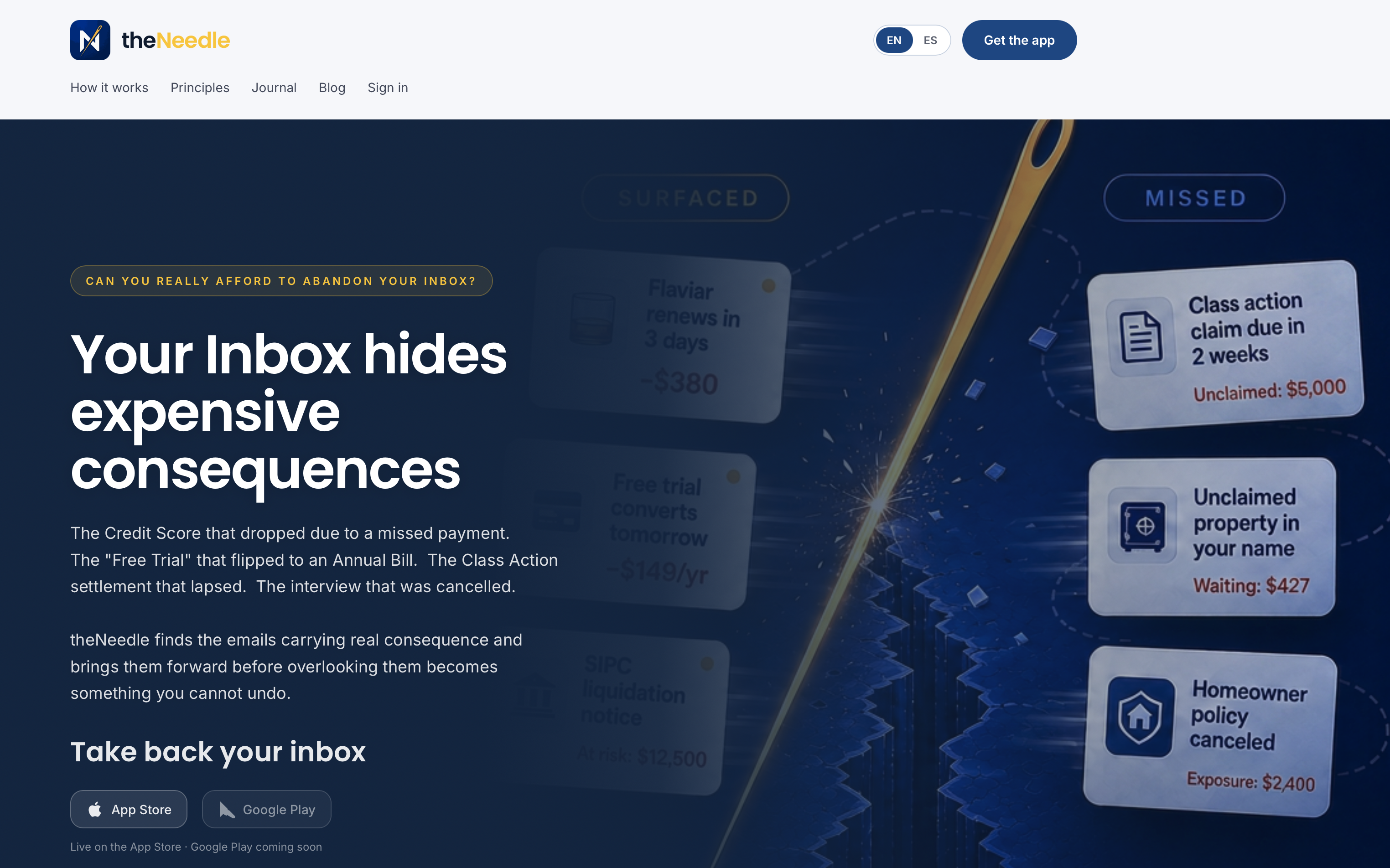
We built theNeedle around a simple idea: your inbox shouldn’t bury the message that costs you money or a deadline under forty newsletters that don’t. Once connected to Gmail, Outlook, Microsoft, Yahoo, or iCloud, we surface overdue and urgent messages, flag replies you still owe someone, track opportunities like credits or refunds before they lapse, and give you a built-in unsubscribe option for senders who won’t take the hint. The one-at-a-time, consequence-ranked view is designed with ADHD-friendly focus in mind, so you’re never facing a wall of equally weighted messages.
During your trial, we’d suggest testing a few specific things:
- Connect your busiest, messiest inbox first, not a quiet secondary account.
- Forward yourself a fake invoice or deadline reminder and see how fast it surfaces against routine mail.
- Try the unsubscribe feature on a recurring sender you’ve been meaning to cut for months.
- Check whether the priority ranking holds up the same way on mobile as it does on desktop.
Start a trial through the the Needle - Monthly plan and see whether consequence-first ranking changes how your week feels by the second day.
FAQ
What does the 3-21-0 email rule mean?
Definitions vary, but the version most commonly referenced describes checking email at set intervals (roughly three times a day), responding promptly when something requires a reply, and aiming for zero unread messages left unprocessed by day’s end. It’s a time-management framework rather than a prioritization system, so it doesn’t distinguish a routine update from a genuine deadline the way consequence-based ranking does.
What is the No. 1 productivity app?
There’s no single universally agreed “number one” productivity app, since the best choice depends heavily on whether your main bottleneck is email, tasks, or scheduling. For professionals whose biggest risk is missing a consequential email, a consequence-first tool like theNeedle addresses that specific gap directly rather than acting as a general catch-all.
What is the best app to manage multiple email accounts?
The best choice depends on whether you need unified prioritization across accounts or just a single view of separate inboxes. Tools that rank messages by consequence across every connected account, including Gmail, Outlook, Microsoft, Yahoo, and iCloud, tend to save the most time for professionals juggling several inboxes at once; our guide on managing multiple inboxes covers the common setups in more detail.
What is replacing Gmail?
No single service is broadly replacing Gmail, but some professionals are supplementing or switching away from it due to frustration with AI-driven interface changes, moving toward local-first clients that prioritize speed and privacy, or toward specialized layers that add consequence-based prioritization on top of the inbox they already use. The right fit depends on whether your frustration is with speed, AI noise, or a lack of smart prioritization.
How can I improve my email efficiency without switching providers?
You can improve efficiency without changing providers by layering a prioritization tool on top of your existing inbox rather than migrating everything to a new platform. This keeps your existing contacts, folders, and history intact while changing only how incoming messages get ranked and surfaced.
Sources
- AI is transforming work emails — and not all humans like the result
- Email Marketing Pricing: How to Avoid Overpaying in 2026