Cut an Hour a Week: Consequence First AI Email Assistants for Professionals

Try theNeedle first if missing a deadline or financial notice would genuinely hurt you: it flags consequential messages instead of just sorting your inbox. If you want raw drafting speed, Superhuman suits keyboard-first power users. If you live inside Microsoft 365, Microsoft Copilot integrates cleanly with Outlook and Teams. Before connecting any assistant, check where your emails are processed and how long the vendor retains them.
TL;DR:
- TheNeedle precisely prioritizes high-stakes emails based on consequences like deadlines and financial alerts, not overall inbox volume.
- Most AI tools support common providers such as Gmail and Outlook, but full replacements require significant workflow adjustments, especially for tools like Superhuman and Shortwave.
- Privacy considerations include verifying data processing locations, retention policies, and admin controls, with detailed documentation from vendors like Microsoft and Google being particularly important.
- Effectiveness is best measured by whether the tool helps prevent missing critical messages, rather than by general productivity metrics like total emails processed.
- For minimal disruption, a small pilot focusing on high-impact message detection and verifying correct flagging is recommended before wider deployment.
Table of Contents
- The quick shortlist: which AI email assistant fits your situation
- Mini-profiles: what each assistant actually does differently
- How we evaluated these tools before recommending any of them
- How to choose the right assistant and questions to ask before you commit
- What to verify about privacy before connecting a live inbox
- Why consequence, not volume, should drive your inbox priorities
- What an AI email assistant actually does
- The everyday workflows these tools are actually built for
- A short note on rolling this out responsibly
- Try theNeedle before you commit to anything heavier
- Sources
- FAQ
The quick shortlist: which AI email assistant fits your situation
You don’t need to test all twenty-eight of these tools. You need one or two that match how you actually work, and a fast way to rule out the rest.
theNeedle leads this list because it solves a different problem than most competitors bother with. Rather than summarizing everything or drafting faster replies, it identifies which messages carry real consequences: a contract deadline, a refund window closing, an unanswered client email that’s been sitting for a week. For professionals whose worst outcome isn’t “my inbox is messy” but “I missed something that cost me money or trust,” that distinction matters more than polish.
Beyond theNeedle, the field splits into recognizable categories. Some are full email client replacements built for speed. Others are AI layers bolted onto Gmail or Outlook. A few are agentic assistants that act on your behalf with minimal supervision, which is powerful and also the category that most needs scrutiny on data handling.
- theNeedle: consequence-driven prioritization for professionals who can’t afford to miss high-stakes messages.
- Superhuman: a premium, keyboard-driven client built for raw speed.
- Shortwave: an AI-native client with strong search across your entire mail history.
- Microsoft Copilot: native Outlook, Teams, and Word integration for Microsoft-based organizations.
- Gemini (Gmail): Google’s drafting and summarization built directly into Gmail.
- Missive: shared inboxes and collaborative drafting for small teams.
- SaneBox: lightweight, rule-based triage without switching clients.
- Front: assignment and SLA workflows for customer-facing teams.
- Spark Mail: cross-device sync with collaborative features.
- Readmail.ai (WriteMail.ai): rewrite and drafting quality as the primary focus.
- Fyxer: automated triage and drafting aimed at reclaiming meeting and email time.
Platform support varies more than people expect. theNeedle connects to Gmail, Outlook, Microsoft, Yahoo, and iCloud, which covers most professional setups without forcing a client switch. Shortwave and Superhuman are closer to full replacements, so they demand more of a workflow change. Pricing shapes fall into two camps: flat monthly subscriptions for individuals (theNeedle’s Monthly plan runs $9.99, with an annual option at $99.99) and tiered enterprise pricing for team-oriented tools like Front or HubSpot Agent Hub, where the number isn’t published without a sales conversation.
| Tool | Best for | Deployment model | Platforms |
|---|---|---|---|
| theNeedle | Professionals who can’t miss high-consequence messages | Overlay across providers | Gmail, Outlook, Microsoft, Yahoo, iCloud |
| Superhuman | Fast, keyboard-driven premium client use | Replacement client | Gmail, Outlook |
| Shortwave | Deep search across inbox history | Replacement client | Gmail |
| Microsoft Copilot | Microsoft 365 organizations | Native plugin | Outlook, Teams, Word |
| Gemini (Gmail) | Gmail-first teams wanting native AI | Native plugin | Gmail |
| Missive | Small teams needing shared inboxes | Replacement client | Gmail, Outlook, IMAP |
| SaneBox | Simple triage without switching clients | Overlay/filter | Gmail, Outlook, IMAP |
| Front | Customer-facing teams needing SLAs | Replacement client | Gmail, Outlook |
| Spark Mail | Multi-device personal and team use | Replacement client | Gmail, Outlook, IMAP |
| Fyxer | Automated triage and drafting | Overlay/agentic | Gmail, Outlook |
Mini-profiles: what each assistant actually does differently
theNeedle takes a narrower, sharper approach than most of the field. Instead of trying to summarize your whole inbox or write every reply for you, it scans for consequence: deadlines, financial alerts, legal or contractual language, and replies that have gone unanswered too long. It connects across Gmail, Outlook, Microsoft, Yahoo, and iCloud, so switching providers doesn’t mean losing the tool. A one-at-a-time focus mode surfaces a single high-priority item instead of a wall of flags, which is deliberately built for people who find triage lists overwhelming rather than helpful. It also tracks opportunities like credits or refunds and offers built-in unsubscribe for persistent senders. Pricing is a flat $9.99 monthly or $99.99 annual subscription, with no enterprise tier to negotiate.
Superhuman positions itself as a premium client built around speed: keyboard shortcuts, fast load times, and curated workflows for people who process large volumes of email daily. It’s a full replacement client, not an overlay, so adopting it means changing how you open and read mail, not just adding a feature.
Shortwave is AI-native from the ground up, with its standout feature being search that can surface a message or thread from months back using natural language rather than exact keywords. It also summarizes long threads automatically. Like Superhuman, it’s a replacement client, currently built around Gmail.
Microsoft Copilot works inside the Microsoft 365 ecosystem rather than as a separate app. It summarizes threads, drafts replies, and can pull context from Word or Teams conversations tied to the same project. Its privacy and data handling are documented directly by Microsoft, including how Copilot processes and retains data inside a Microsoft 365 tenant, which matters for any organization that needs to satisfy an internal security review before rollout.
Gemini (Gmail) brings Google’s drafting and summarization directly into the Gmail interface, so there’s no new client to learn. It fits organizations already standardized on Google Workspace, and the tradeoff is that its usefulness narrows quickly outside that ecosystem.
Missive is built for teams that share inboxes rather than individuals managing a personal one. It supports collaborative drafting, internal comments on threads, and basic automation rules, aimed at support or sales teams working from a shared address.
SaneBox doesn’t try to replace your client or draft anything. It filters lower-priority messages out of your main view using rule-based logic and delivers a digest, which suits people who want less inbox noise without adopting new software habits.
Front and Spark Mail both target team and cross-device use, respectively, with Front’s standout being assignment and SLA tracking for customer-support-style workflows and Spark Mail’s being sync across devices with collaborative features layered on top of a familiar client experience.
Readmail.ai (WriteMail.ai) and Fyxer both concentrate on the drafting side. Readmail.ai focuses on rewrite quality and tone matching, while Fyxer combines automated triage with drafting aimed at cutting time spent both reading and responding.
Beyond these, the category includes MailMaestro, a drafting assistant built for tone-consistent business writing; Inbox Zero, an open-source-rooted triage tool aimed at automatic categorization; Perplexity Email Assistant, which leans on Perplexity’s search and answer engine to pull context into replies; Serif, a drafting and scheduling assistant; Proton Scribe, an AI writing assistant built inside Proton’s privacy-focused Mail client with local processing options; Edison Mail, a consumer-oriented client with AI-assisted triage bundled into a broader personal mail app; HubSpot Agent Hub, an enterprise-oriented agentic layer built for teams already using HubSpot’s CRM; Canary Mail, a security-conscious client with AI summarization and encryption features; Friday AI (Friday-email.ai), a lightweight assistant aimed at drafting and quick triage; Ellie (tryellie.com), an inbox assistant built around daily summaries and prioritized action items; Extra and Cora, both agentic assistants that classify and route mail with minimal manual setup; and Lindy, an agent-building platform that includes an AI email assistant for Outlook as one of its configurable agents, alongside alfred_ (Get Alfred), a background scheduling and email agent aimed at reducing manual coordination work.
Across this wider group, the meaningful split isn’t features, it’s deployment model. Overlays like theNeedle and SaneBox sit on top of your existing provider without asking you to change habits. Replacement clients like Superhuman, Shortwave, Missive, Front, and Spark Mail ask for a bigger commitment but offer deeper redesign of the mail experience. Native plugins like Microsoft Copilot and Gemini (Gmail) live inside tools you already use daily. Agentic background assistants like Cora, Extra, HubSpot Agent Hub, and Lindy act with more autonomy, which raises the stakes on the privacy and audit questions covered later in this guide.

How we evaluated these tools before recommending any of them
Selection started with three filters: does the tool support common providers like Gmail, Outlook, and Apple Mail; does it offer any enterprise-readiness signal, such as admin controls or documented data handling; and does it do something distinct rather than duplicate an existing feature. Tools that failed all three didn’t make the list.
For tools that passed, we looked for specific test signals rather than marketing claims. Triage accuracy was checked against a small set of controlled messages representing genuine deadlines, low-priority newsletters, and ambiguous cases in between, since that’s where prioritization tools tend to fail quietly. Draft quality was judged by how much editing a reply needed before it was sendable, not by how fast it appeared. Summarization fidelity meant checking whether a thread summary preserved the actual decision or commitment buried in it, not just the topic. Workflow automation was tested for reliability under repeat use, and mobile sync was checked for lag between desktop and phone.
We drew evaluation sequence guidance from a field experiment across 66 firms and 7,137 knowledge workers, which recommends verifying provider support and deployment model first, then testing accuracy and draft quality, before moving to integrations and admin controls.
If you’re running your own pilot, a 7 to 10 day test with three realistic scenarios, a genuine deadline-driven thread, a routine reply, and a summarization task on a long chain, will tell you more than any spec sheet.
How to choose the right assistant and questions to ask before you commit
A useful checklist absorbs both technical and behavioral criteria: which providers the tool actually supports, whether it’s an overlay or a full replacement, whether it produces audit logs, what admin controls exist for a team rollout, whether any processing happens locally, how long data is retained, whether permissions can be scoped per sender or folder, and whether you can manually override or roll back an automated action.
Before committing to a paid plan, ask the vendor directly. These ten questions surface the gaps that a features page won’t show you.
- How do you handle drafts created by AI, and are they stored after sending?
- Where are prompts and message content stored, and for how long?
- Can we disable autonomous triage or drafting for specific senders or categories?
- Do you publish a data processing agreement and a subprocessor list?
- What admin controls exist for a team or enterprise deployment?
- Is any part of the processing done locally rather than in the cloud?
- Can we export an audit log of what the assistant flagged, drafted, or sent?
- What happens to our data if we cancel the subscription?
- How is billing structured, and are there hidden usage-based charges?
- What’s the rollback process if an automated action needs to be reversed?
A few answers should function as red flags on their own: opaque data flows the vendor can’t explain clearly, no admin controls at all for a team deployment, automation that runs with unlimited scope by default rather than requiring explicit permission, and billing structures that aren’t clear before you enter payment details.
Pro Tip: Run your checklist against a tool’s privacy documentation before you connect a live inbox, not after.
What to verify about privacy before connecting a live inbox
Before you grant any assistant access to your inbox, confirm where processing actually happens and whether the tool sees full message text or only metadata. This single question separates tools built for casual convenience from ones ready for professional or regulated use.
Ask for a data processing agreement and a list of subprocessors, since a vendor’s own infrastructure is rarely the whole picture: many tools route requests through third-party model providers, and you’re entitled to know who else touches your messages. Admin controls and logs matter just as much. A tool with no visibility into what it flagged, summarized, or drafted on your behalf leaves you unable to audit its own decisions later.
For enterprise deployments, request more than a privacy summary page. Ask for a data flow diagram, the retention policy in writing, encryption details for data in transit and at rest, and contractual protections that hold the vendor accountable if something goes wrong. Microsoft, for example, documents Copilot’s data handling at this level of detail, which is the standard other vendors should be measured against, not the exception.
These choices aren’t just technical hygiene. They determine who’s accountable when an AI-drafted message goes out with an error, or when a summarized thread drops a commitment that later matters. An ACM study of 204 participants found that higher perceived AI agency correlated with reduced human oversight and more missed errors in socially sensitive email tasks, which is exactly the scenario better logging and admin controls are meant to catch before it becomes a liability.
Why consequence, not volume, should drive your inbox priorities
Most inbox tools measure success by how much they reduce: fewer unread messages, faster sorting, quicker replies. theNeedle starts from a different question: which of these messages, if missed, would actually cost you something? That reframing is the whole basis of its consequence-driven approach, surfacing deadlines, financial alerts, contractual language, and replies that have gone unhandled long enough to become a problem.
This isn’t just a philosophical distinction. A field experiment across 66 firms and 7,137 knowledge workers found that generative AI access reduced time in Outlook by a little more than one hour per week on average, and created close to one and a half hours per week of genuinely email-free work blocks. A related analysis of Microsoft 365 Copilot’s early impact found that treated users consolidated their email work into fewer sessions per week and opened up protected blocks of uninterrupted time, evidence that the real productivity gain isn’t drafting speed, it’s attention protection.
If you pilot theNeedle or any consequence-first tool, track a small set of numbers rather than a general impression: email sessions per week, minutes spent in email-free blocks, and, most importantly, whether any high-consequence message was missed during the trial period. That last metric is the one most inbox tools never measure, because most aren’t built to notice consequence in the first place.
What an AI email assistant actually does
Under the marketing language, these tools fall into four functional types. A drafter writes or rewrites replies for you but leaves triage and organization untouched, which describes Readmail.ai and Proton Scribe. An overlay or wrapper sits on top of your existing Gmail or Outlook account and adds a layer, like filtering, prioritization, or flagging, without replacing the interface you already use; theNeedle and SaneBox both work this way. A replacement client swaps out your mail app entirely for a new one built around AI features from the ground up, the model Superhuman, Shortwave, Missive, and Spark Mail all follow. An agentic assistant goes further still, acting with more autonomy: classifying, routing, summarizing, and sometimes responding without a human confirming each step, which describes Cora, Extra, and parts of HubSpot Agent Hub and Lindy.

The distinction matters because it changes what you should scrutinize. A drafter mainly needs to prove its writing is usable. An agentic assistant needs audit logs and human-override options built in, because it’s making decisions on your behalf with less oversight by design. Overlay tools like theNeedle sit in a useful middle ground: they observe and flag without taking unilateral action, which limits the downside if the classification is occasionally wrong.
The everyday workflows these tools are actually built for
Four workflows account for most of what people use these assistants for. Summarization condenses a long thread into a few sentences so you don’t have to reread twenty replies to find the decision that was made. Drafting generates a reply based on context, ranging from a quick acknowledgment to a fully written response you edit lightly before sending. Triage sorts incoming messages by urgency or category, whether that’s a simple rule-based filter or a more sophisticated system weighing consequence, sender history, and content. Search and recall lets you find a message or commitment from weeks or months ago using natural language instead of remembering the exact sender or subject line.
Most tools specialize rather than doing all four well. Shortwave’s strength is search and recall across a long mail history. Readmail.ai and MailMaestro concentrate on drafting quality. SaneBox and theNeedle focus on triage, though from different angles: SaneBox filters by rule, theNeedle by consequence. Microsoft Copilot and Gemini (Gmail) split attention across summarization and drafting since they’re embedded in tools already handling volume.
Knowing which workflow actually costs you the most time is the fastest way to narrow this list. If you lose time searching for old threads, that points toward Shortwave. If you lose time rereading long chains, summarization-focused tools help more. If your real problem is missing something important buried in volume, that’s the workflow theNeedle is built around.
A short note on rolling this out responsibly
Start small: a pilot of five to ten people for two weeks tells you more than a company-wide rollout on day one. Track email sessions per week and whether anyone missed a high-consequence message, and compare that against the two weeks before the pilot started.
Train people to treat AI drafts as a starting point requiring verification, not a finished reply, especially for anything touching contracts, client relationships, or sensitive personal topics. Build in a human-in-the-loop step for those categories specifically.
On governance, assign one admin role responsible for reviewing flagged actions and set a quarterly cadence to revisit whether the tool’s judgment still matches how your team actually works.
— Glen Bover
Try theNeedle before you commit to anything heavier
If the idea of a tool that tells you which five emails actually matter, rather than reorganizing all five hundred, sounds like the right fit, theNeedle is built exactly for that. It connects to Gmail, Outlook, Microsoft, Yahoo, and iCloud in a few minutes, and instead of asking you to adopt a new client or learn new shortcuts, it works quietly in the background, surfacing deadlines, financial alerts, and unanswered messages that carry real consequence if ignored.
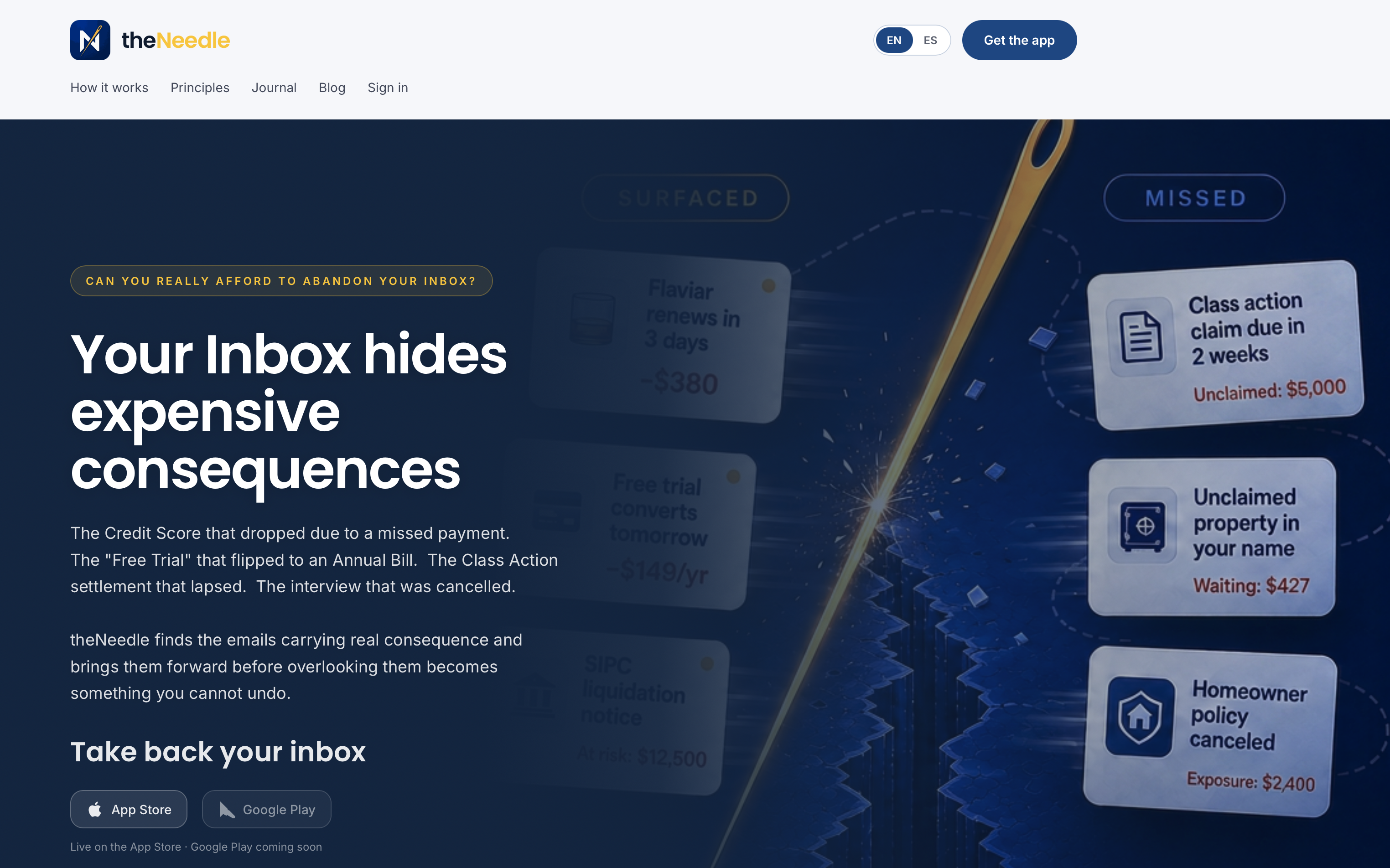
Where Superhuman sells speed and Microsoft Copilot sells integration, theNeedle sells something narrower and, for many professionals, more urgent: the assurance that the one email that could cost you money or a relationship won’t get buried on page three of an unread list. It won’t rewrite your emails for you or replace your client, and it isn’t trying to.
Start with the Monthly plan at $9.99, or commit annually at $99.99 if you already know inbox overload is a recurring problem rather than an occasional one. During your trial, check three things: does it correctly flag a real deadline, does it correctly ignore a routine newsletter, and does it stay quiet when nothing consequential has arrived. If those three hold up, you’ve found the answer this whole guide was pointing toward.
Ready to see what’s actually hiding in your inbox? Connect your account and start your trial.
Sources
The HBS field experiment and the related arXiv analysis of Microsoft 365 Copilot are the strongest available evidence on time savings and attention protection from generative AI in email. The ACM study on AI-drafted email reliance explains why verification steps matter. Microsoft’s Copilot privacy documentation is worth reviewing as a benchmark for what vendor transparency should look like, and organizations exploring wider automation may find useful context in Pattrn Data’s overview of AI automation consulting.
- Shifting work patterns with generative AI (HBS)
- Early impacts of M365 Copilot (arXiv preprint)
- Reliance on AI-drafted emails at work (ACM)
- Copilot privacy documentation (Microsoft)
FAQ
How much do AI email assistants cost?
Pricing varies by deployment model: theNeedle charges a flat $9.99 per month or $99.99 per year, while team-oriented tools like Front or HubSpot Agent Hub typically use tiered enterprise pricing not published without a sales conversation. Drafting-focused and overlay tools generally sit closer to individual subscription pricing than full enterprise contracts.
Can AI help me with my emails?
Yes, though the kind of help depends on the tool’s type: drafters help you write faster, overlays like theNeedle help you notice what actually matters, and replacement clients redesign the whole experience around speed or search. A field experiment across 66 firms found generative AI access reduced weekly Outlook time by a little over one hour and created approximately one and a half hours of email-free work blocks.
Is there a free AI email assistant for Outlook?
Microsoft Copilot integrates directly with Outlook, though its availability depends on your Microsoft 365 subscription tier rather than being offered as a standalone free product. Lindy also offers a configurable AI email assistant that works with Outlook as one of its agent types, with its own pricing structure separate from Microsoft’s.
Can ChatGPT organize my emails?
ChatGPT itself doesn’t connect directly to your inbox to organize messages, but purpose-built tools use similar underlying AI models to do that work, ranging from simple triage filters like SaneBox to consequence-aware prioritization like theNeedle. If inbox organization is the goal, a dedicated email assistant will get you there faster than a general-purpose chat tool.