Stop Missing Deadlines: Consequence First Inbox Apps for Busy Pros

For busy professionals drowning in messages, theNeedle stands out as the recommended pick because it prioritizes emails by consequence, not clutter, surfacing deadlines, financial alerts, and unhandled replies before anything else. The approach matters because most inbox tools still sort by sender or rule, leaving the one email that actually costs you money or a relationship buried on page three. Below, we walk through the category, the criteria that matter, and a short onboarding plan to get there fast.
TL;DR:
- Tools that prioritize consequence-driven emails, such as deadlines and financial alerts, significantly reduce the risk of missing critical messages.
- Compatibility with your email provider and the ability to accurately classify messages are essential features to ensure effective inbox management.
- Spending time correcting AI misclassifications in the first week boosts the system’s ability to learn and improve prioritization accuracy.
- Managing multiple accounts or team workflows requires shared visibility and delegation features, making team inbox platforms more suitable than individual apps.
- Focusing on surface relevant, high-impact messages rather than volume alone leads to better stress reduction and inbox control.
Table of Contents
- Quick Picks for Every Kind of Inbox Chaos
- What to Look for in an Inbox Management App
- How We Decided on This Recommendation
- Why Consequence-First Prioritization Cuts Through Overload
- Your First Week: A Simple Onboarding Checklist
- theNeedle: Built for the One Email You Can’t Afford to Miss
- Who This Approach Is Really For
- FAQ
- Sources
Quick Picks for Every Kind of Inbox Chaos
Not every reader needs the same fix. Some of us juggle a single overloaded inbox; others manage three accounts across devices or a shared team queue. Here’s how we’d sort the options by job to be done.
- Best for consequence-driven prioritization: an app that identifies emails tied to deadlines, financial alerts, or contractual obligations and surfaces them first, which fits anyone whose biggest risk is missing the one message that matters.
- Best for quick inbox cleanup: lightweight cleaner apps that batch-unsubscribe and archive old threads work well if your main problem is volume rather than consequence.
- Best for AI-drafted replies: AI assistant tools built into major email clients can draft responses and summarize threads, suiting readers who want help writing rather than help triaging.
- Best for shared or team inboxes: collaborative platforms with delegation and shared-label features suit sales or support teams where multiple people touch the same queue.
If you manage a single personal or professional account and your real fear is a missed deadline or an overlooked refund, a consequence-prioritized tool fits best. If you manage multiple accounts and mainly want less noise, a cleaner app may be enough on its own. Teams coordinating replies across several people usually need delegation and shared visibility more than individual prioritization, which points toward a team inbox platform instead.
The common mistake is picking a tool based on its interface polish rather than its prioritization logic. A beautiful inbox that still buries your tax deadline under forty newsletters hasn’t solved the actual problem.
What to Look for in an Inbox Management App
Before you commit to a subscription, it helps to know which features actually change your day-to-day experience and which ones just look good in a product demo.
- Provider and integration support. Confirm the app connects cleanly to Gmail, Outlook, iCloud, or IMAP accounts you actually use, since some tools quietly drop support for older authentication methods.
- Prioritization model. Decide whether you want sender-based rules, which sort by who sent the message, or consequence-first prioritization, which sorts by what happens if you ignore it. The two produce very different inboxes.
- AI learning curve. Expect a short adjustment period: AI classification tends to improve faster when you correct misclassifications consistently for the first couple of weeks rather than ignoring them.
- Core inbox actions. Look for snooze, built-in unsubscribe, delegation, and tracking of unhandled replies, since these are the features that actually shrink a backlog rather than just reorganize it.
- Security and privacy scope. Check what permissions the app requests from your email provider and whether it states a clear data-handling policy, particularly if you handle client or patient communications.
- Pricing shape and trial limits. Many tools offer a free tier with capped features or a time-limited trial; read the fine print on what happens to your prioritized inbox once the trial ends.
- Platform coverage. Verify the app works where you actually read email, whether that’s a desktop client, a mobile app, or a browser extension, since a tool that only works on one device will not change your habits.
Pro Tip: Before you trust any AI prioritization feature, spend your first week actively correcting its mistakes. That feedback loop is often what separates a tool that learns your inbox from one that never does.
On integrations specifically, our guide to organizing your email inbox covers practical setup steps worth reading alongside this comparison. For readers evaluating AI-assisted classification inside a major email client, Microsoft Outlook’s Copilot AI features offer a useful point of comparison on how built-in assistants handle smart sorting versus dedicated third-party tools.
How We Decided on This Recommendation
Our recommendation rests on matching product features to documented drivers of email stress and overload, not on marketing claims alone.
- We mapped each evaluation criterion (prioritization model, integrations, security, pricing, platform coverage) against research on what actually reduces perceived email load.
- We consulted peer-reviewed studies on email classes and workplace stress, field research on email duration and interruption patterns, and buyer-facing directories like Capterra’s free email management listings for feature context.
- We weighted reliability of provider integration, time to first visible benefit, and accuracy of consequence detection above interface polish or raw feature count.
- Disclosure: we publish this comparison and theNeedle is our own product; that relationship shaped which features we chose to emphasize, though the underlying research on email load and prioritization comes from independent sources cited throughout.
The goal was to recommend an approach, consequence-first prioritization, that the research supports, and then to be transparent about where our own product fits into that approach.
Why Consequence-First Prioritization Cuts Through Overload
The case for consequence-based sorting isn’t just a product pitch, it shows up in how researchers describe email load itself. A study on email classes and work stressors found that communication-related emails, things like newsletters and general announcements, are the main driver of subjective email load, with task-related emails contributing far less to that burden.
Communication-related email volume showed a statistically strong link to perceived email load (β=0.46, p < 0.001) in peer-reviewed research on email classes, meaning the sheer number of low-stakes messages, not the important ones, is what wears people down.
That finding has a direct product implication: sorting mail by when it arrived or who sent it treats a newsletter and a contract deadline as equals. Action regulation theory, discussed in the same research, suggests tools that classify by next action, reply, delegate, file, or watch, fit how people actually think about their inbox far better than a simple read or unread filter.

Separately, field research on email duration and interruption found that longer daily time spent on email correlates with lower perceived productivity and higher measured stress, while work on email capabilities and performance found that certain habits, like deleting versus leaving messages sitting in the inbox, relate directly to subjective workload.
Put together, these findings point toward a few practical priorities:
- Reduce the volume of low-consequence messages competing for attention rather than just reorganizing all of them.
- Detect and surface deadlines, financial alerts, and unhandled replies specifically, since these carry the real cost of being missed.
- Support quick deletion or archiving, not just filing, to lower the cognitive weight of a growing backlog.
- Let the sorting logic mirror the next action required, not just the sender or arrival time.
A consequence-prioritized approach, which is the design principle behind theNeedle, targets exactly these levers: fewer low-value messages fighting for your attention, and the ones that genuinely matter surfaced automatically.
Your First Week: A Simple Onboarding Checklist
Getting from a chaotic inbox to a manageable one doesn’t require a complete overhaul, just a few deliberate steps in the right order.
- Connect your accounts and verify access. Link your primary Gmail, Outlook, iCloud, or IMAP account first, and confirm the app can actually read and categorize new mail before adding a second account.
- Turn on consequence-based prioritization. Enable settings that flag deadlines, financial alerts, and contractual messages, and spend your first few sessions correcting any misclassifications so the system adapts faster.
- Mute noisy notifications. Turn off push alerts for every email except the ones flagged as consequential, and set two or three fixed windows during the day to process everything else.
- Use unsubscribe and delegation tools. Batch-unsubscribe from recurring low-value senders and delegate or forward anything that belongs to someone else on your team.
- Track unhandled replies. Check weekly for messages you meant to answer but didn’t, since this backlog is often where missed deadlines quietly accumulate.
- Watch three metrics. Track missed deadlines, total backlog size, and time spent in your inbox each day; a real improvement should show up in all three within two weeks.
Pro Tip: Schedule two short twenty-minute sessions in your first week purely to correct AI misclassifications. That early investment tends to pay off faster than any other single habit change.
Our blog on one-at-a-time focus goes deeper into why handling one consequential email at a time beats bulk-sorting for reducing task-switching costs.
theNeedle: Built for the One Email You Can’t Afford to Miss
We built theNeedle around a simple idea: most inbox tools treat every message as equally urgent, and that’s exactly backward. Our system connects to Gmail, Outlook, Microsoft, Yahoo, and iCloud accounts and identifies the emails most likely to cost you money, time, or a relationship if you miss them, whether that’s an overdue invoice, a contract deadline, or a reply you forgot you owed someone.
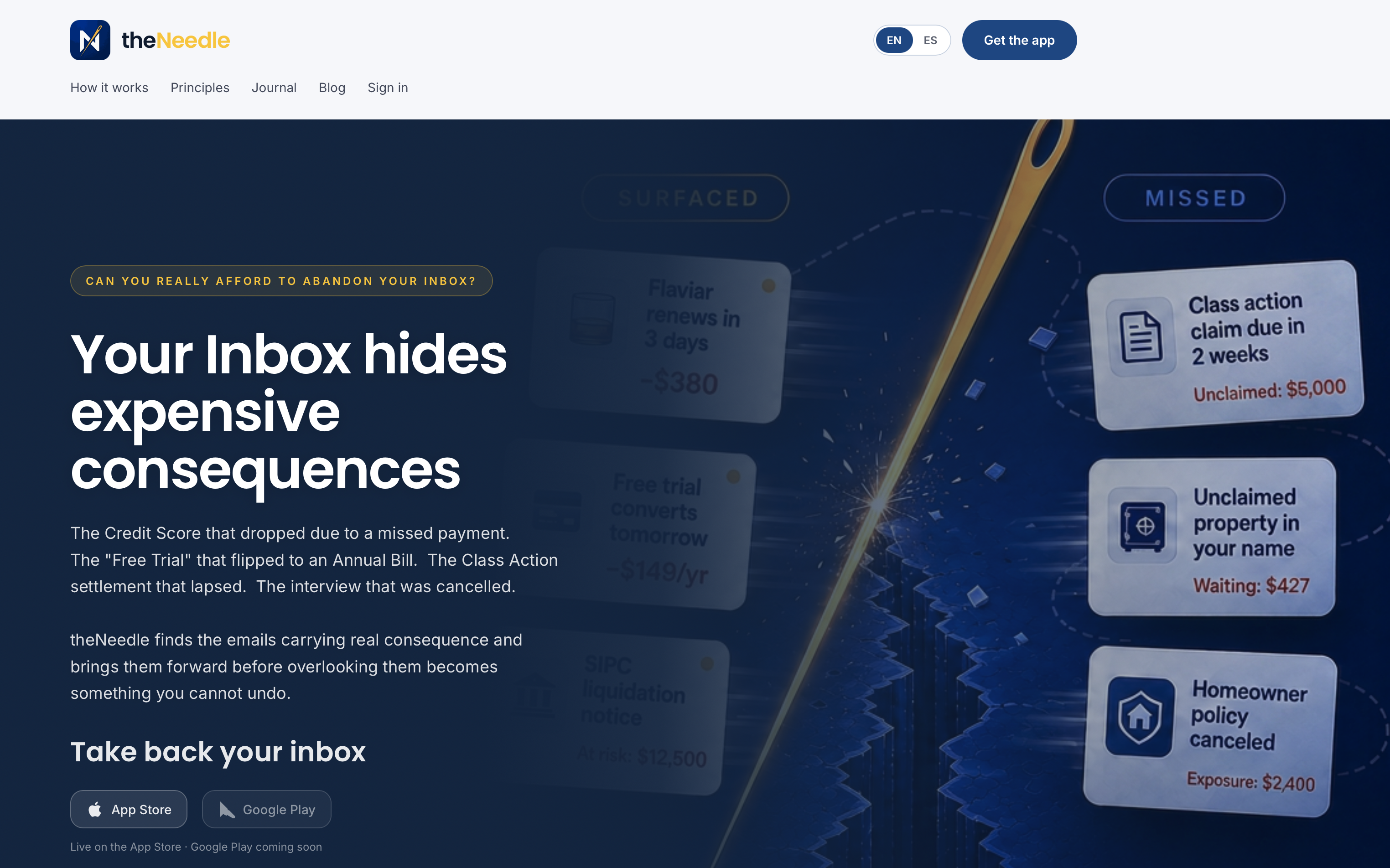
What that looks like in practice:
- Overdue, urgent, and high-priority messages surface automatically instead of waiting to be found.
- Unhandled replies get tracked so nothing you meant to answer quietly disappears.
- Opportunities like credits or refunds get flagged before their windows close.
- Built-in unsubscribe handles persistent senders without manual digging.
- One-at-a-time focus mode, designed with ADHD-friendly workflows in mind, keeps you working through what matters without getting lost in a long list.
We offer a free trial through theNeedle - Monthly at $9.99 per month, or theNeedle - Annual at $99.99 per year for anyone ready to commit past the trial. If you’ve read this far because your inbox has already cost you something, a missed deadline, a forfeited refund, a reply you forgot you owed, start your trial today and see what surfaces in the first week.
Who This Approach Is Really For
Consequence-prioritized inboxing works best for people whose real risk isn’t clutter, it’s missing the one message with teeth: a deadline, a financial alert, a client reply left hanging too long. If that describes your week, the shift from sender-based sorting to consequence-based sorting will likely feel immediate.
That said, this isn’t the right fix for every inbox problem. If your real challenge is coordinating replies across a team, tracking a sales pipeline, or managing customer support tickets, a shared inbox platform or CRM with built-in delegation, like the kind of team tracking and collaboration features built for sales workflows, will likely serve you better than a personal prioritization tool.
We’d encourage you to test any inbox tool against your actual worst email week, not your average one, since that’s when a prioritization system either proves itself or doesn’t. Feedback from that kind of real stress test tells you more than any feature list.
— Glen Bover
FAQ
What is the best app for managing emails?
The best choice depends on your main problem: consequence-prioritized tools like theNeedle work best when missed deadlines or financial alerts are your biggest risk, while lightweight cleaners suit people whose main issue is sheer volume. Match the tool to the specific pain point rather than picking the most popular option.
What is replacing Gmail?
Nothing is broadly replacing Gmail itself; instead, many professionals are layering specialized inbox management tools on top of their existing Gmail, Outlook, or iCloud accounts to add prioritization, unsubscribe, and tracking features that the base email client doesn’t offer. The trend is toward smarter filtering on top of existing providers, not a wholesale switch away from them.
What is the most hacked email provider?
There’s no single authoritative ranking naming one provider as “the most hacked,” since breach exposure varies by year, attack type, and how incidents get reported. What matters more for any user is enabling strong authentication and reviewing email security practices regardless of which provider you use.
Is there an app that can clean up my inbox?
Yes, several categories of apps handle inbox cleanup, from bulk unsubscribe tools to AI-based prioritization systems that separate consequential messages from routine clutter. theNeedle combines both approaches, offering built-in unsubscribe alongside consequence-based surfacing so cleanup and prioritization happen together.
Sources
- Drowning in emails: investigating email classes and work stressors as antecedents of high email load and implications for well-being
- Email duration, batching and self-interruption: Patterns of email use on productivity and stress
- E-mail interruptions and individual performance: capabilities and effects
- Best Free Email Management Software Solutions 2026