Best Email Management Apps That Catch the One Critical Message in 117 Emails

The most reliable approach to email overload is consequence-first prioritization, and theNeedle is the clearest tool built around that idea today. With the average worker receiving 117 emails a day, the real risk isn’t volume, it’s the one message with a deadline or financial stake that gets buried. A consequence-first app surfaces that message before it costs you something.
TL;DR:
- Choosing an email app should focus on solving specific failures like missed deadlines or overlooked financial alerts, not just features.
- Prioritize apps that support consequence detection and ranking across platforms, especially for urgent or high-stakes messages.
- Verify platform support, security protocols, and data export options before testing new email tools during a trial period.
- Connecting multiple accounts securely requires OAuth or app-specific passwords, with initial sync delays being normal.
- AI and privacy features involve trade-offs, as server-side indexing can compromise sensitive content, so evaluate these before enabling.
Table of Contents
- Which type of email app fits your biggest inbox problem?
- How to choose the right email app for your workflow
- Safe steps to connect multiple email accounts
- What your email app can and can’t protect you from
- Workflows that keep consequential emails from slipping through
- Why consequence-first thinking matters more than inbox zero
- theNeedle: the practical way to try consequence-first email
- FAQ
- Sources
Which type of email app fits your biggest inbox problem?
Not every inbox failure needs the same fix. Before you pick a tool, match it to the specific way your inbox is letting you down.
- Best for priority sorting: apps that rank by sender and keyword history work well if your main issue is noise, though they tend to miss one-off urgent messages from new contacts.
- Best for AI assistance: AI-first clients draft replies and summarize threads, which saves time on volume but can blur which summarized message actually needs action.
- Best for privacy: privacy-focused clients limit server-side indexing, a trade-off worth making if you handle sensitive client or financial correspondence.
- Best for mobile-first use: lightweight mobile apps handle quick triage well but often strip out the deeper filtering rules available on desktop.
- Best for consequence-prioritization: theNeedle flags deadlines, financial alerts, and unhandled replies specifically, which matters most if missed consequences, not clutter, are your real problem.
Platform fit varies by category. Priority and AI tools generally run the strongest on desktop and web, and mobile-first apps are built for iOS and Android first.
How to choose the right email app for your workflow
Start by naming the failure you want to fix, not the features you want to own. If you keep missing refund windows or contract deadlines, you need consequence detection, not another folder system.
- List your failure point first: missed deadlines, buried financial alerts, or unanswered replies each point to a different feature set.
- Check platform support: confirm the app runs on your actual devices, desktop, mobile, or both, before testing anything else.
- Review protocol and security fit: look for OAuth support rather than plain password access, since OAuth and app-specific passwords determine how smoothly multi-account setup goes.
- Weigh AI and privacy together: AI summarization is useful, but editorial testers recommend checking how much is indexed server-side first.
- Confirm export options: make sure you can pull your data out cleanly, since reviewers at PCMag flag export access as a safeguard against vendor lock-in.
Pro Tip: Run a 3-step test: trial the app for one week on a secondary account, evaluate whether it actually surfaces your highest-consequence messages, then migrate your primary account only after that proves out.
Safe steps to connect multiple email accounts
Multi-account setup is where most email apps break, usually because of authorization, not the app itself. Two-factor authentication on Gmail, Outlook, or iCloud often blocks a naive password login outright, which is why provider documentation points toward OAuth consent or app-specific passwords instead.
- Connect a secondary account first: test send and receive permissions before linking the inbox you depend on daily.
- Generate an app password when prompted: this is required by some providers when 2FA is active and a third-party client needs access.
- Confirm IMAP settings are enabled: some providers disable IMAP by default, which silently blocks syncing.
- Check the OAuth scopes you grant: approve only what the app needs to read and send mail, nothing broader.
- Watch for sync delays on first connection: a slow initial sync is normal and not a sign of a failed setup.
What your email app can and can’t protect you from
Your email client is a layer on top of your provider’s defenses, not a replacement for them. Gmail alone reports blocking 99.9% of spam, malware, and dangerous links at the provider level, and that protection keeps running regardless of which client you use on top of it.
No third-party app can substitute for multifactor authentication or your provider’s own account recovery process. Keep MFA enabled on every connected account, and review the OAuth permissions you’ve granted periodically, since broader scopes than necessary increase your exposure if a client is ever compromised.
AI features inside email apps raise a separate privacy question: summarization and smart replies often require indexing message content server-side. If you handle sensitive financial or legal correspondence, weigh that trade-off before turning AI features on, and consider a privacy-focused desktop option that processes content locally instead.

Workflows that keep consequential emails from slipping through
The habit that actually reduces overload is reviewing by consequence, not by inbox position. A one-at-a-time focus view, checking the single most consequential message before anything else, beats scrolling through a flat list of 117 unread items looking for the one that matters.
- Daily triage: open your consequence-ranked view first thing and clear anything with a deadline before touching general correspondence.
- Weekly unsubscribe sweep: remove recurring low-value senders once a week rather than one at a time as they arrive.
- Automated snooze rules: push non-urgent threads to resurface after a set window instead of letting them sit unread.
Pro Tip: During any trial period, track two numbers: how many deadlines you nearly missed, and how fast you responded to flagged messages. Those two metrics tell you more than how “organized” your inbox feels.
Pairing this with light workflow automation, such as auto-tagging follow-ups for recurring tasks, extends the same consequence logic beyond your inbox. Our own guide to inbox organization walks through a fuller version of this daily routine.
Why consequence-first thinking matters more than inbox zero

At 117 emails a day, the goal was never going to be reading everything, it was catching the handful that carry real consequences. We built our recommendation around that distinction because the cost of a missed deadline or an ignored financial alert is measured in dollars and relationships, not in unread counts.
Run the 3-step test plan from the buying guide above before committing to anything long-term. The right app should prove its value in a week, not a quarter.
— Glen Bover
theNeedle: the practical way to try consequence-first email
We built theNeedle to surface the one email that actually needs your attention before the rest of your inbox does. It detects messages tied to deadlines, financial alerts, or contracts, flags overdue and unhandled replies, tracks opportunities like refunds or credits, and includes built-in unsubscribe tools for senders who won’t stop. The one-at-a-time focus view is designed with ADHD-friendly workflows in mind, so you review by consequence instead of by chronology.
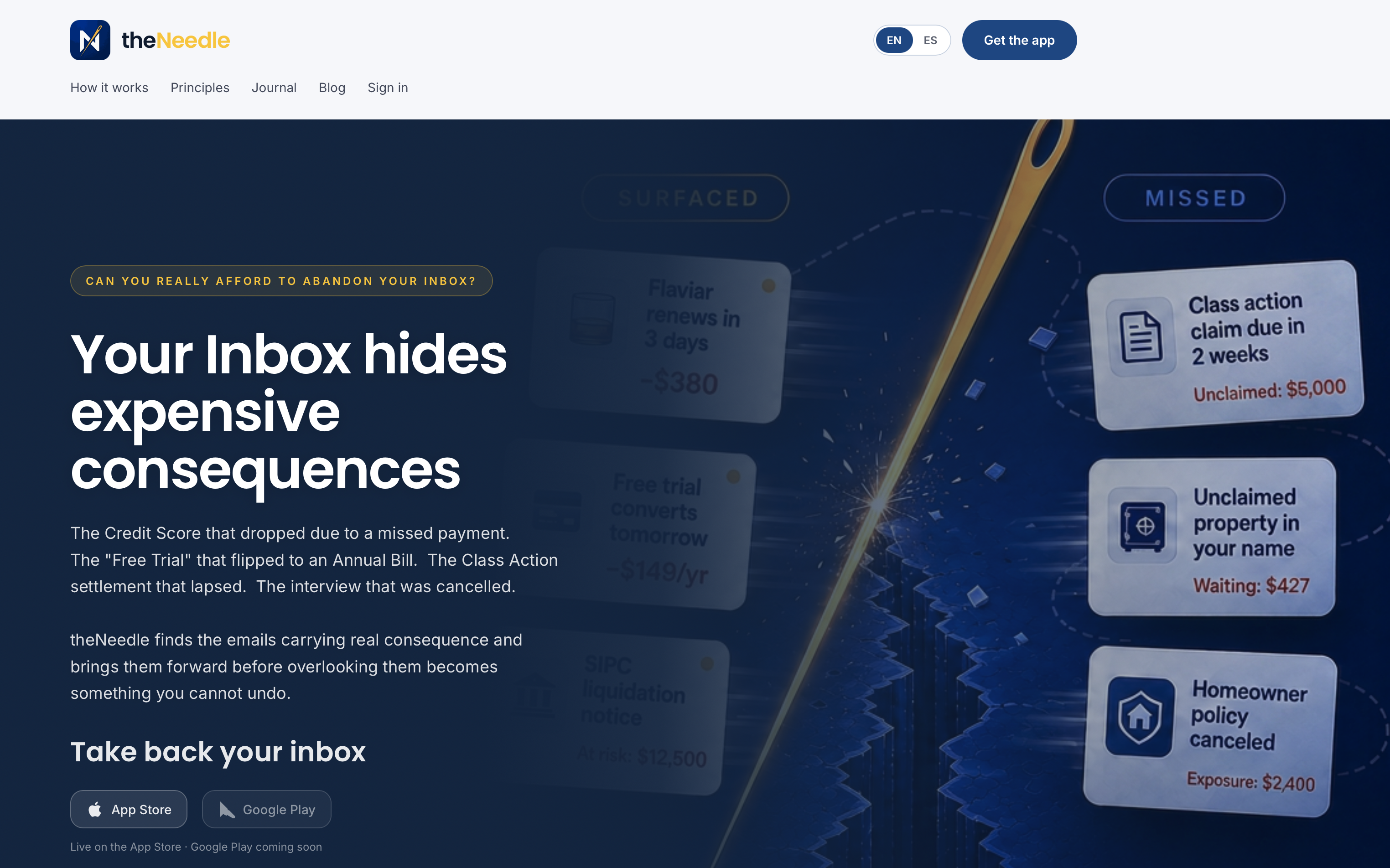
In your first week, test three things specifically:
- Does it catch deadlines you would have otherwise scrolled past?
- Does it flag overdue items accurately across every connected account?
- Does it surface unhandled replies you forgot you owed someone?
Current prices for subscription plans are available on the pricing page of our website.
Start with the theNeedle monthly plan to run your own week-one test, or visit the theNeedle landing page for a full overview before you commit.
FAQ
What are the top 5 email apps?
The strongest picks vary by what you’re solving for: priority sorting, AI assistance, privacy, mobile use, or consequence-prioritization. Editorial roundups confirm there’s no single universal winner, so match the category to your actual inbox failure rather than picking from a generic list.
Is there a better alternative to Gmail?
Gmail remains a strong provider-level choice, blocking 99.9% of spam and dangerous links automatically, and most third-party apps connect to Gmail rather than replace it. If your real problem is missing consequential messages inside Gmail, a consequence-prioritization layer like theNeedle addresses that without requiring you to switch providers.
What is the best app to manage multiple email accounts?
The best choice is whichever app supports OAuth cleanly across your providers and lets you test a secondary account first, since provider-side authorization steps are the most common point of failure. theNeedle connects Gmail, Outlook, Microsoft, Yahoo, and iCloud in one consequence-ranked view, which simplifies managing several inboxes at once.
What is the most hacked email provider?
There’s no single authoritative ranking naming one provider as “most hacked,” and definitions of a breach vary widely by source. What’s consistent across provider documentation is that enabling multifactor authentication and reviewing OAuth permissions matters more to your actual security than which provider you choose.
Sources
- The 9 best email apps to manage your inbox in 2026 — Zapier
- Gmail: Secure, AI-Powered Email for Everyone | Google Workspace
- Add an email account to Outlook for Windows | Microsoft Support
- The Best Email Clients We’ve Tested for 2026 | PCMag