Best Email Organizer Apps Catch Due Dates Before They Cost You

If you want fewer missed deadlines and fewer costly surprises buried in your inbox, choose an organizer that prioritizes by consequence rather than volume. We built an organizer around that exact idea: it surfaces overdue items, financial alerts, and unanswered replies so the messages that can actually hurt you never slip past unnoticed.
TL;DR:
- During a trial, compare how the organizer handles a mock invoice with a due date, a promotion, and a colleague’s unanswered message.
- Cleanup tools reduce noise, summarizers compress long threads, and task integrations track owners and deadlines; choose according to the inbox failure you need to fix.
- Before subscribing, confirm provider compatibility and data handling, then test connected accounts for seven days while tracking missed follow ups and overdue items.
- Because workers receive roughly 117 emails daily, check at set times and decide whether to delete, delegate, reply, defer, or act on each message.
Table of Contents
- What an email organizer does and why it matters
- Key features to look for in an email organizer
- How to choose the right organizer for your inbox
- Organizer categories and which approach fits each problem
- Practical setup and daily routine that produces results
- Evidence and theNeedle’s consequence-first approach
- A note from the author
- Try theNeedle: what it does and how to run a trial
- FAQ
- Sources
What an email organizer does and why it matters
An email organizer is software that sits on top of your existing inbox and automates the busywork: sorting messages into categories, bulk-unsubscribing from newsletters, flagging items that need a reply, and surfacing what actually requires your attention today. It is different from your inbox’s native folder system because it applies rules and, in more advanced cases, judgment, across the entire flow of mail rather than waiting for you to drag messages into place one at a time.
Built-in filters and categories handle the basics well: separating promotions from personal mail, catching obvious spam, letting you create a rule for one sender. Where they fall short is judgment calls, like recognizing that an invoice with a due date carries more weight than a marketing blast, even though both arrived from unfamiliar senders. That’s the gap a dedicated organizer is built to close.
Whatever app you choose, it works alongside a human habit, not instead of it. Productivity guidance describes a five-decision method for processing each message: delete it, delegate it, reply to it, defer it, or do it immediately. An organizer’s job is to make that decision obvious at a glance; your job is still to make the call.
A few things most organizers automate once set up:
- Sorting incoming mail into categories like receipts, newsletters, and personal correspondence.
- Flagging messages tied to deadlines, payments, or unresolved replies.
- Bulk-unsubscribing from senders you no longer want to hear from.
- Surfacing a short list of what needs action today instead of a full inbox scroll.
Key features to look for in an email organizer
Not every feature marketed as “smart” actually reduces risk in your day. Some sort faster; a smaller number protect you from the message that costs you money or a relationship if it goes unanswered. Here is what to weigh:
- Filters and rules: the foundation for routing newsletters, receipts, and known senders without manual sorting.
- AI triage or summarization: useful for compressing long threads, but it should tell you what to do next, not just what a message says.
- Priority or consequence scoring: the feature that separates a routine notification from a deadline, invoice, or contractual notice.
- Snooze and follow-up tracking: lets you defer a message without losing it, and reminds you if nobody replied.
- Unsubscribe and mass cleanup: clears recurring noise so the signal underneath is easier to see.
- Multi-account support: one dashboard across Gmail, Outlook, Yahoo, and iCloud instead of four separate habits.
- Task and due-date integrations: moves action items out of email and into a system where they’re tracked with an owner and a deadline.
- Security and privacy controls: how the app accesses, stores, and shares your mail data.
During a free trial, test “AI” and “smart sorting” claims directly: send yourself a mock invoice with a due date, an irrelevant promotional email, and a reply-needed message from a colleague. A genuinely useful organizer treats those three very differently. One that just buckets everything as “important” or “not important” is sorting by sender reputation, not by consequence.
Pro Tip: Judge an app by which failing layer of your inbox it actually fixes, noise, triage, or follow-through, rather than by how many features are listed on its pricing page.
Feature priority shifts depending on who you are. Someone managing a single busy inbox benefits most from consequence scoring and snooze. Someone who finds a crowded inbox genuinely hard to process benefits from one-at-a-time focus views that remove visual clutter. Someone juggling several accounts for different roles needs strong multi-account support more than anything else, since the biggest risk there is a deadline landing in the account you check least; learn more about optimizing unified inbox and team workflows here.
How to choose the right organizer for your inbox
Choosing well means testing against your actual failure points, not comparing feature lists side by side. Before you commit to a subscription, work through this:
- Check compatibility first. Confirm the organizer connects cleanly to your providers, Gmail, Outlook, Yahoo, iCloud, and supports IMAP if you use a less common client. Review how your current client’s built-in features already compare, so you know what the organizer needs to add rather than duplicate.
- Confirm the prioritization method. Ask whether the app ranks by consequence (deadlines, money, unresolved replies) or simply by sender frequency and volume. These produce very different results during a busy week.
- Review security and data handling. Understand what the app can see, how long it retains data, and whether it shares anything with third parties.
- Test integrations. If you run your to-dos elsewhere, confirm the organizer can push flagged items into that system rather than trapping them in another inbox.
- Read the pricing and trial terms closely. Know exactly what happens when the trial ends and what features sit behind a paywall.
- Run a one-week test. Connect your core accounts, turn on priority rules, and use the app daily for seven days. Track how many follow-ups you would have otherwise missed and whether your inbox feels clearer by day seven.
Watch for red flags during the trial: an app that buries its unsubscribe tool, one that requires full account access without a clear explanation, or one that treats every flagged message with the same urgency label. If nothing is ranked above anything else, you have not gained a prioritization system, you have gained a second inbox.
Organizer categories and which approach fits each problem
Most email tools fall into a few broad categories, and matching the category to your actual problem matters more than picking the one with the most features.
- Built-in client tools: free, already installed, and handle basic sorting like Focused Inbox style separation. They fit light inboxes but rarely distinguish a bill from a newsletter.
- Cleanup and unsubscribe apps: excellent at cutting volume fast, ideal if your main problem is noise rather than missed deadlines. They don’t typically rank what remains by consequence.
- AI triage and summarization tools: good at compressing long threads into quick reads, useful for people drowning in detail rather than missing specific items.
- Task-integrated platforms: push flagged emails into a tracked work system with owners and due dates, closing the gap between a tidy inbox and finished work, as inbox zero methodology describes.
- Consequence-first organizers: rank messages by what happens if you ignore them, not by how many arrived from the same sender.
Each category trades something: built-in tools cost nothing but offer little judgment; cleanup apps reduce clutter but don’t rank what’s left; AI summarizers save reading time but can flatten urgency; task-integrated platforms are powerful but add a second tool to maintain. For readers whose real risk is a missed deadline or an overlooked financial notice, a consequence-first approach addresses that risk directly instead of as a side effect of general tidiness.
Practical setup and daily routine that produces results
An organizer only pays off if you give it a real first week and a repeatable daily habit. Here’s a sequence that works:
- Connect your accounts. Link every inbox you actually check, not just your main one.
- Run an initial cleanup. Unsubscribe from recurring low-value senders in one pass.
- Set basic rules. Route receipts, newsletters, and known senders automatically.
- Enable priority or consequence detection. This is the step that catches deadlines and financial alerts before they age into a crisis.
- Connect your task system. Push anything flagged “do” or “defer” into wherever you track work.
From there, build a daily batching habit: check email at two or three set times rather than continuously, and apply the five-decision triage to each message as you go, delete, delegate, reply, defer, or do. An average worker receives roughly 117 emails per day, which means even a disciplined routine needs software that tells you which of those 117 actually matter.
To judge whether it’s working, track two numbers across two weeks: how many follow-ups you missed, and how many items sat overdue past their deadline. A meaningful drop in either is your signal that the organizer is doing its job, not just reorganizing clutter.
Evidence and theNeedle’s consequence-first approach
Most inbox problems aren’t really about volume, they’re about which messages carry real stakes. We built theNeedle to identify emails tied to deadlines, financial alerts, contractual notices, and other consequential threads, then surface those ahead of everything else. It also tracks unhandled replies and flags opportunities like credits or refunds that are easy to let expire unnoticed, and it includes a built-in unsubscribe tool for senders who won’t take no for an answer.
An average worker receives roughly 117 emails per day.
That volume is precisely why ranking by consequence matters more than ranking by sender or recency. When 117 messages arrive daily, a handful might carry legal, financial, or contractual weight, and those are the ones most likely to get lost in a feed sorted by arrival time. Surfacing them first, rather than relying on you to notice them in passing, is the difference between catching a deadline with time to act and discovering it after the fact.
For readers managing multiple accounts, we’ve also outlined practical setups in architectures for handling several inboxes, since the risk of a missed deadline often lives in the account checked least often. The expected outcome of a consequence-first approach is straightforward: fewer overdue items, fewer forgotten replies, and a clearer sense of what actually needs your attention today instead of a flat list of everything that arrived.

A note from the author
I’ve spent enough time watching smart, capable people miss a deadline buried in an unread thread to believe the real problem was never inbox volume, it was never knowing which message mattered until it was too late. Consequence-first organizing fixes that by design. It helps most if you’re a busy professional, a freelancer juggling client threads, or anyone running more than one inbox. Give the approach a real week before judging it.
Try theNeedle: what it does and how to run a trial
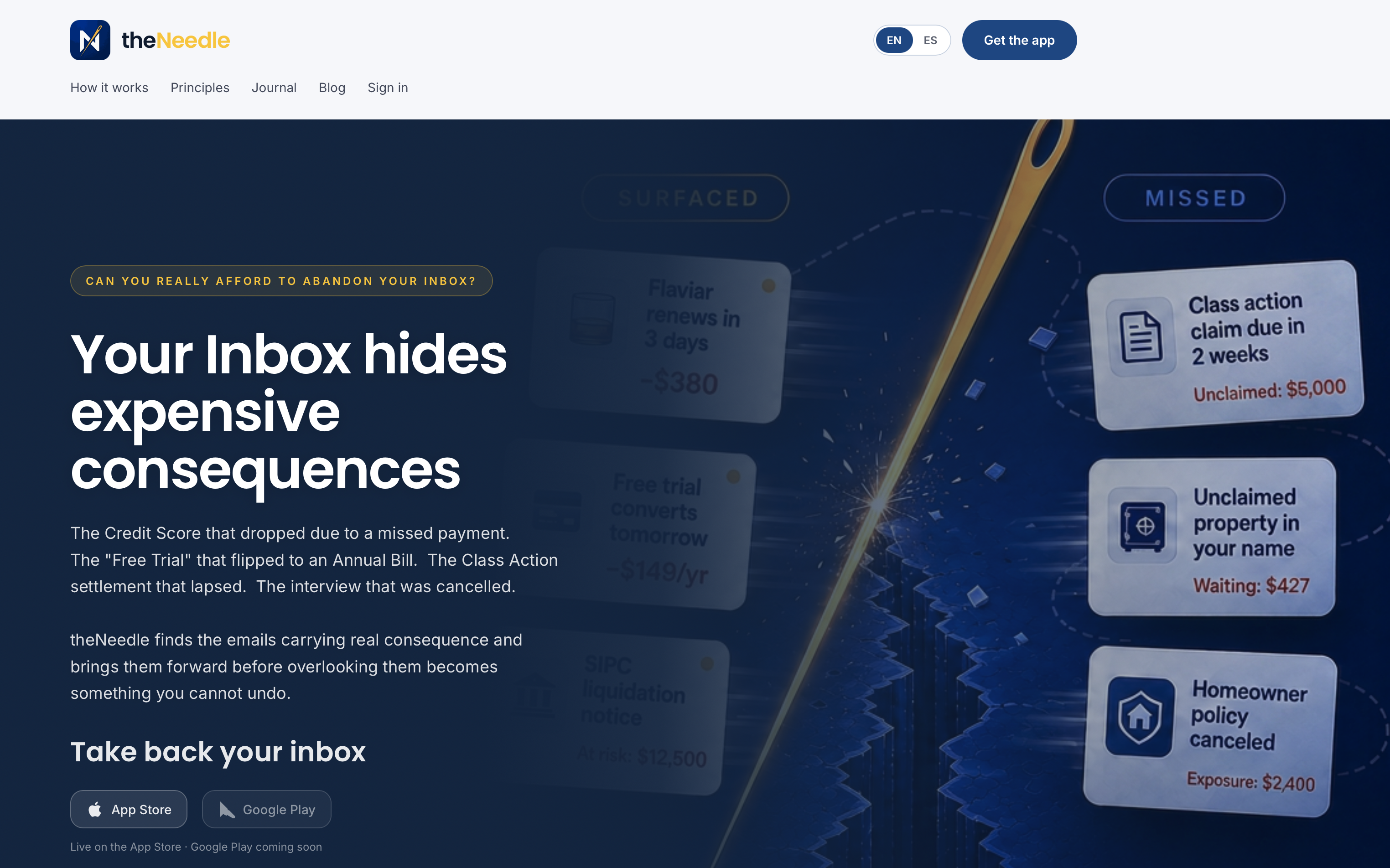
If missed deadlines or overlooked financial alerts are the real cost in your inbox, give theNeedle a direct trial rather than another round of manual filtering. We built it to surface overdue and urgent messages, catch unhandled replies, track opportunities like credits or refunds before they lapse, and clear out persistent senders with a built-in unsubscribe tool, all with support across Gmail, Outlook, Microsoft, Yahoo, and iCloud.
- Connect your core accounts and let priority detection run for a full week.
- Watch for overdue and unhandled-reply flags rather than scanning your whole inbox.
- Use the one-at-a-time focus view if a crowded inbox typically slows you down.
Our plans start with a free trial period, then continue as theNeedle - Monthly at $9.99 per month or as an annual plan at $99.99 per year. Start the trial today and run the same week-one routine outlined above to see what it catches.
FAQ
What is the best app to manage multiple email accounts?
The best choice is an organizer with strong multi-account support that consolidates Gmail, Outlook, Yahoo, and iCloud into one priority view rather than four separate habits. Some organizers connect across multiple providers and rank messages by consequence regardless of which account they arrived in, which matters most when a deadline lands in the account you check least.
What is the best free email sorter?
Built-in tools like Focused Inbox in Outlook offer free, basic sorting that separates important senders from the rest, and are a reasonable starting point for light inboxes. For sorting based on actual consequence rather than sender patterns, a dedicated organizer with a free trial period adds a layer that free built-in tools don’t provide.
What is replacing Gmail?
Nothing is replacing Gmail or other major email providers; the shift happening is in how people manage what arrives in them. Rather than switching providers, most people are adding an organizer layer on top of Gmail, Outlook, or iCloud that prioritizes messages by consequence instead of relying on the provider’s native sorting alone.
What is the best app for decluttering emails?
Cleanup and unsubscribe apps are built specifically for decluttering and work fast if your main problem is sheer volume. If decluttering alone still leaves you missing deadlines or financial alerts buried in what remains, a consequence-first organizer addresses that gap directly by ranking what’s left instead of just reducing it.
Sources
- Inbox zero: What it is and how to actually get there | Zapier
- Monday
- New and classic Outlook for Windows feature comparison | Microsoft Support