Best AI Email Organizer That Prioritizes Consequence, Not Volume

An AI email organizer for professionals who need consequence-driven prioritization rather than generic sorting flags emails carrying real deadlines, financial stakes, or contractual weight instead of just cleaning up the inbox. It connects to multiple popular email providers and offers a one-at-a-time focus view designed to support users with diverse workflow needs. A free trial is often offered to let users test priority detection before committing any payment details.
TL;DR:
- Consequence-prioritization tools are most effective for professionals who miss important deadlines or financial alerts buried in high-volume inboxes.
- These tools rely on classification, extraction, and language models that can hallucinate or misclassify messages, making real-world testing essential.
- When choosing, verify native email integrations, review privacy policies, and test the tool with real, messy data to ensure it accurately flags critical messages.
- Setup is quick, but building trust takes one to two weeks of daily use, and support responsiveness on security and privacy questions is crucial.
- The typical cost for standalone tools ranges from about $10 monthly to $99 annually, with the importance of reviewing data retention and permission scope before connecting your inbox.
Table of Contents
- Which type of AI email tool fits your workflow
- What AI email organizers actually do behind the scenes
- How to choose the right AI email organizer for you
- What to verify about privacy and permissions before you connect an inbox
- Integrations and how an organizer fits your daily workflow
- The four categories of email tools, explained plainly
- What an AI email organizer actually costs
- How long it takes to set up and get comfortable
- What good customer support looks like for this category
- Security certifications worth checking before you connect an inbox
- Why we built theNeedle around consequence, not volume
- Try theNeedle: what to expect from setup to your first flagged deadline
- Where to verify these claims yourself
- Sources
- FAQ
Which type of AI email tool fits your workflow
Not every inbox problem calls for the same fix, and the fastest way to choose is to match your actual pain point to a category of tool rather than chasing whichever app ranks highest this month.
- Consequence-prioritization apps: best for professionals who miss deadlines or financial alerts buried in high-volume inboxes.
- Built-in client AI (native to Gmail and Outlook): best for casual users who want basic summarization without adding another login.
- Inbox cleanup tools: best for people drowning in newsletters and promotional mail who mainly need aggressive unsubscribing.
- Premium speed-first apps: best for users who want a faster, prettier interface layered over existing accounts.
- Automation-first platforms: best for teams that want to build custom rules and multi-step workflows across email and other business systems.
Many professionals end up combining two categories: a cleanup tool to cut volume, paired with a consequence-prioritization app to catch what actually matters once the noise is gone. That pairing solves two different problems instead of asking one tool to do both jobs at once.
What AI email organizers actually do behind the scenes
Most tools marketed as “AI email organizers” perform some mix of five core functions: triage (sorting incoming mail by urgency or topic), summarization (condensing long threads into a few lines), draft generation (writing reply suggestions), labeling (tagging messages by project, sender, or type), and bulk cleanup (mass unsubscribing or archiving). Understanding which of these a tool actually delivers, rather than just claims, is the difference between a useful assistant and a glorified filter.

Under the hood, these features rely on a handful of techniques. Classification models sort messages into categories based on patterns learned from labeled examples. Extraction models pull specific details, like a due date or an invoice amount, out of unstructured text. Vector search allows a tool to find related messages by meaning rather than exact keyword matches, which is how some assistants surface “similar past threads.” Draft generation and summarization typically run on a large language model guided by prompt templates that tell it what to look for and how to phrase output.
This is also where the risk lives. Language models can hallucinate: they might summarize a thread and confidently state a deadline that was never actually mentioned, or miss the one line in a long email that changes its meaning entirely. Classification models can misfire too, treating an urgent client email as low priority because it lacks the keywords the model was trained to recognize, or the reverse: flagging a routine automated receipt as high priority because it contains a dollar sign and the word “due.” A tool that prioritizes by sender frequency or subject-line keywords, rather than actual consequence, produces plenty of false positives and false negatives alike.
A few concrete workflow examples illustrate the gap between marketing copy and daily reality:
Morning triage. You open your inbox to 40 new messages. A well-built organizer should surface the two or three that carry a deadline or financial stakes, not just the two or three from senders you email most often.
Contract follow-up. A vendor emails a revised agreement with a response deadline buried in paragraph three. A keyword-based tool might miss it entirely because the subject line reads “Re: touching base.” A consequence-aware tool should catch the deadline regardless of where it sits in the text.
Refund tracking. An airline emails about a flight credit with an expiration date three months out. Most inboxes bury this under later, louder messages. The value of an organizer here is remembering what a human would forget.
The practical takeaway: ask any vendor which of the five core functions their product actually performs, and ask for a specific example of how it handles a buried deadline or a financial detail, not just a demo of inbox zero.
How to choose the right AI email organizer for you

Picking a tool by feature list alone is a common mistake, mostly because most feature lists sound identical. The better approach is to run a short, structured evaluation before you hand over calendar and email access to anything.
Here is a practical framework you can complete in under an hour, including trial signup:
- Define your primary pain point. Are you missing deadlines, drowning in volume, or just tired of retyping the same replies? Your answer determines which category from the section above you should even be testing.
- Check integration coverage. Confirm the tool connects natively to your actual email provider, whether that is Gmail, Outlook, Microsoft 365, Yahoo, or iCloud, rather than requiring a workaround.
- Read the privacy policy before you connect anything. Look specifically for what permissions are requested (read-only versus read-and-send) and where your email content is processed.
- Test priority detection with real, messy data. Connect a real account (or a sandbox one, see below) and see whether the tool correctly flags a buried deadline or financial detail versus a loud but low-stakes message.
- Test draft generation on an ambiguous email. Give it a message that requires context to answer well, and see whether the draft it produces is usable or generic.
- Confirm the trial terms in writing. Note the exact trial length, whether a card is required upfront, and how to cancel before any charge.
- Ask about data retention after cancellation. A vendor should be able to tell you clearly whether your email data is deleted, and on what timeline, once you revoke access.
A handful of red flags should make you pause. Vague answers to “where is my email content processed” are a warning sign, as is a vendor who cannot explain the difference between read-only and read-write permissions. Be cautious of any tool that requires full account access (including the ability to delete or send mail) before you have even tested its accuracy. And treat aggressive dark-pattern trial signups, ones that make cancellation deliberately hard to find, as a signal about how the company treats customers generally.
Here is a concrete 30-minute trial script you can run against nearly any AI email organizer:
- Minutes 0 to 5: Sign up, read the permission request screen closely, and note exactly what access is being granted.
- Minutes 5 to 15: Let the tool process your inbox and check its first triage pass against three messages you already know matter (a deadline, an invoice, a personal message) and three you know are low priority.
- Minutes 15 to 25: Test one draft reply on a genuinely ambiguous thread, and test the unsubscribe or cleanup function on a newsletter you actually want gone.
- Minutes 25 to 30: Locate the cancellation and data-deletion settings before you close the tab, not after.
Pro Tip: Where possible, connect a secondary or test email account first, forward a handful of real (but non-sensitive) messages into it, and run your evaluation there before granting access to your primary inbox.
What to verify about privacy and permissions before you connect an inbox
Granting an AI tool access to your email is not a small decision, and the permission screen you click through in seconds deserves more scrutiny than most people give it.
Most email integrations request one of a few permission tiers: read-only access (the tool can see your mail but not act on it), read-and-send (it can draft or send on your behalf), and full access (which often includes delete and calendar permissions). Calendar access in particular deserves attention, since a tool that can see or modify your calendar has a much broader view of your schedule than one limited to your inbox.
Where your data actually gets processed matters just as much as what it can access. Some tools process email content on the vendor’s own cloud servers, some route it through a third-party large language model provider, and a smaller number process certain tasks on-device. Each of these has different implications for who can see your content and how long it might be retained. Microsoft’s own guidance on Copilot Pro and Microsoft 365 privacy is a useful baseline for what a major vendor is willing to disclose about data handling, and it sets a reasonable minimum expectation for any third-party organizer you evaluate.
At minimum, a legitimate vendor should publish documentation covering what data it collects, how long it retains that data after you cancel, whether your content is used to train models, and how to revoke access entirely. If that documentation does not exist or is vague on these points, treat that as information in itself.
A few concrete mitigations reduce your exposure while you evaluate a new tool:
- Start with read-only permissions where the vendor offers that tier, and upgrade access only after you trust the accuracy.
- Set up exclusion rules for especially sensitive folders (legal, HR, financial) before connecting the tool broadly.
- Revoke the app’s access token through your email provider’s security settings, not just by deleting the app, since uninstalling alone does not always cut off access.
- Review Microsoft’s Copilot privacy documentation for a model of what a full privacy disclosure should include, even if you are not evaluating a Microsoft product.
One average worker receives 117 emails per day, which means any tool touching your inbox is handling a genuinely large volume of personal and professional information, not a handful of messages you’d casually forward to a friend.
Integrations and how an organizer fits your daily workflow
The integration layer determines whether a tool actually saves you time or just adds a second inbox to check. Most legitimate organizers connect through OAuth, the standard permission handshake that lets an app access your account without you handing over your password directly. Beyond that baseline, look for native Gmail add-ins, Outlook add-ins, and IMAP support if you use a less common provider.
Microsoft’s own Copilot documentation for Microsoft 365 describes how its assistant integrates directly into Outlook and the wider Microsoft 365 environment, which is the kind of integration depth worth comparing any third-party organizer against.
In daily use, integration quality shows up in three moments. Morning triage should happen automatically, with priority messages surfaced before you start scrolling. Follow-up tracking should catch threads where you are waiting on a reply and nothing has come back, rather than relying on your memory. Deadline surfacing should pull dates out of email bodies, not just subject lines, and ideally push them toward a calendar or task app rather than leaving them stranded in an inbox.
Mobile experience matters more than most buyers expect going in. A tool with a strong desktop interface but a clunky mobile app, or one that floods you with push notifications for every low-priority message, defeats the purpose of prioritization. Ask specifically how notifications are tiered before you rely on a tool during travel or between meetings.
The four categories of email tools, explained plainly
Vendor marketing tends to blur these distinctions, so it helps to separate them clearly before you evaluate any specific product.
- Built-in client AI is bundled directly into Gmail or Outlook, requires no extra signup, and typically handles basic summarization and reply suggestions. It suits casual users but rarely offers deep customization or cross-platform consistency.
- Standalone consequence-prioritization organizers, the category theNeedle occupies, connect across multiple providers and focus on surfacing messages with real stakes rather than just sorting by sender or keyword. These suit professionals managing several inboxes or a high volume of consequential mail.
- Cleanup and unsubscribe tools focus narrowly on reducing inbox volume through mass unsubscribing and archiving, and suit anyone whose main problem is noise rather than missed deadlines.
- Automation-first platforms let you build custom rule chains connecting email to other business systems, and suit teams with the time and technical appetite to configure workflows rather than use something out of the box.
Pricing shapes tend to track these categories. Built-in client AI is often bundled into an existing subscription tier you already pay for. Standalone organizers and cleanup tools typically run on monthly or annual subscriptions with a free trial period. Automation-first platforms often price by usage or seat count, and can carry a steeper learning curve to configure well. Industry roundups covering the best AI email assistants reflect this same split, framing choices around built-in AI versus standalone tools depending on platform and need.
What an AI email organizer actually costs
Pricing for standalone organizers is usually straightforward on paper: a monthly or annual subscription after a free trial. theNeedle’s monthly plan runs $9.99 per month, while the annual plan runs $99.99 per year, a structure that rewards commitment without locking you into a long-term contract.
Hidden costs tend to show up in three places rather than in the sticker price itself. First, some tools charge extra for premium integrations, like connecting a less common provider or adding calendar sync, as an add-on rather than including it in the base tier. Second, automation-first platforms often price by usage volume, meaning your bill can climb as your email volume grows, which matters if you are already dealing with an overloaded inbox. Third, watch for trials that require a card upfront: if you forget to cancel before the trial ends, you are billed automatically at the full subscription rate.
Before committing, confirm three things in writing: the exact price after any trial, whether that price is locked or subject to change, and whether canceling mid-cycle gets you a partial refund or simply stops future billing.
How long it takes to set up and get comfortable
Setup time for most AI email organizers is shorter than people expect, but the learning curve for trusting the tool is longer. Connecting an account through OAuth typically takes a few minutes: you authorize access, the tool begins scanning your inbox, and an initial triage pass usually appears within minutes to an hour depending on inbox size.
The real learning curve is behavioral, not technical. It takes most users one to two weeks of daily use to build confidence in a tool’s priority calls, since you are essentially learning whether to trust its judgment about what matters. During that window, it helps to keep checking the tool’s flagged items against your own instincts rather than blindly following its sorting from day one.
Expect a shorter runway if you are switching from a similar tool, and a longer one if this is your first time letting any AI system touch your inbox. Either way, the first week is the right time to adjust settings like notification frequency and exclusion rules, rather than living with defaults that do not fit how you actually work.
What good customer support looks like for this category
Support quality is easy to overlook during a trial and hard to ignore once something breaks, like a missed deadline the tool should have caught or a sync issue that stops new email from appearing.
At minimum, look for a documented way to reach support (email, chat, or a help center) and a stated response time, even an approximate one. A vendor that cannot tell you how quickly they typically respond is telling you something by omission. It also helps to test support before you need it: send one genuine question during your trial period and see how the answer compares to what the sales page promised.
For a tool touching something as sensitive as your inbox, responsiveness on security and privacy questions specifically matters more than general feature support. If a company answers billing questions quickly but goes quiet on “where is my data stored,” treat that gap as meaningful.
Security certifications worth checking before you connect an inbox
Certifications will not tell you whether a tool’s priority detection is accurate, but they do tell you whether a vendor takes data handling seriously enough to submit to outside scrutiny.
Look for whether a vendor discloses encryption practices for data in transit and at rest, whether they publish a privacy policy that specifically addresses email content (not just account metadata), and whether they describe any third-party audits or compliance frameworks relevant to handling personal communications. Microsoft’s own privacy documentation for Microsoft 365 Copilot is a useful reference point for the level of detail a major platform is willing to publish, and it is a fair baseline to hold smaller vendors to as well.
If a vendor’s site is silent on encryption, data retention, and third-party access, that silence is itself an answer. Ask directly, in writing, before connecting any account that contains financial, legal, or contractual correspondence you cannot afford to have mishandled.
Why we built theNeedle around consequence, not volume
I have spent time testing how different inbox tools handle the same buried deadline, the same overdue invoice, the same contract renewal notice sitting three replies deep in a thread, and the pattern is consistent: most tools sort by sender, subject keywords, or recency, none of which reliably predicts what actually matters. That gap is the reason theNeedle exists.
The scale of the problem is not abstract. The average worker receives 117 emails per day, and buried somewhere in that volume are the handful of messages with a real deadline, a financial stake, or a contractual consequence attached. Picture a freelancer who overlooks a client’s fifteen-day payment dispute window because it arrived the same week as forty other unrelated messages. The cost of that miss is not inconvenience, it is a forfeited right. Consequence-based prioritization exists to catch exactly that message before the window closes.
theNeedle is not built to replace your inbox or to write your emails for you. It is built to answer one narrower question every day: which of these messages, if ignored, actually costs you something? That scope is deliberate, and it means the tool will not try to be a full writing assistant or a project management platform. Readers should expect a focused tool, not a do-everything one.
— Glen Bover
Try theNeedle: what to expect from setup to your first flagged deadline
theNeedle automates the part of email that costs the most attention for the least reward: scanning every new message for deadlines, financial stakes, and contractual consequences, then surfacing only those, one at a time, so you are never guessing which of forty unread emails actually needs you today.
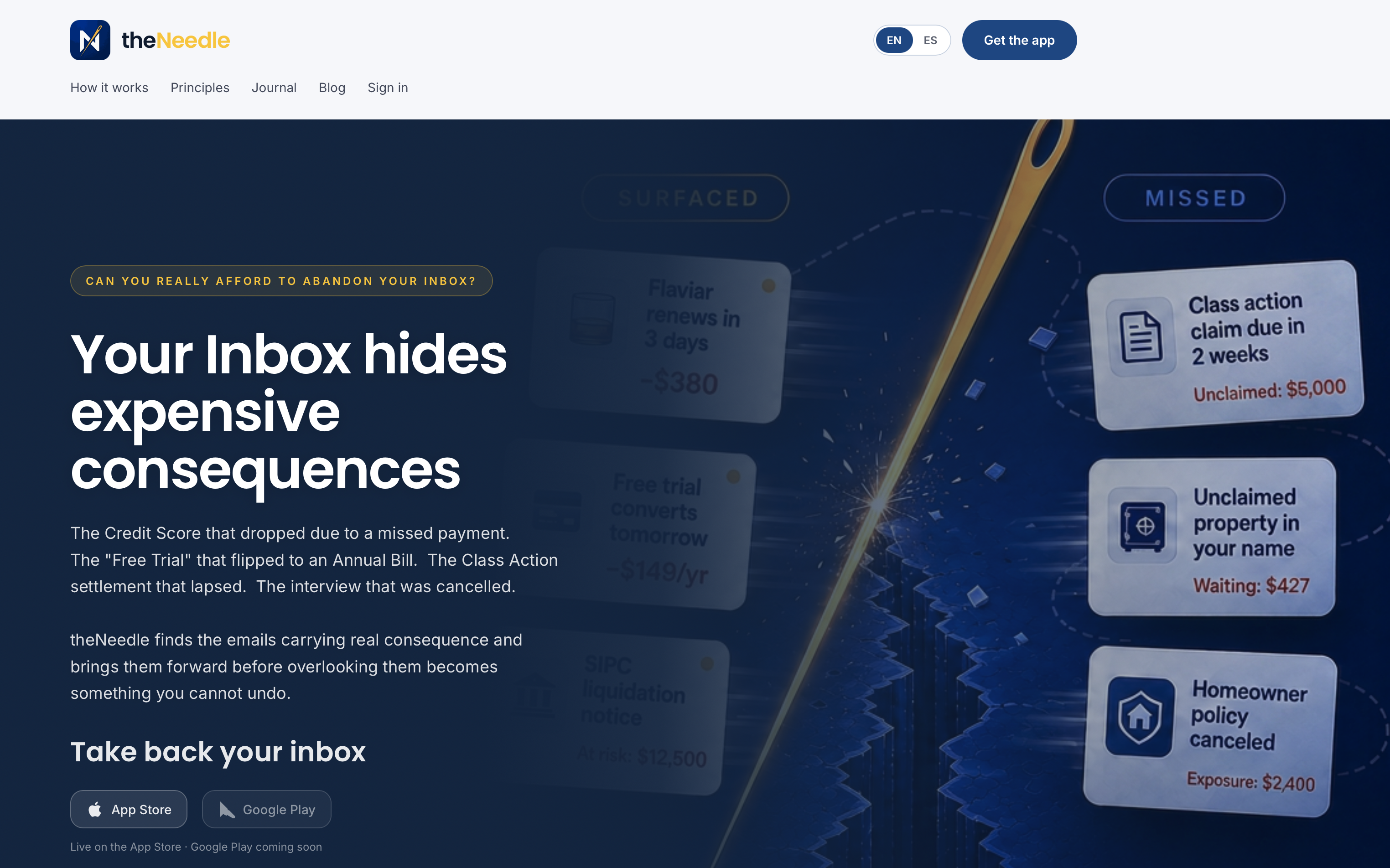
Getting started takes about fifteen to twenty minutes if you want to run a proper first check. Connect one account through theNeedle’s live page, whether that is Gmail, Outlook, Microsoft, Yahoo, or iCloud, and let the initial scan complete. During that first session, check three things: whether it correctly flags a message you already know has a deadline attached, whether the one-at-a-time focus view feels manageable rather than overwhelming, and whether the built-in unsubscribe tool handles a persistent sender you have been meaning to block.
- Connect your inbox through the live plan page and review the permissions screen before granting access.
- Let the first scan run and compare its flagged messages against ones you already know matter.
- Test the focus view to see whether one-at-a-time surfacing fits how you actually work through a day.
- Check the unsubscribe tool on a sender you have been ignoring for months.
- Review cancellation and data settings in your account before the trial period ends.
Pricing after the trial is straightforward: $9.99 per month or $99.99 per year for the annual plan, with no long-term contract locking you in beyond your chosen billing cycle. If theNeedle is not the right fit, canceling and revoking access takes only a few minutes from your account settings, and you can pair the trial period with the evaluation script earlier in this guide to make a confident decision either way. Start your trial at theNeedle when you are ready to see what’s actually waiting in your inbox.
Where to verify these claims yourself
Before connecting any inbox to an AI tool, it is worth reading the primary sources rather than taking a vendor’s word alone.
- Copilot Pro, Microsoft 365 apps, and your privacy explains how a major platform vendor handles data and privacy controls.
- Microsoft 365 Copilot privacy documentation covers data residency and admin-level privacy controls in more technical detail.
- theNeedle and its live plan page detail the product’s specific features, pricing, and trial terms.
- Ampwise AI illustrates how email alerts can connect into broader financial and ERP workflows for readers building more advanced setups.
- The AI Learning Center offers additional context on AI governance and transparency practices worth applying when evaluating any inbox tool.
Sources
FAQ
Can I use AI to organize my emails?
Yes, AI email organizers can triage, summarize, and flag important messages automatically once you connect your inbox through a secure integration. The right choice depends on whether your main problem is missed deadlines, inbox volume, or a need for custom automation.
Can ChatGPT organize my emails?
ChatGPT itself does not connect directly to your inbox, so it cannot automatically triage or flag incoming mail without a separate integration or plugin. Purpose-built email organizers, whether built into your client or offered as a standalone app, are generally a more direct fit for ongoing inbox management.
Which AI email organizer is best for catching missed deadlines?
theNeedle is built specifically around surfacing emails with deadlines, financial stakes, or contractual consequences, rather than sorting by sender or keyword alone. It connects to Gmail, Outlook, Microsoft, Yahoo, and iCloud, and offers a free trial so you can test priority detection before subscribing.
Which AI model is best for emails?
There is no single AI model considered best for email, since different tools use different combinations of classification, extraction, and language models depending on the task. What matters more for most professionals is whether the finished product reliably catches consequential messages and integrates with the email provider they already use.