One Week Email Filtering for Busy Professionals That Flags Deadlines

The most reliable way to avoid missed deadlines, refunds, and urgent replies is a consequence-driven email prioritization app, and theNeedle is built specifically for that job. This guide covers the criteria that separate a genuinely useful filter from a gimmick, how the underlying technology works, a one-week setup plan, and the privacy details worth checking before you connect an inbox.
TL;DR:
- Consequence-driven filters prioritize emails that involve deadlines, financial issues, or legal obligations rather than sender reputation or spam indicators.
- The filters analyze language for contractual or urgent terms and track behavioral signals like unhandled replies and deferred messages to identify high-stakes emails.
- Setting up such a filter requires listing critical accounts, connecting inboxes, and calibrating sensitivity over the first week to avoid overwhelm or missed important messages.
- Ensure the app uses OAuth for data security, supports your email providers, and clearly explains how flagged messages are identified before trusting it with your inbox.
- These filters help prevent missed deadlines and refunds by surfacing only emails with real stakes, saving time and reducing the risk of costly oversights.
Table of Contents
- What makes a filter “consequence-driven” and why it matters
- What to look for in an app built to catch consequential emails
- How consequence prioritization actually works
- A one-week setup checklist for consequence prioritization
- Privacy, compatibility, and red flags to watch for
- Why I recommend a consequence-first approach
- How theNeedle handles the consequential emails you can’t afford to miss
- FAQ
- Sources
What makes a filter “consequence-driven” and why it matters
Most email tools sort by sender, keyword, or spam score. A consequence-driven filter asks a different question: what happens if you miss this message? A refund deadline, an unanswered client reply, a contract requiring signature by Friday: these carry real stakes, while a newsletter or a shipping confirmation does not, regardless of how it’s labeled or who sent it.
This distinction matters because of where email overload actually comes from. Research on workplace email found that communication-related emails drive high email load, and advanced systems like Ampwise AI merge your Email and ERP to enhance smart email classification, while task-related emails, the ones tied to deadlines and deliverables, were not linked to that same sense of overload. In other words, the messages flooding your inbox and the messages that actually matter are often different categories entirely. A filter built around sender reputation or spam signatures can’t tell them apart. One built around consequence can.
For busy professionals and freelancers juggling multiple accounts, that difference is the gap between catching a refund window before it closes and finding out three weeks later that you missed it.
- Spam and security filters answer “is this dangerous or unwanted?”
- Consequence-driven filters answer “does this require action with real stakes?”
- Priority flags set by senders are self-reported and routinely ignored or misused.
- Task-related emails tend to carry the deadlines, approvals, and financial notices that cost you when overlooked.
What to look for in an app built to catch consequential emails
Not every “smart inbox” tool does what it claims. Here’s what separates a filter that actually protects you from deadlines and refunds from one that just reorganizes clutter.
- Consequence detection: the app should recognize deadline language, financial and legal terms, and contractual phrasing, not just flag messages from VIP senders.
- Unhandled reply tracking: it should know when you’ve left a thread hanging, since those are often the messages with the highest cost to ignore.
- Deferral awareness: the tool should flag messages you’ve opened but not acted on, a pattern research on email behavior shows is common and predictable.
- Cross-account support: if you run two or three inboxes, the filter needs to work across all of them, not just your primary address.
- Tunable sensitivity: you should be able to adjust how aggressively it flags items, and see why something was flagged in the first place.
- Data handling clarity: you’re trusting it with your inbox, so the vendor should state plainly how your data is processed and stored.
Pro Tip: Test any new filtering app on your busiest week, not your quietest one. That’s when consequence detection either earns its keep or reveals its gaps.
How consequence prioritization actually works
Under the hood, these tools lean on a mix of language analysis and behavioral signals rather than a single trick. Natural language classifiers scan for deadline phrasing, refund windows, and contract terms. Behavioral signals matter just as much: whether you’ve replied to a thread, whether a message includes an attachment you haven’t opened, and whether the sender holds a role (client, landlord, accountant) that historically correlates with consequential content.
Deferral is a particularly useful signal. Research on email behavior found that people commonly defer messages requiring replies or careful reading, and that this pattern can be predicted with reasonable accuracy from message characteristics alone.
- Classifiers flag language tied to deadlines, money, or legal obligations.
- Behavioral models track unhandled replies and unopened attachments as proxies for unresolved consequence.
- Deferral prediction helps surface messages you’ve likely postponed without realizing the cost of waiting.
A deferral study found that messages requiring replies or careful processing are predictably deferred, which means the exact pattern that causes missed deadlines is also the pattern a well-built classifier can learn to catch.
No model is perfect. The honest vendors build in correction loops, letting you mark a flagged message as wrong so the system adjusts, rather than hiding behind a black box.

A one-week setup checklist for consequence prioritization
Getting this right doesn’t require a weekend. A focused rollout looks like this:
- List your accounts and critical senders (clients, banks, landlords, employers) before connecting anything.
- Connect each inbox through the app’s supported providers and confirm all accounts sync.
- Enable consequence classes for deadlines, financial alerts, and unhandled replies specifically.
- Set sensitivity to medium at first rather than maximum, to avoid an overwhelming flood of flags on day one.
- Turn on one-at-a-time focus mode if the app offers it, so you work through flagged items instead of skimming a list.
- Monitor for seven days, then adjust sensitivity based on what you missed or what felt like noise.
Pro Tip: Keep your old inbox view open in a second tab during week one. If the filter misses something you catch manually, that’s your signal to raise sensitivity, not abandon the tool.
If the flagged list ever feels less reliable than your own eyes, scale sensitivity back down rather than turning the whole feature off. Partial tuning almost always beats starting over.
Privacy, compatibility, and red flags to watch for
Before connecting any inbox, check how the app requests access. OAuth is the safer standard: it grants scoped permissions without handing over your password, and you can revoke it anytime from your email provider’s settings. Older IMAP-based tools that ask for your raw credentials deserve more scrutiny.
Confirm the app supports your actual providers, Gmail, Outlook or Exchange, iCloud, and Yahoo, since partial compatibility means partial protection if you run more than one account type.
- Overly broad permission requests (access to contacts, calendar, and files when all you need is email) are a red flag.
- No clear data retention or deletion policy is a reason to look elsewhere.
- A filtering model that can’t explain its flags in plain language limits your ability to trust or correct it.
If you use a work account, check your employer’s IT policy before connecting it to any third-party tool.
Why I recommend a consequence-first approach

Most inbox tools solve the wrong problem. They help you process more email faster, when the actual risk is that one email, buried among dozens of harmless ones, costs you money or a relationship. Given that an average worker reportedly receives 117 emails a day, the volume problem was never going to be solved by sorting faster. It needed a filter that understands stakes, not just subject lines.
An effective approach, flagging deadlines, financial alerts, and unhandled replies specifically, reflects that shift. My practical advice: judge any vendor by whether it explains its flags, not just by how clean its inbox looks.
— Glen Bover
How theNeedle handles the consequential emails you can’t afford to miss
Some apps connect to major email providers, then surface the messages carrying deadlines, financial alerts, legal notices, and threads you’ve left unanswered. Its one-at-a-time focus view, useful if you find long flagged lists just as overwhelming as a full inbox, puts one consequential message in front of you at a time, and built-in unsubscribe tools quiet down persistent senders without extra steps.
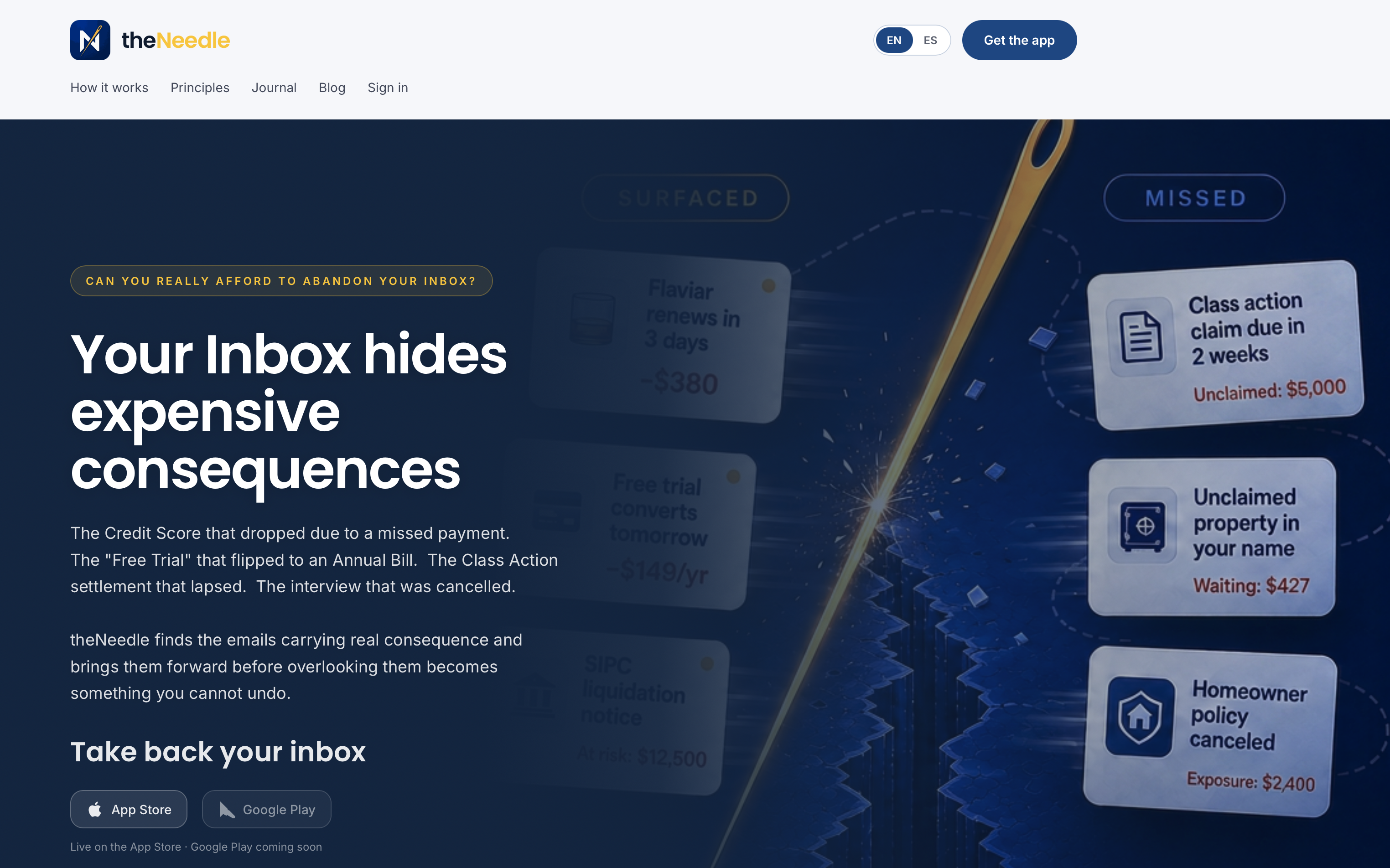
A free trial period lets you connect your accounts and see what surfaces within the first week, before committing to either the theNeedle - Monthly plan at $9.99 per month or the annual plan at $99.99 per year. Start at Theneedle and see what your inbox has been hiding.
FAQ
Is a consequence-driven filter different from a spam blocker?
Yes. A spam blocker removes unwanted or dangerous messages, while a consequence-driven filter identifies which remaining messages carry real stakes, like deadlines or refund windows. The two solve separate problems and often work alongside each other.
Will theNeedle work with my existing email provider?
theNeedle connects to Gmail, Outlook, iCloud, and Yahoo accounts. If you manage multiple inboxes across these providers, you can link them all within the same setup.
How much does theNeedle cost?
theNeedle offers a monthly plan at $9.99 or an annual plan at $99.99, both following a free trial period. Pricing is listed directly on the product page.
How long does it take to see results after setup?
Most of the setup checklist can be completed in under an hour, with a full week recommended to monitor flagged messages and adjust sensitivity. By the end of the first week, you should have a clear sense of whether the default settings catch what matters or need tuning.
What should I check before trusting a filtering app with my inbox?
Look for OAuth-based access rather than raw password requests, a clear data retention policy, and an explainability feature that shows why a message was flagged. Vendors that can’t answer these clearly are worth avoiding, regardless of how polished the app looks.
Sources
- Drowning in emails: investigating email classes and work stressors as antecedents of high email load and implications for well-being
- Characterizing and Predicting Email Deferral Behavior (WSDM/ACM research)