Spike Alternatives for Professionals: Catch Costly Deadline Emails

If you are comparing Spike alternatives, the short answer is this: theNeedle is our pick for professionals who need to catch deadline-driven or financially consequential emails first. Google Workspace, Microsoft 365, Clariti, and FrontApp cover broader collaboration needs. We recommend theNeedle because it ranks messages by consequence, not volume. Below, a comparison table and a short checklist help you choose.
TL;DR:
- With professionals receiving an average of 117 emails daily, run a pilot for two weeks and track missed deadlines and response delays on urgent threads.
- Choose Google Workspace or Microsoft 365 for collaboration and compliance controls; consider Rocket.Chat when self hosting and control over data location are priorities.
- theNeedle costs $9.99 monthly or $99.99 annually, while free tiers elsewhere may limit storage, automation, or administration; compare paid costs at projected headcount.
- Before subscribing, confirm how vendors use email content, what protects stored data, whether exports are available, and when a trial converts to paid billing.
Table of Contents
- A curated shortlist of theNeedle and the leading Spike alternatives
- Comparing Spike alternatives side by side
- How to choose the right Spike alternative for your team
- Why consequence-first prioritization matters and when theNeedle fits
- How customer support compares across these tools
- What user reviews and reputation signals tell you
- Pricing in detail: watch for upgrade costs and hidden limits
- Trial periods and refund policies to check before you commit
- Security and privacy features worth comparing
- Choosing between an all-in-one suite and consequence-first prioritization
- Try theNeedle before your next deadline slips through
- FAQ
- Sources
A curated shortlist of theNeedle and the leading Spike alternatives
Spike built its reputation on merging email and chat into one conversational inbox. That approach works for some teams, but it leaves a gap for anyone whose real problem is not clutter, it is missing the one email that actually matters. That gap is where theNeedle sits: instead of unifying every channel, we rank messages by consequence, surfacing deadlines, payment notices, and contract-related threads ahead of routine traffic. For professionals juggling multiple inboxes, that distinction often matters more than a cleaner UI.
The rest of the field splits into a few camps. Some tools widen the net (full productivity suites), some narrow it to tasks, and some focus on shared or threaded conversations. Here is where each one fits:
- Google Workspace bundles Gmail with Docs, Drive, and Meet, making it a natural fit for teams already living inside the Google ecosystem.
- Microsoft 365 pairs Outlook with Teams and enterprise admin controls, suiting organizations standardized on Microsoft tools.
- monday AI Work Platform turns communication into project-driven boards with AI-assisted automation, useful for teams that think in workflows rather than inboxes.
- Asana keeps the focus on task tracking and cross-team accountability rather than inbox management itself.
- Bitrix24 combines CRM, project management, and communication in one platform, appealing to companies that want fewer vendors to manage.
- Clariti groups email, chat, and tasks into threads, giving teams shared context without hunting across apps, as its own comparison of Spike alternatives explains.
- Twist organizes conversations into asynchronous threads, a fit for distributed teams that want to cut down on real-time noise.
- Rocket.Chat offers an open-source, self-hostable chat platform for organizations that need heavy customization or data control.
- FrontApp runs on shared-inbox workflows with routing and assignment features, built for customer-facing teams.
- Chanty keeps things simple: a lightweight chat app with basic task integration for small teams that do not want a steep learning curve.
Pricing shapes vary across this list, from freemium tiers to seat-based enterprise contracts. theNeedle keeps it simple with a flat theNeedle - Monthly plan at $9.99 per month or a theNeedle - Annual plan at $99.99 per year, available on our live product page. None of these alternatives are wrong choices. The question is which job you are actually hiring software to do: unify your channels, manage your tasks, or make sure you never miss the email that costs you money or a deadline.
Comparing Spike alternatives side by side
The table below lines up the shortlist against the dimensions that matter most when you are choosing a replacement: who it suits, how pricing works, what collaboration features it leads with, which integrations it supports, and where it runs.
A few cells shift depending on plan level: free tiers on Google Workspace, monday, Asana, Bitrix24, Clariti, Twist, and Chanty cap users, storage, or automation, while admin controls and advanced integrations tend to sit behind paid seats. The average professional now receives 117 emails a day, which is the core reason prioritization, not just unification, has become the deciding factor for many of these tools.
How to choose the right Spike alternative for your team
Before you commit, run your shortlist against a few practical criteria. Some of these matter more to solo professionals, others to larger teams managing shared infrastructure.
Start with what the tool actually prioritizes: does it rank messages by consequence (deadlines, payments, contracts), by sender, or simply by recency? Then check integration depth with your existing email provider and calendar, since a tool that only partially syncs creates its own blind spots. Admin controls, single sign-on, and compliance certifications matter more as team size grows. Search and archive quality determines whether you can actually find an old thread under pressure. Finally, look at pricing predictability: seat-based tiers can balloon as you add people, while flat per-user pricing is easier to forecast.
When you get a vendor on a call, ask direct questions:
- How does your prioritization or sorting logic work, and can I customize it?
- Which email providers and calendar tools integrate natively, without a workaround?
- Can I export my data if I cancel, and in what format?
- What happens to my account and data after the trial ends?
- What admin or security controls are included at my plan level, not just the enterprise tier?
Pro Tip: Run a two-week pilot focused only on high-consequence messages, deadlines, invoices, contract renewals, and track whether the tool actually surfaces them before you judge it on looks or speed. Productivity researchers who evaluate tools like Spike recommend exactly this kind of focused pilot, since it surfaces whether a tool catches the items teams tend to miss rather than just streamlining the inbox you already manage fine.
Why consequence-first prioritization matters and when theNeedle fits
The inbox overload problem is not really about volume. It is about which message, buried among dozens, actually carries a deadline, a financial consequence, or a contractual obligation. With the average worker now receiving 117 emails daily, sorting by sender or recency stops being a reliable filter.
theNeedle was built around that specific gap. We connect to Gmail, Outlook, Microsoft, Yahoo, and iCloud, then surface overdue replies, urgent deadlines, and high-priority threads ahead of routine traffic, while also tracking opportunities like credits or refunds that are easy to lose in a crowded inbox. Readers who want the fuller case for this approach can see how we frame it against other premium inbox tools in our comparison of consequence-first alternatives to Superhuman, or our breakdown of how we compare to Spark. We also built one-at-a-time, ADHD-friendly focus into the product, recognizing that not every busy professional processes a crowded inbox the same way.
The question is not which tool shows you the most, it is which one makes sure you never miss the one that costs you.
— Glen Bover
How customer support compares across these tools
Support quality tends to track company size and business model. Enterprise suites like Microsoft 365 and Google Workspace offer tiered support, with faster response times reserved for higher-paying business and enterprise plans, while free-tier users typically rely on help centers and community forums. Project platforms like Asana and monday AI Work Platform follow a similar pattern: paid tiers unlock priority support, while free users wait longer or self-serve through documentation.
Smaller, more focused tools often respond faster simply because their support queues are shorter. Chanty and Twist, both built for smaller teams, tend to resolve straightforward questions quickly through chat-based support. Rocket.Chat’s open-source model shifts more responsibility onto the user, since self-hosted deployments mean your own IT team handles first-line troubleshooting, with paid support plans available for organizations that want a vendor safety net. FrontApp and Clariti, built around shared-inbox and thread-based workflows, generally support business customers through dedicated channels rather than public forums, reflecting their focus on team accounts over individual freemium users.
For a solo professional or small team evaluating support, the practical test is simple: submit a question during your trial period and see how long it takes to get a real answer, not just an automated acknowledgment. That single data point tells you more than any marketing page about what support will look like once you are a paying customer.

What user reviews and reputation signals tell you
Review patterns across this category tend to split along the same lines as the tools themselves. All-in-one suites like Google Workspace and Microsoft 365 draw large review volumes simply due to scale, with feedback often focused on reliability and breadth of features rather than any single standout capability. Project management tools like Asana and monday AI Work Platform tend to draw praise for ease of adoption and criticism when automation or customization requires a higher-priced tier.
Specialized tools draw narrower but more pointed feedback. Reviewers of all-in-one email and chat tools in Spike’s category note that unifying everything into one interface can trade away depth in specialized features, a trade-off worth weighing against your actual workflow rather than the interface alone. That same dynamic shows up across this list: a thread-based tool like Clariti or Twist earns praise for reducing context-switching, but reviewers sometimes note a learning curve in adjusting to a threaded mental model instead of a flat inbox.
Rather than chasing the highest star rating, read a handful of recent reviews for the specific feature you care about most, whether that is integration reliability, mobile performance, or support responsiveness. Reputation tells you how a tool performs in general; your own trial tells you how it performs for your specific inbox.
Pricing in detail: watch for upgrade costs and hidden limits
Pricing shapes vary more than they first appear. theNeedle charges a flat $9.99 per month or $99.99 per year with no tiered feature gating on our live plan, which makes costs predictable as you use the product. Many of the broader suites work differently: Google Workspace, Microsoft 365, monday AI Work Platform, Asana, Bitrix24, Clariti, Twist, and Chanty all offer freemium entry points, but core features like advanced automation, admin controls, or higher storage limits typically sit behind a paid upgrade.
That structure is not inherently a problem, but it does mean the advertised entry price is rarely the price a growing team ends up paying. Seat-based pricing on tools like Microsoft 365 and FrontApp can also multiply quickly as headcount grows, turning what looked like an affordable per-user rate into a significant monthly bill. Rocket.Chat’s open-source core is free to self-host, but organizations that want managed hosting or vendor support typically pay for those services separately.
Research into premium email tool pricing suggests that higher-cost tools deliver the clearest return for roles where email speed directly drives revenue, while general administrative or mixed-use teams often get better value from a flat-rate or integrated platform. Before committing, map out your expected team size a year out and price the plan at that scale, not just at today’s headcount.

Trial periods and refund policies to check before you commit
Trial length and refund terms vary enough across this list that they deserve a direct check before signup, not after. Most freemium tools, including Google Workspace, Asana, monday AI Work Platform, Bitrix24, Clariti, Twist, and Chanty, let you use a limited free tier indefinitely rather than offering a traditional time-boxed trial, which gives you more runway to test fit without a clock running. Microsoft 365 and FrontApp typically offer a fixed free trial window before billing begins, so mark your calendar.
Refund policies tend to follow standard SaaS norms: most vendors will refund within a short window if you cancel immediately after an unintended renewal, but policies differ on whether a partial month is refunded at all. Rocket.Chat’s self-hosted core sidesteps the refund question entirely since there is no subscription to cancel, though managed or supported tiers follow normal billing terms.
Whatever tool you are testing, the smart move is the same: set a calendar reminder a few days before any trial converts to a paid plan, and confirm in writing what happens to your data and settings if you decide not to continue.
Security and privacy features worth comparing
Email management tools handle sensitive content by definition, so security posture deserves real scrutiny, not just a checkbox glance. Enterprise suites like Microsoft 365 and Google Workspace lead on compliance certifications and admin-level controls, including data loss prevention and audit logging, which matter most for regulated industries or larger teams. Rocket.Chat’s self-hosted option gives organizations full control over where data lives, an advantage for teams with strict data residency requirements.
Smaller or more specialized tools vary more. Shared-inbox platforms like FrontApp and Clariti generally offer standard encryption in transit and at rest, along with role-based access for team accounts, while simpler chat tools like Chanty and Twist focus their security efforts on core account protection rather than enterprise-grade compliance tooling.
theNeedle connects directly to your existing email provider, Gmail, Outlook, Microsoft, Yahoo, or iCloud, rather than migrating your mail elsewhere, which limits the surface area of data we need to handle. Whichever tool you choose, confirm two things directly with the vendor: whether your email content is used to train any model, and what encryption standard protects data at rest. Those two answers tell you more than any badge on a pricing page.
Choosing between an all-in-one suite and consequence-first prioritization
If your team’s real bottleneck is coordination, who is doing what, and where a project stands, an all-in-one suite like Google Workspace, Microsoft 365, or monday AI Work Platform earns its complexity. These platforms are built for shared visibility across many people and many moving pieces.
But if your real bottleneck is personal, missing the one email that carries a deadline or a financial consequence buried under dozens of routine messages, adding more surface area rarely solves it. That is a prioritization problem, not a collaboration problem, and it is worth testing a narrower tool before buying into a broader suite.
A practical next step: run a two-week pilot with theNeedle alongside your current setup. Track two numbers only, missed deadlines and average response lag on high-consequence threads. If both improve, you have your answer.
— Glen Bover
Try theNeedle before your next deadline slips through
If the real cost of email overload in your work is the occasional missed invoice, overdue reply, or forgotten contract deadline, we built theNeedle specifically to catch those before they become expensive. We connect to Gmail, Outlook, Microsoft, Yahoo, and iCloud, surface the messages that carry real consequences, and get out of the way for everything else.
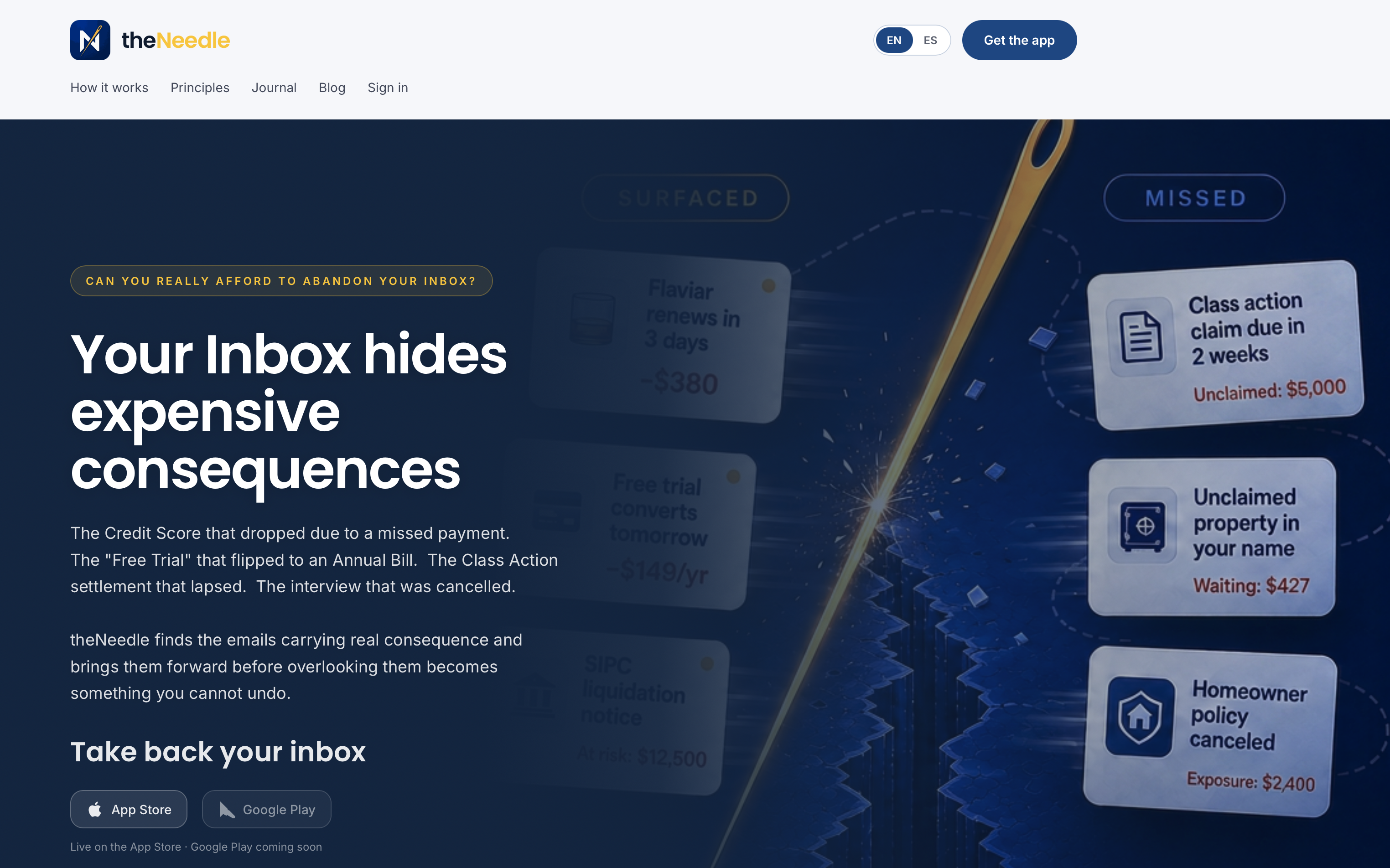
- Flat pricing: $9.99 per month or $99.99 per year, no tiered feature gating.
- Built-in unsubscribe to quiet persistent senders without manual cleanup.
- One-at-a-time, consequence-ranked focus designed for busy and easily overwhelmed inboxes alike.
Start with theNeedle today and see which high-consequence email was waiting in your inbox the whole time.
FAQ
What are some apps similar to Spike?
Apps that cover similar ground to Spike include Google Workspace, Microsoft 365, Clariti, Twist, Rocket.Chat, FrontApp, and Chanty, each emphasizing a different mix of email, chat, and task collaboration. For readers whose priority is catching consequential messages rather than unifying channels, theNeedle offers a consequence-first alternative instead.
What are some alternatives to speaker spikes?
This question refers to physical speaker stands rather than software, and it falls outside what we cover here since our focus is on email and communication tools. For audio equipment alternatives, a specialty audio retailer or manufacturer’s support page is the better resource.
What is Spike email used for?
Spike email combines a traditional inbox with chat-style conversation threading, letting people read and reply to messages in a conversational format rather than a classic email thread. It also bundles collaboration features like notes and shared team inboxes into the same interface.
What are some alternatives to spike seasoning?
This question points to a cooking seasoning blend rather than software, which sits outside the scope of this article on communication tools. A recipe or cooking resource would be the right place to find seasoning substitutes.