Consequence First Superhuman Alternatives for Professionals ($9.99/mo)

A consequence-first inbox tool is a strong choice for busy professionals needing more than just speed, with other alternatives available for team collaboration, AI-enhanced experiences, and inbox-zero routines. Each solves a different piece of what Superhuman used to promise. Try theNeedle’s trial first, then compare pricing pages before you commit.
TL;DR:
- The Needle prioritizes consequence-based email management, surfacing overdue, urgent, and high-priority messages rather than just volume or speed.
- Unlike Superhuman, it focuses on tracking deadlines and financial opportunities, with features tailored for professionals managing multiple accounts and real-world impact.
- Its trial period offers the chance to verify notification accuracy, unsubscribe effectiveness, and focus mode functionality during peak email hours.
- Alternatives like Missive and Spark support shared drafts and delegation, making them suitable for team collaboration, while others like SaneBox and Mailman add cost-effective inbox triage layers.
- Switching is recommended if deadlines are missed or team collaboration features are essential, but organizations heavily reliant on enterprise AI or IT controls may prefer waiting or sticking with integrated solutions.
Table of Contents
- Superhuman alternatives compared: who each one actually fits
- How to evaluate and test an email client before you switch
- Why theNeedle takes a consequence-first approach to email
- What happens if you don’t like the alternative you picked
- When to switch off Superhuman, and when to wait
- Try theNeedle before your next inbox pileup
- Sources
- FAQ
Superhuman alternatives compared: who each one actually fits
Superhuman built its reputation on keyboard speed and a polished command palette, but that focus came at the cost of shared inboxes, admin controls, and the kind of AI that understands consequence rather than just summarizing threads. The alternatives below split into a few camps: tools built for teams, tools built for AI-assisted speed, and tools built for people who just want fewer distractions and lower monthly bills.
theNeedle takes a different starting point than most of the list. Instead of optimizing for typing speed, it looks at what an email actually costs you if you miss it: a deadline, a refund window, a contractual obligation. It connects to various email providers, surfaces overdue and high-priority messages, flags unhandled replies, tracks financial opportunities, and includes a built-in unsubscribe tool for persistent senders. The one-at-a-time focus mode was designed with ADHD-friendly workflows in mind, which matters for professionals who find a crowded inbox actively paralyzing rather than just annoying.
| Best for | Free tier / pricing | Platform support | Team features | AI and automation |
|---|---|---|---|---|
| theNeedle: consequence-driven prioritization for busy professionals | Free trial, then $9.99/month or $99.99/year | Gmail, Outlook, Microsoft, Yahoo, iCloud | Multi-account support | Deadline and consequence detection, unsubscribe helper |
| Missive: shared inboxes and collaborative drafting | Free tier available, paid team plans | Gmail, Outlook, IMAP, macOS, Windows, iOS, Android | Shared inboxes, delegation, shared drafts | Rules-based automation |
| Shortwave: Superhuman-like UI with an AI assistant | Free tier, paid tiers for AI features | Gmail-first, web, macOS, iOS, Android | Limited team sharing | AI summaries, AI compose, migration tooling |
| Spark: smart sorting for teams and individuals | Free tier, paid team plans | Gmail, Outlook, IMAP, macOS, Windows, iOS, Android | Shared inboxes, comment threads | Smart categorization |
| Mailman: low-cost inbox-zero automation | Free trial, low monthly cost | Gmail, Outlook | None | Batch delivery, sender screening |
| Inbox Zero: minimal Gmail/Outlook layer | Free and paid tiers | Gmail, Outlook | None | Rule-based triage |
| Notion Mail: email inside a workspace | Bundled with Notion plans | Web, macOS, Windows, iOS, Android | Shared workspace context | Notion AI integration |
| HEY: privacy-forward curated inbox | Paid only, no free tier | Web, macOS, Windows, iOS, Android | None | Opinionated screening, no ads |
| Outlook: enterprise mail with Copilot | Free tier, bundled with Microsoft 365 | Windows, macOS, web, iOS, Android | Shared mailboxes, delegation, admin controls | Copilot integration |
| SaneBox: mailbox-side triage service | Free trial, paid subscription | Works with any IMAP client | None | Machine-learning triage and snoozing |
| Gmail: default web mail with Gemini | Free, paid via Google Workspace | Web, macOS, Windows, iOS, Android | Shared labels via Workspace | Gemini summaries and smart reply |
| Canary Mail: privacy and local search | Free tier, paid Pro tier | macOS, Windows, iOS, Android | None | Local AI assistant |
| Mimestream: native Gmail client for Mac | Free trial, paid subscription | macOS only | None | Minimal, focuses on speed |
A few things stand out once you line these up side by side.
- Missive and Spark both build shared drafts and delegation directly into the client, which makes them the natural picks for support or ops teams that used to run Superhuman seats individually.
- Shortwave leans hardest into AI parity with Superhuman, and it even publishes a migration guide walking former Superhuman users through keyboard shortcuts and setup.
- Mailman, Inbox Zero, and SaneBox skip the client entirely and work as a layer on top of Gmail or Outlook, which keeps costs low but means you’re still using the same interface you had before.
- HEY and Canary Mail both trade breadth for a point of view: HEY on privacy-first screening, Canary Mail on local search performance and encryption.
- Outlook and Gmail remain the default choice for teams already inside Microsoft 365 or Google Workspace, mostly because Copilot and Gemini are already licensed and IT already trusts them.
- Notion Mail and Mimestream serve narrower audiences: one for teams that live inside Notion, the other for Mac users who want a fast, native Gmail client and nothing else.
Missive’s reviews on G2 consistently highlight team workflow scenarios, shared drafts, and how collaboration actually plays out day to day, more than raw speed benchmarks, which tracks with how it’s positioned above.
How to evaluate and test an email client before you switch
Choosing a Superhuman replacement isn’t just a feature checklist. It’s a question of what breaks if the tool gets it wrong on a Tuesday morning when you have forty unread messages and three of them matter.
Run your evaluation against five criteria: speed and keyboard workflow parity, the quality and privacy of any AI or automation features, whether the tool supports shared inboxes if you work with a team, how well it fits your existing platform (Gmail, Outlook, or a mix), and whether the pricing makes sense against what you’re actually saving in time or avoided mistakes.
During a trial, work through this checklist rather than just skimming the interface:
- Set up a follow-up automation and confirm it actually fires when a thread goes quiet.
- Send a shared draft to a teammate and check the roundtrip: comments, edits, and final send.
- Ask the AI assistant to summarize a long thread and check the summary against what actually happened.
- If you’re on a company account, test SSO login and confirm your IT admin can see and manage the account.
- Import a chunk of old email and time how long it takes, plus whether labels and folders survive the move.
- Check unsubscribe or sender-screening tools against a genuinely noisy inbox, not a curated demo one.
Before you sign anything, ask the vendor’s sales or support team directly: how is customer data used to train models, what happens to your data if you cancel, and what’s the actual SLA for support response. A vendor that hedges on data retention or can’t describe its security practices in plain language is a red flag worth taking seriously, especially if file attachment security matters for your work.
Pro Tip: Don’t test during a quiet afternoon. Pick your actual peak hour, the one where messages pile up fastest, and run your trial then. That’s when a tool’s real strengths and real friction points show up.
Once you’ve settled on a replacement, it helps to rethink your inbox organization habits rather than just recreating your old folder structure in a new tool.
Why theNeedle takes a consequence-first approach to email
Most email tools compete on volume: more folders, faster search, quicker replies. theNeedle starts from a different question, which is what actually happens if you miss this message. A deadline slips. A refund window closes. A client waits three days for a reply they needed in one. That’s the gap theNeedle is built to close, and it matters most for professionals juggling multiple accounts who don’t have time to triage everything manually.
theNeedle’s own research points to why this matters: the average worker receives 117 emails per day, a volume that makes manual sorting unreliable no matter how fast someone types. That’s the throughline in Glen Bover’s writing on inbox overload for theNeedle, which treats email volume as a productivity problem, not just an inbox-management one.
What theNeedle actually does:
- Connects to Gmail, Outlook, Microsoft, Yahoo, and iCloud accounts in one place.
- Surfaces overdue, urgent, and high-priority messages based on consequence rather than sender or keyword rules.
- Flags emails you started replying to but never finished.
- Tracks financial opportunities like credits or refunds that are easy to lose track of.
- Offers one-at-a-time focus mode designed with ADHD-friendly workflows in mind.
- Includes a built-in unsubscribe tool for senders who won’t take no for an answer.
theNeedle doesn’t claim enterprise SSO, certified compliance frameworks, or bundled workspace AI the way Outlook or Gmail do. It’s built for individual professionals and freelancers managing real deadlines, not for IT departments rolling out policy across a thousand seats.
What happens if you don’t like the alternative you picked
Every tool on this list expects you to test it before paying full price, but the terms differ enough to matter. theNeedle offers a free trial period before the paid subscription kicks in, giving you time to run the checklist above against your real inbox rather than a demo account. Missive and Spark both offer free tiers with usage limits, so you can use them indefinitely at a smaller scale before deciding whether to upgrade for team features. SaneBox and Mailman typically run short free trials since they’re built around ongoing subscriptions rather than one-time purchases.

Outlook and Gmail are the exceptions, since they’re often already included in a Microsoft 365 or Google Workspace subscription your organization is paying for regardless of what email client you personally prefer. HEY stands out for not offering a free tier at all, asking for payment upfront, which makes it a riskier trial unless you’re already confident in its privacy-first approach.
Read the fine print before you commit a full year to any annual plan. Some vendors prorate refunds if you cancel mid-cycle, others don’t, and that detail rarely shows up until you’re looking for the cancellation page.
When to switch off Superhuman, and when to wait
Switch now if you’re missing deadlines, need shared drafts your team can’t get in Superhuman, or you’re paying a premium per seat for speed alone. Wait if your organization leans hard on bundled Copilot or Gemini features, or if IT restrictions make a new client a compliance headache. Start with a short trial: theNeedle for prioritization, a 30-day pilot for team tools, or a deeper look at your existing workspace AI first.
— Glen Bover
Try theNeedle before your next inbox pileup
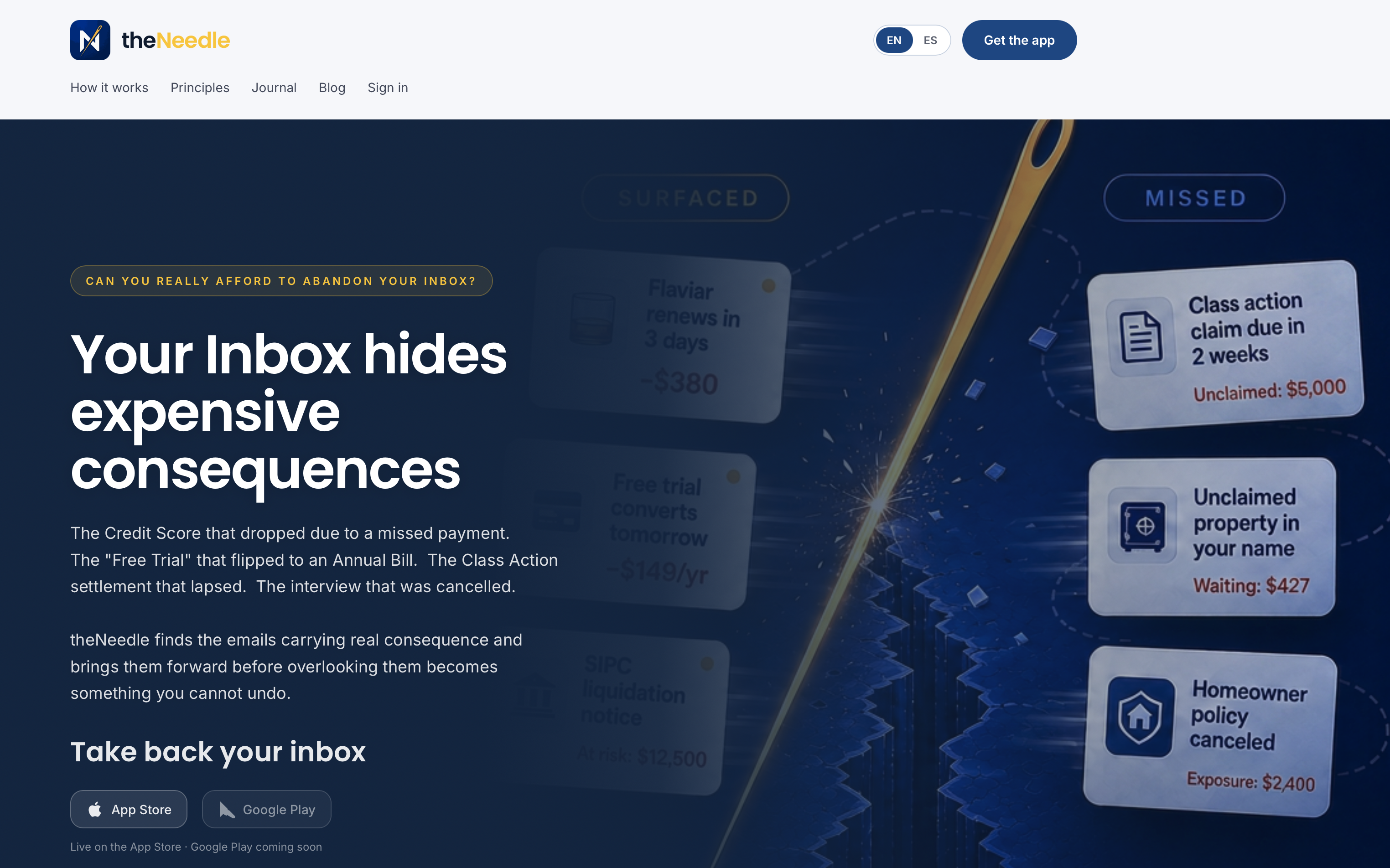
Most alternatives on this list ask you to choose between speed, team features, or a lower price. theNeedle asks a different question: what happens if you miss the one email that actually costs you money or a relationship. It connects to Gmail, Outlook, Microsoft, Yahoo, and iCloud, flags what’s overdue or financially consequential, and gives you a one-at-a-time focus mode that cuts through the noise instead of just reorganizing it.
During your trial, run through the same checklist that matters most:
- Confirm it catches a real deadline or financial email in your own inbox, not a demo one.
- Test the unsubscribe tool against your noisiest recurring senders.
- Try the focus mode during your actual peak email hour.
| Plan | Price |
|---|---|
| theNeedle - Monthly | $9.99 per month |
| theNeedle - Annual | $99.99 per year |
Run the checklist for 7 to 14 days against your real inbox, then decide. Compare plans and start your trial whenever you’re ready to see whether consequence-first prioritization changes how your week actually goes.
Sources
FAQ
Is Superhuman really worth it?
Superhuman is worth it mainly for people who value keyboard-driven speed above all else, since it’s built on top of Gmail and Microsoft 365 rather than replacing them, as Observer’s coverage explains. Whether it’s worth the price depends on whether you need shared inboxes, admin controls, or consequence-based prioritization, features Superhuman has historically deprioritized.
Is there a free version of Superhuman?
Superhuman does not offer an ongoing free tier; it operates as a paid subscription product built for speed rather than budget flexibility. Alternatives like Missive, Spark, and Inbox Zero offer usable free tiers if cost is the deciding factor.
Is Superhuman better than Outlook?
Superhuman generally offers a faster, more keyboard-driven experience, while Outlook offers deeper enterprise integration, native Copilot AI, and admin controls that matter for larger organizations. The better choice depends on whether your priority is individual speed or organization-wide compliance and collaboration.
Why is Superhuman better than Gmail?
Superhuman’s advantage over Gmail comes down to its command palette and keyboard-first design built for speed, since it’s layered on top of Gmail rather than replacing its underlying infrastructure. Gmail itself has closed part of that gap with Gemini-powered summaries and smart replies, narrowing the practical difference for many users.