Hey Email Alternatives: Flag Deadlines and Payments in One Week

Yes: choose a consequence-driven prioritizer that connects to your existing inbox and surfaces deadline, financial, or legal messages instead of asking you to switch providers. We built theNeedle around exactly this approach. This guide walks through how these tools differ from ordinary filters, what to check before committing, and how to set one up in a week.
TL;DR:
- Consequence-driven email prioritization surfaces messages related to deadlines, financial obligations, or legal notices, reducing reliance on sender or folder rules.
- The tools connect securely with existing email accounts via standard protocols like OAuth, avoiding provider switching and maintaining your current email address.
- Setting review windows of 30 to 60 minutes can significantly reduce interruptions, helping users focus without constant alerts.
- Proper calibration during the first week involves tracking false flags and adjusting sensitivity to improve accuracy and avoid missed urgent messages.
- TheNeedle specifically detects overdue replies, opportunities like refunds, and offers features like unsubscribe and one-at-a-time focus to enhance visibility in busy inboxes.
Table of Contents
- How consequence-driven alternatives actually work
- What to look for when evaluating an alternative
- Quick setup checklist to stop missing important emails
- Why theNeedle fits this job
- Comparing pricing models across alternatives
- Mobile app availability and quality
- User interface and user experience differences
- Migration tools and ease of switching from Hey
- What switching to consequence-first email taught us
- Start with theNeedle: trial and next steps
- FAQ
- Sources
How consequence-driven alternatives actually work
Most inbox tools sort by sender, folder, or keyword. Consequence-driven prioritization works differently: it looks for signals tied to real-world stakes, a contract deadline, an overdue invoice, a legal notice, a reply someone is still waiting on. The goal is not to organize everything. It is to find the handful of messages that could cost you money, a client, or a legal obligation if you miss them.
That distinction matters because volume and importance are not the same thing. A newsletter can arrive from a “VIP” sender and still carry zero consequence. A one-line email from a vendor about a payment deadline can sit quietly in a crowded inbox, indistinguishable from the noise around it. Rule-based filters catch the sender; they rarely catch the stakes.
- Rules and filters sort by who sent a message or what folder it lands in, but they cannot tell a routine update from a contractual deadline.
- Provider switching changes where your mail lives, not how it gets triaged, so the core problem of missed consequence follows you to the new inbox.
- Consequence-driven tools connect to your current accounts through standard protocols like IMAP and OAuth, so nothing about your address or provider changes while the prioritization logic does the work underneath.
Research on how people actually handle email backs up why this shift matters. A CHI 2016 study that tracked 40 information workers for 12 workdays found that batching email raised perceived productivity for people who spent longer stretches on email, but did not reduce measured stress. In other words, grouping your email checks into blocks can help you feel more in control of your time without actually lowering your stress level, which suggests the content of what you are reviewing matters as much as how often you review it.
What to look for when evaluating an alternative
Not every tool that claims “smart prioritization” earns the label. Before you commit time to setup, run through a short checklist.
- Connectivity and security model: confirm the tool connects to Gmail, Outlook, Microsoft 365, Yahoo, and iCloud without requiring you to export or forward mail, and check how it authenticates (OAuth is the standard to look for).
- Consequence detection and explainability: ask what signals drive the ranking, deadline language, financial terms, legal phrasing, and whether you can see why a message was flagged.
- Next-action visibility: look for snooze, one-at-a-time focus, and a clear way to mark something handled so it stops resurfacing.
- Notification controls: the tool should let you set your own review window rather than pushing alerts the moment anything arrives.
- Evidence and trialability: check for a free trial, documented setup guidance, and the ability to export your data if you decide to leave.
- Operational fit: consider whether it integrates with your calendar or task manager, and whether your team uses consistent subject-line conventions it can learn from.
Pro Tip: Ask any tool you are evaluating to show you a real example of a flagged message and the reasoning behind the flag before you trust it with a full week of your inbox.
The notification question deserves extra weight. A productivity guidelines paper modeled interruption counts using a 90-second read-and-recovery assumption and found that reducing check frequency, from every five minutes to every 45 minutes, can model a dramatic drop in interruptions across an eight-hour workday. That is a strong argument for choosing a tool that lets you set review windows rather than one that pings you continuously.
Quick setup checklist to stop missing important emails
Getting a consequence-focused tool working well takes less time than most people expect if you follow a deliberate order.
- Connect your inboxes and send yourself a test message with deadline language to confirm the tool picks it up correctly.
- Enable consequence signals and set an initial sensitivity level for deadline, financial, and legal terms, then adjust after a few days of real traffic.
- Build next-action rules: decide what happens when something is flagged, a reply template, an automatic snooze, or a mark-as-actioned step.
- Choose a review window: start with 30 to 60 minutes, a range grounded in research on notification frequency and interruptions, then narrow or widen it based on how your week feels.
- Run a 7-day trial and track how many consequential messages you would have otherwise missed, then tighten or loosen your rules accordingly.
Pro Tip: Keep a short note of every false flag during your trial week. Patterns in what gets wrongly surfaced tell you exactly which sensitivity settings to adjust.
Maintenance matters as much as setup. Unsubscribing from repeat senders who clutter your detection signals and agreeing on consistent subject-line cues with your team both make the underlying detection sharper over time.
Why theNeedle fits this job
We built theNeedle specifically to answer the problem this guide describes: too many emails, not enough visibility into which ones carry real stakes. Our tool connects to Gmail, Outlook, Microsoft 365, Yahoo, and iCloud, and it is designed to surface messages tied to deadlines, financial consequences, or legal and contractual obligations rather than ranking by sender or volume.
- We detect overdue replies and resurface them instead of letting them sit buried under newer messages.
- We track opportunities like credits or refunds that are easy to lose track of in a crowded inbox.
- We include a built-in unsubscribe feature for persistent senders who add noise without adding value.
- We offer a one-at-a-time focus view, a design choice that works especially well for people who find a packed inbox overwhelming to process, including those with ADHD.
The scale of the underlying problem is part of why we built this way: the average worker reportedly receives a high volume of emails each day, and when every message competes for equal attention, the ones with real consequences get lost in the crowd. During a trial week, test theNeedle against a few real deadline or payment emails you know are coming, and see whether it surfaces them before you would have found them yourself. Our guide to organizing your inbox walks through practical setup details if you want to go deeper.
Comparing pricing models across alternatives
Email prioritization tools tend to fall into three pricing patterns, and each one shapes what you can expect from the product.
Subscription-based tools charge a recurring fee, monthly or annual, in exchange for ongoing access to the full feature set. This model tends to fund continuous development of detection logic, since the provider’s revenue depends on the tool staying accurate as email patterns shift.
Free tiers offer a limited version, often capped on inbox connections or detection sophistication, as a way to let you test the core idea before paying. These are useful for a quick gut check but rarely show you the full value of consequence detection, since the more nuanced signals are usually reserved for paid plans.
Freemium models blend the two, offering a functional free version alongside a paid upgrade path for advanced features like multi-inbox support or deeper customization.
Our own structure keeps this simple: theNeedle is offered as a Monthly plan at $9.99 per month or an Annual plan at $99.99 per year, both following a straightforward subscription model with a free trial period so you can test the detection accuracy on your own inbox before committing.
Mobile app availability and quality
Checking email away from your desk is where missed deadlines often happen, so mobile support is not optional for most busy professionals. When evaluating any consequence-driven tool, confirm it offers a dedicated mobile app rather than relying on a mobile browser view, since native apps handle push notifications and offline access more reliably.
Quality matters more than existence. A mobile app that simply mirrors your desktop inbox without carrying over the same prioritization logic defeats the purpose: you want the same consequence detection and the same review window controls on your phone that you set up on your laptop. Test this specifically during any trial period, flag a test message on desktop and confirm it surfaces the same way on mobile.
Notification behavior on mobile deserves its own check. The same research on interruption frequency that applies to desktop notifications applies even more directly to phones, where alerts compete with everything else demanding your attention throughout the day. A tool worth keeping lets you apply your chosen review window consistently across devices, rather than defaulting to constant pings on your phone while staying quiet on your desktop.
User interface and user experience differences
The interface is where consequence-driven tools diverge most visibly from traditional inbox apps. A conventional email client shows you a chronological list and asks you to do the sorting work yourself. A consequence-driven tool inverts that: the interface leads with what needs your attention, often through a single surfaced item rather than a scrollable list of everything that arrived.
This one-at-a-time presentation is a deliberate design choice, not a limitation. For people who find a packed inbox visually overwhelming, seeing one flagged message at a time reduces the decision fatigue that comes with scanning dozens of subject lines looking for the one that matters. It also forces a next action before you move on, which aligns with research showing that leaving messages unresolved in the inbox correlates with higher subjective workload.

Look for clarity in how a tool explains its flags. A well-designed interface shows you why a message was surfaced, not just that it was. That transparency is what lets you trust the system enough to stop manually double-checking your inbox out of habit, which defeats the purpose of adopting the tool in the first place.
Migration tools and ease of switching from Hey
Switching tools works best when it does not require abandoning your existing email address or re-training everyone who emails you. Consequence-driven prioritizers are built to sit on top of your current accounts rather than replace them, so migration is less about moving data and more about connecting accounts and calibrating detection settings.
The practical steps are straightforward: connect your existing inbox through OAuth, confirm the tool can read your recent mail history to establish a baseline, and then spend the first few days adjusting sensitivity as real messages arrive. There is no need to export mailboxes or change your address, since the tool works alongside your current provider rather than in place of it.

If your team relies on CRM workflows or compliance-driven email automation, plan for a short overlap period where both your old triage habits and the new tool run side by side. This lets you confirm nothing consequential slips through during the transition before you fully rely on the new system.
What switching to consequence-first email taught us
The honest version of this story includes a few false positives in the first week. Any system tuned to catch deadline and financial language will occasionally flag something harmless, and that is a calibration problem, not a design flaw.
Track three things during a trial: how many consequential items you would have missed without the tool, how much time you actually spend on email, and whether you feel calmer by the end of the week. Pair the tool with a simple habit, a fixed review window and a clear next action for every flagged item, and the combination does more than either one alone.
— Glen Bover
Start with theNeedle: trial and next steps
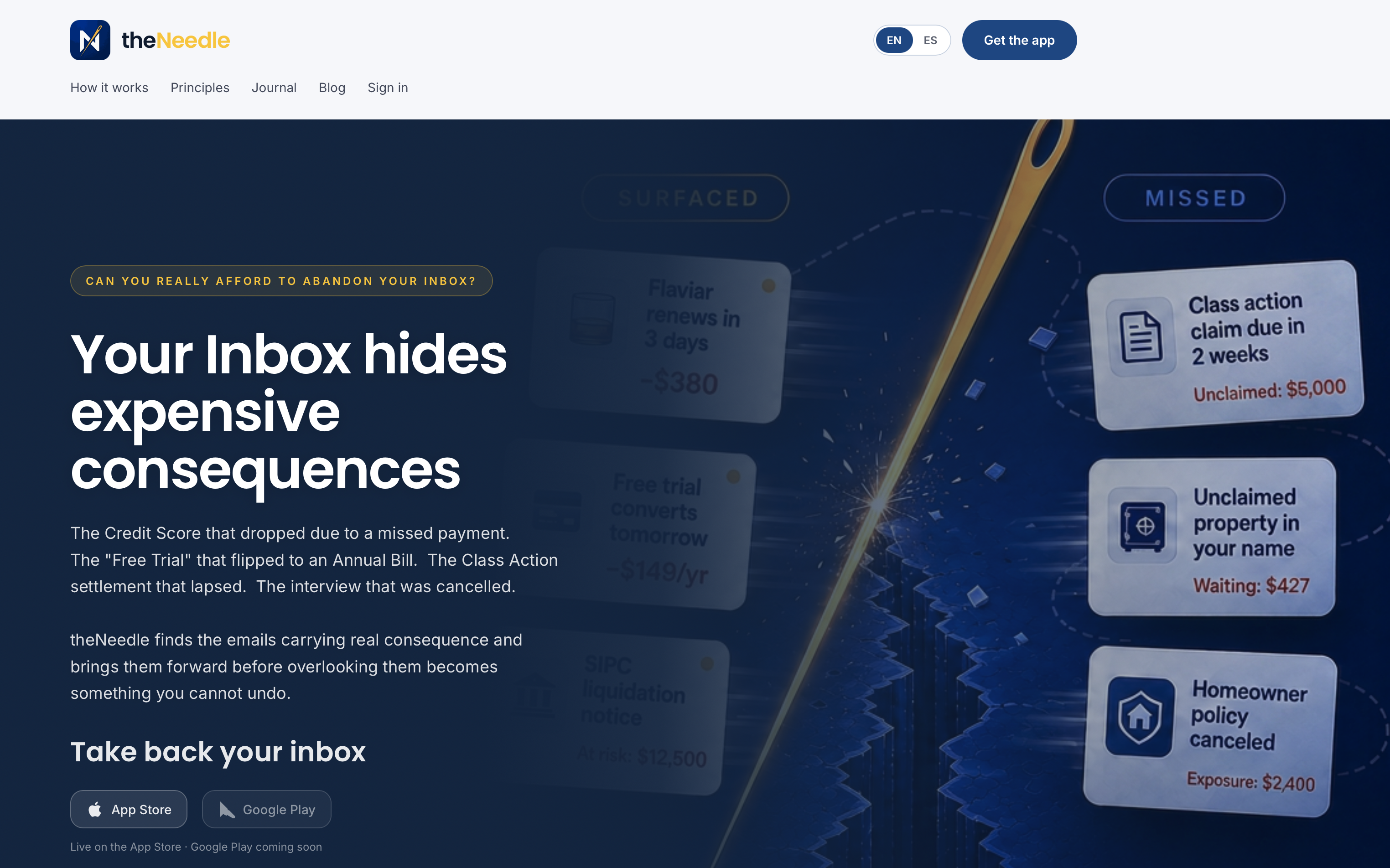
We built theNeedle for exactly the problem this guide describes: too many emails, not enough clarity on which ones carry real stakes. Connect your Gmail, Outlook, Microsoft 365, Yahoo, or iCloud account and let our consequence detection start surfacing deadline, financial, and legal messages instead of asking you to scroll through everything else first.
- Read our setup guidance before your first week to get the most accurate detection from day one.
- Explore theNeedle to see the full feature set, including overdue tracking and built-in unsubscribe.
FAQ
What makes a tool a true Hey email alternative?
A true alternative connects to your existing inbox, such as Gmail or Outlook, and surfaces messages with deadline, financial, or legal consequences rather than sorting by sender or volume. The focus is on consequence detection, not on replacing your email provider.
How is consequence-driven prioritization different from rules and filters?
Rules and filters sort by sender, keyword, or folder, which catches patterns but misses stakes, a routine sender can carry a high-consequence message. Consequence-driven tools look at the content and context of a message to flag deadlines, financial terms, or legal language regardless of who sent it.
Does theNeedle require switching email providers?
No, theNeedle connects to your existing Gmail, Outlook, Microsoft 365, Yahoo, or iCloud account through standard secure authentication, so your email address and provider stay the same. You can start a trial on the Monthly plan at $9.99 per month without migrating any data.
How often should I check email with a consequence-driven tool?
Research modeling interruption counts suggests starting with a review window of 30 to 60 minutes rather than checking continuously, since reducing check frequency can model a significant drop in interruptions across a workday. Adjust the window based on how your own week feels after a short trial.
Will a consequence-driven tool flag things incorrectly at first?
Yes, most tools need a short calibration period where sensitivity settings get adjusted based on false positives. Tracking flagged messages during your first week, and tuning accordingly, is the fastest way to get detection accuracy where you need it.