Consequence First Spark Alternatives for Busy Pros and Freelancers

If you’re choosing a Spark alternative because urgent, consequence-heavy emails keep slipping past you, look at consequence-driven apps first: tools built to flag deadlines, financial alerts, and contract risk instead of just sorting by sender or volume. A clear example in this category is a tool worth trying. The reasoning is simple: when your real risk is a missed deadline or a forfeited refund, the tool that finds that email matters more than one that just tidies your inbox.
TL;DR:
- Consequence-driven apps prioritize deadlines, financial alerts, and contractual messages over sender reputation, making them ideal for urgent, risk-sensitive needs.
- Support for multiple platforms varies significantly; verify native support for your devices before choosing a client to ensure seamless daily use.
- Privacy and security checks should include storage of credentials, encryption practices, and explicit AI data use policies, especially for apps analyzing inbox content.
- Automation offers convenience but increases privacy exposure; choose based on your willingness to trade control for smarter, less manual sorting.
- Trial periods should last at least a week, running the new client in parallel with your current one on a limited set of folders to detect any missed important messages.
Table of Contents
- What are the alternative approaches to Spark, and which fits you?
- How do you choose: decision criteria, privacy checks, and red flags
- Comparing the categories on what actually matters for urgent messages
- Where Spark holds up and where it falls short
- How to migrate and trial a new email client without losing anything
- What features actually matter when comparing email clients
- What subscriptions and free tiers actually cost you
- How platform support compares across alternatives
- How much these tools slow down your devices
- How the interface and daily experience differ
- What kind of support and community you can expect
- What security features matter beyond basic privacy
- Why consequence, not clutter, is the real inbox problem
- Try theNeedle for your consequence-driven inbox
- Sources
- FAQ
What are the alternative approaches to Spark, and which fits you?
Not every Spark alternative solves the same problem, so it helps to think in categories rather than brand names. Each one trades something for something else, and the right pick depends on what actually costs you money or sleep when it slips through.
- Consequence-driven apps surface messages tied to deadlines, financial alerts, or contracts first. Some tools are built specifically around this logic, making them a direct pick for anyone whose real risk is a missed due date or an overlooked refund window.
- Focused-inbox clients cut down visual noise by separating “important” from “other,” but their importance signal is usually based on sender history, not consequence, so a first-time deadline email from a new client can still get buried.
- Rules and filters-first clients give you granular control if you’re willing to build and maintain the logic yourself; powerful, but only as good as the rules you remember to write.
- Triage assistants and virtual email assistants hand off sorting to a human or hybrid service, useful when you can delegate but less useful if you need instant visibility yourself.
- Minimal or snooze-first clients are built for calm, not urgency. They’re pleasant to use day to day but weaker at catching the one email that actually needs action today.
Most people land in more than one category depending on the week. The question is which one covers your worst-case scenario, not your average day.
How do you choose: decision criteria, privacy checks, and red flags
Picking a Spark alternative isn’t just about interface preference. A few concrete checks will tell you more than a week of casual browsing.
- Priority logic: does the app rank by deadline, financial stakes, or contract language, or only by sender frequency?
- Integrations: confirm support for Gmail, Outlook, Microsoft, Yahoo, and iCloud if you manage more than one account.
- Notification controls: can you separate urgent alerts from routine ones, or does everything ping the same way?
- Snooze and follow-up tracking: does the app remind you when a sent message goes unanswered, or is that on you?
- Search and triage speed: how fast can you find one email among thousands when it matters?
Privacy deserves its own pass. Security researchers advise checking whether an app stores your credentials in a device keychain or on provider servers, since device-level storage generally carries less exposure. The same guidance cautions that an “AI-powered” label often implies your content gets reused for training unless the provider explicitly says otherwise.
During any trial, ask the provider directly: how does it detect a deadline-bearing email, can you limit access to specific folders or senders, and what does support look like once the trial ends? Red flags include a mandatory full mailbox export before you’ve seen the product work, vague language around AI or data use, and no visible trial or opt-out path.
Pro Tip: Run any new client in parallel with your current one for a week before switching fully, so you can catch anything it misses while the stakes are still low.
Comparing the categories on what actually matters for urgent messages
Strip away brand names and the real differences between Spark alternatives come down to six things: who they’re built for, how they decide what’s urgent, how they treat your data, how much automation they offer, how you can try them, and what they cost.
- Best for: consequence-driven apps fit solo professionals and freelancers with financial or contractual exposure; focused-inbox clients fit people mainly bothered by clutter; rules-first clients fit anyone willing to build their own logic; triage assistants fit people with the budget to delegate; minimal clients fit people who just want fewer notifications.
- Priority approach: consequence-driven tools rank by deadline, financial, or contract signals; focused-inbox tools rank mostly by sender reputation and past behavior; rules-first tools rank by whatever conditions you set; triage assistants apply human judgment; minimal clients often skip ranking entirely in favor of a clean, chronological view.
- Privacy and data handling: this varies more by individual provider than by category, which is exactly why the checklist above matters more than the label on the box. A consequence-driven app that reads message content for prioritization should be explicit about what it stores and for how long.
- Automation and rules: rules-first clients offer the most granular control but the highest setup burden; consequence-driven apps automate the judgment call itself, so there’s less to configure but less to fine-tune too; minimal clients offer the least automation by design.
- Trial and availability: most categories now offer a free trial period, though the length and what’s included during it differ enough to check before committing.
- Cost model: subscription pricing dominates across categories, usually with a free or trial tier gating premium features like advanced prioritization or unlimited accounts.
The practical trade-off is this: more automation usually means the app is reading more of your content to make decisions, so automation power and privacy exposure move together. Delegated triage trades control for convenience, which works until the one week you needed to see something yourself. None of these trade-offs are wrong, they just need to match what you’re actually risking when an email gets missed.
Where Spark holds up and where it falls short
Spark built its reputation on a clean, fast interface and genuinely useful team features like shared drafts and delegated inboxes, which is why it still has a loyal following among people who manage email collaboratively. Its smart inbox separates personal and newsletter-style mail reasonably well, and its search is quick.
Where it tends to fall short is precisely the problem this article is about: Spark’s importance signals lean on sender history and message type, not on consequence. A one-off email from a new landlord about a lease deadline, or a one-time financial alert from an unfamiliar sender, doesn’t have the track record Spark’s algorithm rewards, so it can land in the same tier as a newsletter. For people managing multiple time-sensitive relationships at once, that gap is the whole reason to look elsewhere.
How to migrate and trial a new email client without losing anything
Switching email tools feels riskier than it is if you do it in order. Start by connecting one account, not all of them, so you can watch how the new client behaves before committing your whole workflow to it.
Preserve your existing labels and folders rather than starting from a blank structure. Most clients import these automatically, but it’s worth confirming nothing silently dropped during the connection step. Then test your rules: send yourself a few sample emails that mimic a deadline, a financial alert, and a routine newsletter, and see whether the new client actually sorts them the way you expect.
Give the trial real time. Testing on a limited folder set and running the new client in parallel with your old one for at least a week is enough to catch anything it misses before you fully migrate, rather than finding out the hard way once you’ve deleted the old setup.

What features actually matter when comparing email clients
Beyond first impressions, a handful of features determine whether a client earns a permanent spot on your phone. Priority or important-first sorting is the obvious one, but the mechanism behind it matters more than the label: sender-based sorting and consequence-based sorting produce very different results for the same inbox.
Snooze functions are near-universal now, but the useful distinction is whether snoozed emails resurface with context or just dump back into your inbox unranked. Rules and filters remain the backbone of manual control for anyone who wants to build their own system, though they require upkeep as your correspondents and obligations change.
Integration breadth is often overlooked until it isn’t: if you manage Gmail and Outlook accounts side by side, confirm both are natively supported rather than bridged through a workaround. The features that sound similar on a landing page often behave very differently once your actual inbox is loaded in.

What subscriptions and free tiers actually cost you
Most Spark alternatives follow a familiar pattern: a free or limited tier to get you in the door, then a subscription for the features that actually solve your problem. The free tier usually covers basic sorting and a single account; the paid tier is where prioritization logic, multiple accounts, and advanced automation live.
theNeedle prices its subscription at $9.99 per month or $99.99 per year, which is worth comparing against how much a single missed deadline or overlooked refund actually costs you. A free tier is fine for testing, but the real cost comparison is between a subscription price and the financial risk of the exact problem you’re trying to solve.
How platform support compares across alternatives
Platform coverage still varies more than most comparison charts admit. Some Spark alternatives are strong on iOS and macOS but thin on Windows, a legacy of their origin as mobile-first products. Others built for enterprise teams lean heavily toward Windows and Android, with a lighter mobile experience as an afterthought.
If you split your time across a work laptop and a personal phone, check native support for both operating systems you actually use rather than assuming feature parity across platforms. A client that’s excellent on iPhone can be a stripped-down experience on Android, and the gap is rarely obvious from a features page alone. Cross-platform consistency matters more the more devices you check email from during a given day.
How much these tools slow down your devices
Resource usage rarely makes it onto a comparison list, but it affects daily use more than most features do. Clients that sync large mailboxes locally, or that run continuous background processes to detect priority signals, can noticeably affect battery life on mobile and memory usage on desktop.
Rules-first clients tend to be lighter, since they’re mostly executing simple conditional logic rather than analyzing content. Consequence-driven and AI-assisted tools do more work per email, since they’re evaluating context rather than just applying static rules, which can mean slightly heavier processing in exchange for smarter sorting. Neither approach is inherently wrong, but if you’re on an older device or a limited data plan, it’s worth testing a client for a few days before deciding it earns a permanent spot on your home screen.
How the interface and daily experience differ
Interface design shapes how much friction you feel every time you open your inbox, and the differences between categories are real. Minimal and snooze-first clients tend to favor clean, uncluttered layouts built around one primary action at a time. Rules-first clients often expose more settings and menus up front, which power users appreciate and everyone else finds intimidating.
Consequence-driven apps face a specific design challenge: they need to surface urgency without creating alarm fatigue. A client that treats every third email as critical trains you to ignore its alerts, which defeats the purpose. The better implementations in this category limit themselves to genuinely high-stakes signals, deadlines, financial alerts, contract language, rather than flagging anything that merely looks important. That restraint is itself a design decision worth weighing when you compare products side by side.
What kind of support and community you can expect
Support quality tends to track company size in predictable ways. Larger, established clients usually have searchable help centers, in-app chat, and active user communities on forums or social platforms where you can find answers to common setup questions. Smaller or newer tools often rely more on direct email support and smaller, more responsive teams, which can mean faster personal replies but less public documentation to search through first.
Neither model is strictly better. A large community is useful when you hit a common problem someone else has already solved; direct support is useful when your issue is specific to your setup. If you manage multiple accounts across different providers, a searchable knowledge base focused on integration quirks is often more valuable day to day than a large but generic user forum. Worth checking before you commit: whether support channels are staffed on weekends, since email problems rarely wait for business hours.
What security features matter beyond basic privacy
Privacy and security overlap but aren’t identical. Beyond checking where your credentials are stored, look at whether a client offers encryption for data in transit and at rest, and whether it supports two-factor authentication on top of your email provider’s own login security.
Two-factor authentication on the client itself, not just on your Gmail or Outlook account, adds a meaningful layer if your phone or laptop is ever lost or stolen. Encryption standards are harder to verify from the outside, but a provider’s willingness to state its approach plainly, rather than gesturing vaguely at “bank-level security,” is itself a useful signal. Security-minded professionals should treat any vague reassurance as a prompt to read the actual policy rather than take the marketing at face value.
None of this replaces the basic hygiene of a strong, unique password and keeping your recovery options current. But for a tool that reads your inbox to prioritize consequential messages, the security bar should be at least as high as the email provider it connects to, not lower.
Why consequence, not clutter, is the real inbox problem
The average worker reportedly receives 117 emails a day, a volume that makes manual triage unreliable no matter how organized you are. Most tools respond by sorting for cleanliness. Some tools differ by looking for tangible consequences, deadlines, financial alerts, contractual language, and treating those as the signal that actually matters. Glen Bover’s writing on attention and workplace focus, published on theNeedle’s blog, grew out of watching how easily consequential messages get lost in volume rather than ignored on purpose.
— Glen Bover
Try theNeedle for your consequence-driven inbox
If the categories above tell you anything, it’s that automation and control are usually a trade-off. One approach is to automate the judgment call itself, surfacing overdue, urgent, and financially significant messages without the need to write rules. Such tools may also flag unhandled replies and include built-in unsubscribe features, so noise reduction and urgency detection complement each other.
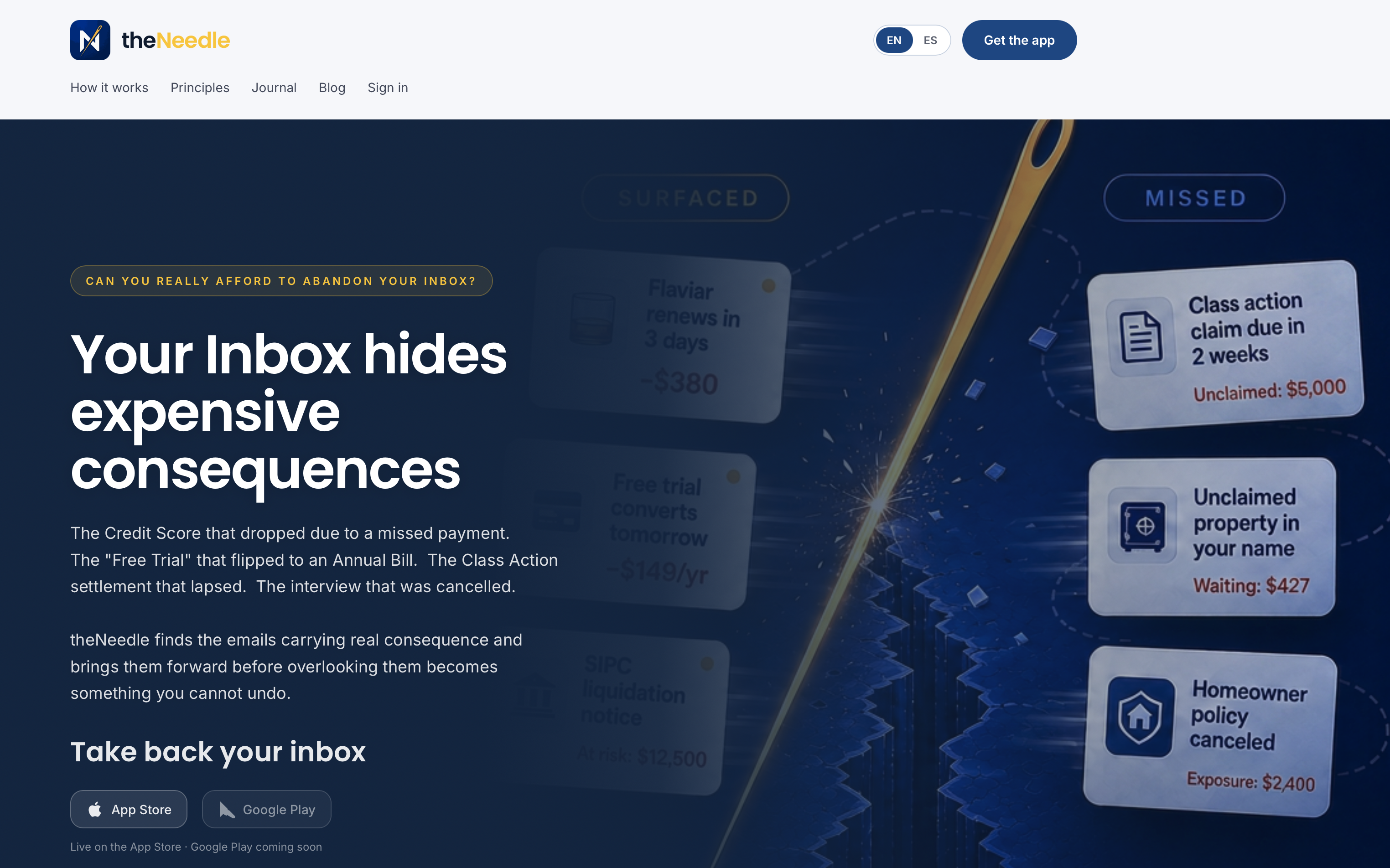
Start with theNeedle’s monthly plan or see the full picture on the main product page. A simple first week: connect one inbox, turn on consequence-based filtering, and watch what surfaces over seven days before deciding whether to add a second account.
FAQ
What is the best type of Spark alternative for missed deadlines?
A consequence-driven app is the strongest fit, since it ranks messages by deadline, financial, or contract risk rather than sender history or volume. theNeedle is built specifically around this approach and is a direct option to try if missed deadlines are your main concern.
How much does theNeedle cost compared to a free email client?
theNeedle charges $9.99 per month or $99.99 per year, with no separate free tier listed on its site. Weigh that against the cost of a single missed deadline or overlooked financial alert, which is the exact risk the subscription is meant to reduce.
Is it safe to give an email app access to my inbox?
Safety depends on the specific app’s data practices, not on email access in general. Security guidance recommends checking whether an app stores credentials in your device’s keychain or on provider servers, and reading its policy on whether message content is used to train AI models before granting access.
Do Spark alternatives work across Windows, macOS, iOS, and Android?
Platform support varies widely by category and product, so coverage should be confirmed directly rather than assumed. Some tools are strongest on mobile with lighter desktop support, while others favor Windows and Android over a fuller mobile experience.
How long should I trial a new email client before switching fully?
A common approach is running the new client in parallel with your current one for at least a week while testing on a limited folder set. This lets you catch any missed or misfiled messages before fully migrating your inbox.