Best Inbox Zero Apps for Professionals: Deadlines Over Empty Inboxes

We recommend theNeedle, because it ranks your mail by consequence, surfacing deadlines, financial alerts, and unhandled replies first so you spend less time inside your inbox. It suits busy professionals juggling several accounts most. Workers can receive a heavy volume of email, and weighing every message by hand can be difficult.
TL;DR:
- If unread backlog dominates, start with a bulk cleanup and unsubscribe pass, then add a maintenance tool; cleanup alone only resets the clock.
- Passive filters suit readers who mainly want newsletters, promotions, and receipts separated, while AI assistants fit people who will review suggested replies before sending.
- Test one account and one week of messages before enabling broad automation, then check missed critical senders, reminder delivery, and email time on day seven.
- Before connecting more inboxes, confirm the app uses OAuth, explains data storage and sharing, and lets you revoke access through your email provider.
- TheNeedle charges $9.99 monthly or $99.99 annually, with a free trial; compare extra tools, setup time, and switching costs before committing.
Table of Contents
- Which inbox zero app fits your situation?
- How do inbox zero apps actually work?
- How do you choose the right app without chasing every feature?
- What does a first-week setup look like?
- What should you check before giving an app access to your email?
- Why can you trust this recommendation?
- What should you look for in an interface, integrations, and support?
- How long does it take to reach Inbox Zero?
- What does an inbox zero app really cost?
- Is Inbox Zero even the right goal?
- Ready to stop missing the emails that matter?
- FAQ
- Sources
Which inbox zero app fits your situation?
Think of this as a map from your problem to an approach. We list ours first, then the other approaches you will meet while shopping, described by type rather than by vendor, because the type tells you more about how the tool will behave in your week.
- theNeedle (consequence-first prioritization). Best when your real fear is the missed deadline, the unanswered client message, or the overlooked refund. We detect emails with legal, financial, or deadline consequences and surface overdue, urgent, and unhandled messages first. A built-in unsubscribe helper handles persistent senders, and one-at-a-time focus keeps you from drowning in a list. Pick this if a single missed message costs you more than a cluttered inbox does.
- AI assistant approach. These tools actively triage for you: they summarize threads, draft replies, and nudge follow-ups. They fit teams and individuals who want a helper doing visible work all day. Pick this if you enjoy delegating and will review the drafts.
- Passive filter and noise-reduction approach. These sit quietly in front of your inbox and sort newsletters, promotions, and receipts away from people-to-people mail. Pick this if you want low-touch relief and rarely face urgent consequences by email.
- Bulk-cleanup and unsubscribe approach. These tools sweep thousands of old messages and mass-unsubscribe you from lists. Pick this if your backlog is the whole problem and you need a fast reset before building any habit.
Pricing across these approaches falls into broad shapes. Passive filters and cleanup utilities tend to sit at the entry level, often with a free tier. AI assistants usually carry the highest subscriptions, especially for team plans. Consequence-first tools sit in the middle. Ours is $9.99 per month or $99.99 per year through our monthly plan page, with a free trial period before you pay.
Most readers need one primary approach and, at most, one supporting utility. If you want a broader vendor-by-vendor comparison, our roundup of email management apps goes wider.
How do inbox zero apps actually work?
Every app in this category makes the same basic promise, fewer decisions per message, but the mechanism behind that promise changes what you get and what slips through.
Triage engines: rules, learning, and consequences
A rule-based filter does exactly what you tell it: anything from this sender goes to that folder. It is predictable and transparent, and it is blind to anything you did not anticipate. A learning engine watches what you open, archive, and reply to, then guesses what matters. It adapts, but it can mistake your habits for your priorities, burying an important message from someone you rarely answer.
Consequence detection asks a different question: what happens if this message is ignored? A renewal notice with a date, a payment alert, or a contract request gets flagged because of what it says, not who sent it or how often you click it. That is the approach we built, and it is why a message from a stranger can outrank a thread from a colleague.

AI features, and where they help or add risk
Summaries save time on long threads. Suggested replies save time on routine answers. Follow-up reminders catch messages you replied to that never got an answer back. The risk is trust: an automatically drafted reply sent without reading it can commit you to something you did not intend, and a summary can flatten the one sentence that mattered. Use AI to shorten your reading, not to replace your judgment on anything with money or a deadline attached. Google’s Gemini is one example of the kind of AI capability that email assistants increasingly build on.
Integrations that anchor the habit
Inbox Zero holds when email stops being your to-do list. Tools such as Todoist capture tasks from email and organize them into views like Today and Upcoming, with recurring tasks and templates for routines. Trello can capture email details into an Inbox and move them across boards with automation. Evernote keeps email-related notes, tasks, and schedules in one searchable place. Our guide on turning emails into tasks walks through a consequence-first version of this handoff.
Data access: OAuth versus passwords
Well-built apps request access through OAuth, the sign-in flow your provider controls, so you can grant and revoke permission without ever sharing your password. Apps that ask for your raw password are a design choice you should treat as a warning. Developers choose OAuth because it limits what an app can do and lets you cut access in one click.
- Rule-based: predictable, but only as smart as your last rule.
- Learning: adaptive, but can mirror your bad habits.
- Consequence detection: judges content, so it catches the stranger’s deadline.
- AI features: fast to read, slow to trust without review.
Pro Tip: Test any triage engine on a small slice of mail, such as one week of messages, before you switch on sweeping automations like auto-archive.
How do you choose the right app without chasing every feature?
Start with the job, not the feature list. A consistent framework keeps you from buying the most impressive demo instead of the tool that fits your week.
Here is the checklist we use, in order of importance:
- Job to be done. Name the one outcome you need: never missing a deadline, clearing a backlog, or answering faster. If you cannot say it in one sentence, no app will fix it.
- Automation level. Decide how much you want done for you. Some people want a tool that acts; others want one that only points.
- Onboarding time. If setup takes more than an evening, the tool competes with your real work. Favor apps that deliver value in the first session.
- Integrations. Confirm it connects to your providers (Gmail, Outlook, Yahoo, iCloud) and to the calendar and task tools you already use.
- Privacy and security. Check how access is granted, what is stored, and who sees it. We cover this in its own section below.
Three common profiles
The busy professional with deadline risk. You manage multiple inboxes, and the cost of one overlooked message is real money or a damaged relationship. A consequence-first approach fits, because it ranks by stakes rather than by recency. This is who we built theNeedle for.
The keyboard-driven power user. You process mail quickly, live in shortcuts, and want speed above all. A fast client with strong rules or an assistant layer suits you, because you already have the discipline and need the throughput.
The backlog cleaner. You have tens of thousands of unread messages and no system. Start with a bulk-cleanup and unsubscribe pass, then add something that keeps the inbox from refilling. Cleaning without a maintenance layer only resets the clock.
Your first-week trial checklist
Run the same four tests on any app you consider:
- Connect one account only, not all of them.
- Run the triage on recent messages and see whether the ones you would have flagged by hand are the ones it flags.
- Verify that follow-up reminders actually fire on a message you sent and never got answered.
- Time yourself. Compare minutes spent in email on day one against day seven.
What to watch for
Be wary of any app that asks for your password instead of using OAuth, that offers no plain statement of what it stores or shares, or that does not connect to the calendar or task tools you rely on. A tool that cannot hand a deadline to your calendar leaves the hardest step to you. If an app hides its data policy, treat that as your answer.
For a deeper walk through organizing what the tool surfaces, our guide on how to organize your email inbox pairs well with this framework.
What does a first-week setup look like?
A good system is built in short, repeatable steps. This seven-day plan works with any app, and we note where it maps to ours.
- Audit your accounts. List every inbox you check, including old ones that still receive bills or account alerts. Forgotten addresses are where consequential mail hides.
- Back up what matters. Export or flag anything you cannot lose, such as contracts, receipts, and tax documents, before you start archiving at scale.
- Name your critical senders. Write down the ten people or organizations whose messages you must never miss: your bank, your landlord, your biggest client, your accountant. Use this list to test whatever triage you turn on.
- Connect and tune. Connect one account, enable priority triage, and set basic snooze behavior. Unsubscribe from your highest-volume newsletters now, while the annoyance is fresh. In theNeedle, this is where our built-in unsubscribe helper earns its keep on persistent senders.
- Wire in follow-ups. Send deadlines to your calendar and actions to your task manager so the inbox stops doubling as a to-do list. Run a backlog-cleanup pass on old messages, then set a daily triage slot at the same time each day.
- Add the maintenance rhythm. Spend a short period on daily triage, a longer grooming session to catch what slipped, and regular checks of your rules and permissions.
Pro Tip: Run everything on a single account first. Once the rules behave the way you expect, roll them out to the rest, because a bad automation across five inboxes is five times the cleanup.
Daily triage matters more than an initial setup sprint. People rarely fail at Inbox Zero in week one. They fail in week six, when the habit lapses and the backlog quietly rebuilds. A consequence-first tool is a safety net for exactly that lapse, since the urgent messages still rise even on days you skip.
What should you check before giving an app access to your email?
Email holds your passwords resets, invoices, and private conversations, so access deserves a short, non-legal review before you click “allow.”
- Prefer OAuth. Authorize through your provider’s own sign-in screen. If an app asks you to type your raw email password, decline.
- Read the data statements. Look for plain language on what is stored, whether messages are read or only processed, and whether anything is shared with third parties. Vague answers are an answer.
- Look for recognized controls. Terms such as SOC 2 and encryption in transit and at rest signal that someone audited the practices. They do not guarantee safety, but their absence is worth a question.
- Use least privilege. Grant the narrowest permissions the app needs, and test on a single inbox before connecting the rest.
- Review access on a schedule. Once a quarter, open your provider’s connected-apps page and remove anything you no longer use.
Why can you trust this recommendation?
We would rather show you our reasoning than ask for blind trust, so here is what stands behind this article.
Glen Bover wrote this guide. We work on the specific problem of surfacing consequential email, so we are close to the category and have a stake in it. You should weigh our recommendation with that in mind and use the trial checklist above to verify it yourself.
What our product does is specific. theNeedle connects to Gmail, Outlook, Microsoft, Yahoo, and iCloud. It detects and prioritizes emails with deadlines or significant consequences, surfaces overdue, urgent, and high-priority messages, identifies replies that were never handled, and tracks opportunities such as credits or refunds. For readers with ADHD, it offers a one-at-a-time focus mode with consequence-based ranking, so you face one decision rather than a wall of them.
The premise comes from a simple observation about volume. The average worker receives 117 emails a day, and that number rises whether or not the important messages do. A tool that counts and sorts by volume leaves the hard judgment to you. A tool that asks what each message could cost you changes the question.
The quiet cost of email is not the time you spend reading it. It is the one consequential message you never saw.
We will not invent performance statistics for theNeedle here. What we can offer is a free trial and a method for testing it on your own mail. Treat our claims the way you would treat any vendor’s: promising until your own week proves them.
If you want the longer argument behind our approach, our explainer on inbox zero versus prioritization lays it out.
What should you look for in an interface, integrations, and support?
A few qualities can help determine whether you will keep using an app over time.
Interface. The best design shows you less. If opening the app produces another long list, it has reproduced your inbox with a new coat of paint. Look for a view that tells you what to do next and lets you act in a gesture or two. Check that it works on your phone, since many urgent messages arrive away from your desk.
Integration capability. Check the exact providers you use, then check the exits: does it hand deadlines to your calendar and actions to your task manager? An app that traps information inside itself adds a place to check instead of removing one. Some teams also move certain conversations out of email entirely, and platforms like Slack position real-time conversation as an alternative to email for those threads.
Customer support. Send one real question during your trial and see how long the answer takes and whether it is useful. Support you can reach during a trial is the support you may need later. For team-level workflows and automation, the partner guide on productivity strategies for teams offers a wider view.
Score each of the three from one to five during your trial. An app that wins on features but loses on support will cost you more than its price suggests.

How long does it take to reach Inbox Zero?
Plan on three stages rather than a single finish line.
The first session. Connect an account, unsubscribe from your loudest senders, and let triage rank what is left. You will not be at zero, but you will know where the urgent items are, which is the real relief.
Early on. With the setup playbook above, people may be able to clear their critical backlog, meaning anything with a deadline or a pending reply. Clearing every old, low-stakes message takes longer and matters less.
As the habit develops. Daily triage can become automatic, regular grooming catches stragglers, and the inbox can stay manageable instead of refilling. How fast you get here depends on your starting backlog, how many accounts you manage, and how consistently you keep the daily slot.
Published claims of “zero in a day” usually mean archiving everything, not handling it. Judge your own progress by whether you are still catching the important messages, not by the unread count.
What does an inbox zero app really cost?
The monthly price is only part of the bill. Count these before you commit.
Subscription. Compare monthly against annual billing. Ours is $9.99 per month or $99.99 per year, and you can start from our monthly plan page.
Add-on tools. If the app hands tasks to a separate manager or notes tool, factor in those subscriptions as well, since several of the options mentioned earlier have both free and paid tiers.
Upgrades and tiers. Some apps gate follow-up reminders, extra accounts, or team features behind higher plans. Ask what you would need to unlock on day one and what you would need in six months.
Your time. A cheap tool that takes an evening to configure and a weekend to trust costs more than it appears. Setup hours and the cost of a missed deadline both belong in the total.
Switching costs. If you leave, can you export your rules and data? An app that locks you in raises the price you pay later.
Add these up over a year, then compare against what a single missed deadline or lapsed refund would cost you. For many professionals, that comparison settles the question quickly.
Is Inbox Zero even the right goal?
Inbox Zero was never really about an empty screen. It was about getting your attention back from email, and an empty inbox is only one way to measure that. I have seen people hit zero every night and still miss the one message that mattered, because they treated every email as equal.
For busy professionals, I think consequences are the better yardstick. A deadline, a payment alert, or a client waiting on your answer deserves your first minutes; a promotional offer does not deserve any. A tool that ranks by stakes lets you leave a few harmless messages unread without anxiety. Try the setup playbook above, run the trial checklist on a single account, and see whether the quiet in your inbox holds for a week.
— Glen Bover
Ready to stop missing the emails that matter?
We built theNeedle for people who cannot afford to overlook the one message that carries a deadline, a payment, or a promise. Instead of asking you to empty your inbox, we show you what could cost you if ignored.
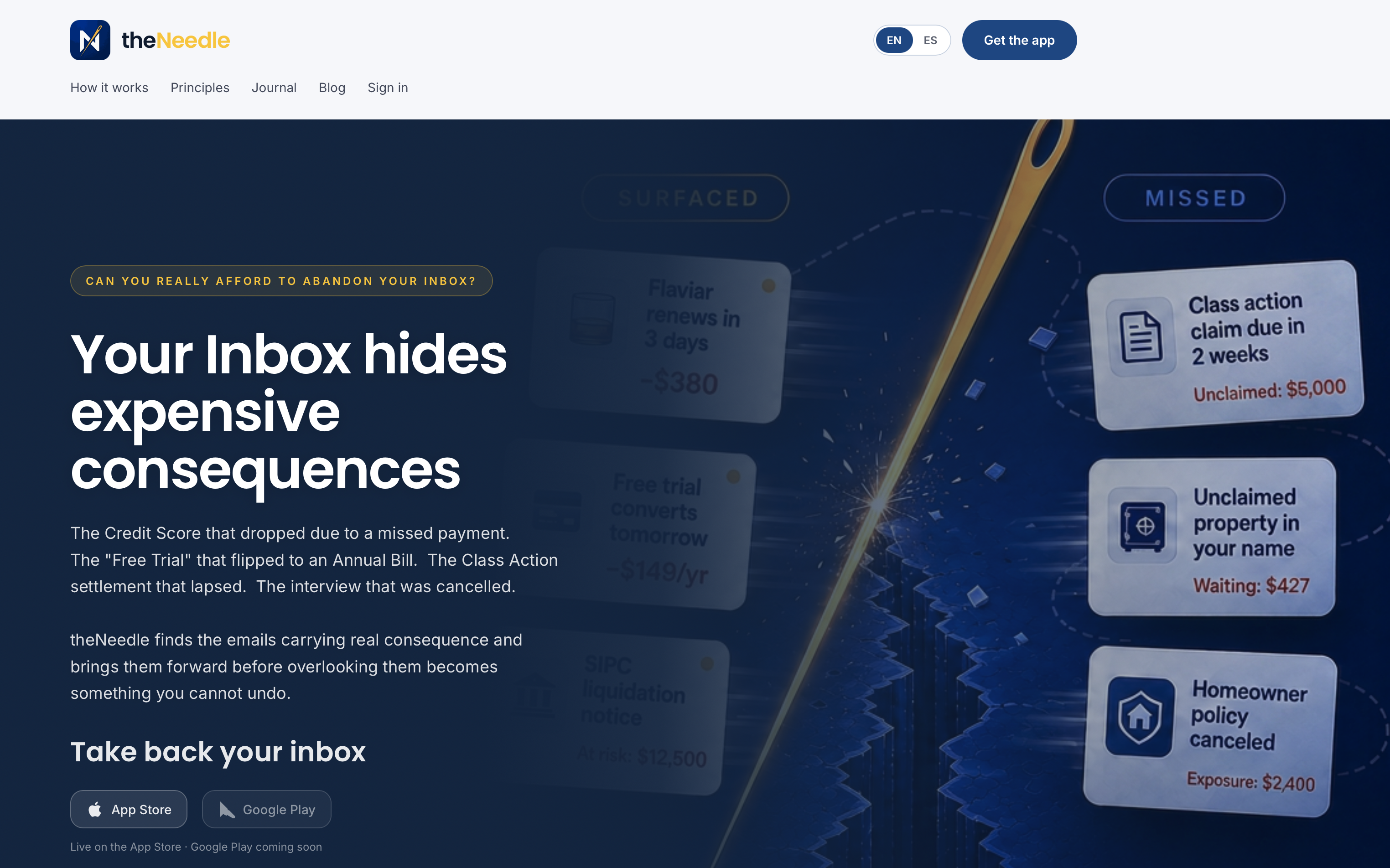
- Consequence-driven prioritization: we surface emails with legal, financial, or deadline stakes ahead of everything else.
- Overdue and urgent focus: overdue, urgent, and high-priority messages rise to the top, with unhandled replies flagged.
- Opportunity tracking: credits, refunds, and similar items are tracked so they do not expire unnoticed.
- Built-in unsubscribe: persistent senders get handled without leaving the app.
- Broad connections: Gmail, Outlook, Microsoft, Yahoo, and iCloud all work.
We offer monthly and annual plans, and you can begin with a free trial period. When you sign up, you connect an account, and our triage ranks what you have by consequence. The first-week playbook above maps directly onto this: connect one inbox, test the ranking against your list of critical senders, then add follow-ups and the rest.
Start your free trial of theNeedle and see which messages deserve your attention first.
FAQ
What is the best app for reaching Inbox Zero?
The best app depends on your goal. We recommend theNeedle for busy professionals because it ranks email by consequence, surfacing deadlines and financial alerts first. If your main problem is a huge backlog, a bulk-cleanup tool is a better first step.
How long does it take to reach Inbox Zero?
Most people can clear their urgent backlog within the first week using a structured setup. Reaching a habit that holds takes closer to a month. Published claims of instant results usually mean archiving everything rather than handling it.
Is it safe to give an app access to my email?
It can be, if you check a few things first. Choose apps that use OAuth rather than asking for your password, read what they say about storage and sharing, and test on one inbox before connecting more. Review connected apps in your provider settings regularly.
Do I need Inbox Zero, or just prioritization?
Many busy professionals are better served by prioritization. Reading every message matters less than never missing the ones with consequences. If your inbox causes anxiety even when it is tidy, a consequence-first approach is worth trying.
Sources
- Todoist | A To-Do List to Organize Your Work & Life
- Capture, organize, and tackle your to-dos from anywhere
- Best Note Taking App - Organize Your Notes with Evernote