Gmail Productivity Apps: Prioritize Consequences, Not Inbox Zero

The most effective fix for a chaotic inbox is not another inbox-zero ritual, it’s consequence-first prioritization: sorting by what happens if you miss a message, not by sender or subject line. From there, pick the category that matches your job (AI drafting, consequence-prioritizers, task integrators, or focus blockers), run a two-week trial, and judge it by what it catches.
TL;DR:
- During a two week trial, test whether the tool surfaces buried financial or legal deadlines, then track acknowledgment time and missed deadline incidents.
- Review requested OAuth permissions before installation, favor the narrowest access that supports the feature, and reject tools that cannot explain their data practices clearly.
- Task integrations matter most when teams need flagged emails converted into tracked work items, while Workspace users can summarize mail with native Gemini.
- People managing several inboxes should prioritize unified notifications and per account filters, preventing client messages from disappearing beneath unrelated personal newsletters.
- Keep only three to five tools active and install one at a time, using a full week to judge whether each saves time.
Table of Contents
- Top Picks by Use Case: Which App Category to Try First
- Categories of Gmail Productivity Apps and Integrations Explained
- How to Choose the Right Gmail Productivity App: a Compact Decision Checklist
- Install, Configure, and Get Immediate Wins: Practical Setup Tips
- Why Consequence-First Inbox Management Matters: a Practitioner View
- Which Roles and Workflows Benefit Most from This Approach
- Try theNeedle: a Consequence-First Way to Protect What Matters
- FAQ
- Sources
Top Picks by Use Case: Which App Category to Try First
The fastest way to narrow your search is to start with your actual problem, not a feature list. Each category below solves a different kind of email pain, and most of us only need one or two at a time.
If you spend your mornings writing the same three replies in different words, drafting and reply automation tools save the most time. Setup usually takes under 15 minutes since most plug directly into Gmail’s compose window, and pricing tends to follow a freemium model with a paid tier once you exceed a monthly draft limit.
If your real problem is missing the one email that actually matters among dozens that don’t, automates financial tracking by parsing receipts and subscription charges are worth testing before anything else. These tools differ from inbox-zero apps in a specific way: inbox zero optimizes for an empty inbox, while consequence-first prioritization optimizes for not missing the email with a deadline, a refund window, or a contract term attached to it. During a trial, test whether the tool actually surfaces a financial or legal deadline buried on page three of your inbox, not just whether it sorts by sender.
If you’re juggling a work account, a freelance account, and a personal one, multi-account managers solve a different problem entirely. Prioritize tools with unified notifications across accounts and per-account filtering, so a client email doesn’t get buried under newsletter noise from a different inbox.
If your team lives in a project tool, task integrators convert flagged emails into tracked work items automatically, which matters more than any inbox view. The ClickUp integration guide documents how these connections typically work: an email triggers a task creation, which syncs a notification to your project board and removes the need to re-type the request somewhere else.
Budget-conscious readers have free-first options in every category, though the tradeoffs are real.
- Free tiers often cap automation volume or limit you to one connected account.
- Privacy practices vary widely among free add-ons, so scope review matters more, not less, when the price is zero.
Categories of Gmail Productivity Apps and Integrations Explained
Before you install anything, it helps to know what each category is built to do and where it runs into limits. Gmail’s native features have closed some gaps that third-party tools used to fill, so the right pick depends on how deep that gap still runs for your workflow.
Task and project add-ons turn an email into a tracked action the moment it lands. A client request triggers a task, a deadline email triggers a due date, and the original thread stays linked so you’re not hunting for context later. The ClickUp integration roundup describes this pattern across several popular add-ons: task creation, notification syncing, and attachment handling all reduce the context switching that comes from managing email and project work in separate tabs.
Scheduling, snooze, and follow-up tools reduce cognitive load by taking a decision off your plate the moment you read a message. Instead of deciding right now whether to reply, you snooze it to tomorrow morning or set an automatic follow-up if no one responds in three days. The mental tax of an open email sitting in your inbox disappears once it’s scheduled rather than simply ignored.
AI drafting and summarization is where native Workspace features and third-party assistants genuinely overlap, and the right choice depends on where you already work. Google Gemini, integrated directly into Workspace, can scan and summarize inbox content and surface action items without leaving Gmail, which cuts triage time for professionals who already live inside Docs, Sheets, and Drive. Third-party AI assistants still fill specialized gaps, like drafting in a very specific brand voice or summarizing threads from inboxes outside the Google ecosystem, but for anyone working primarily in Workspace, the native option usually wins on integration depth alone.
Inbox focus and distraction-limiting extensions strip visual clutter, hide the promotions tab, or limit how often new mail refreshes on screen. These deliver quick wins for attention management but don’t solve prioritization. A clean-looking inbox can still bury a consequential email behind twenty harmless ones.
Interface overhauls versus side-panel add-ons come with a stability tradeoff worth knowing before you commit. Extensions that modify Gmail’s actual interface, turning your inbox into a Kanban board or compact list view, can offer a dramatically different visual experience, but Google’s developer documentation notes that extensions modifying the Gmail DOM are more fragile and break more often when Gmail updates its interface. Side-panel Workspace add-ons, by contrast, run in a contained space and tend to survive those updates without breaking.
Automation and connectors in the Zapier style handle the cross-app plumbing that no single add-on covers. Zapier’s own roundup recommends these for patterns like saving attachments straight to Drive or creating a task in a separate project tool the moment a specific label gets applied. The same source makes a point worth repeating here: most people get more value from 3 to 5 well-chosen tools than from stacking ten add-ons that never get fully configured.

How to Choose the Right Gmail Productivity App: a Compact Decision Checklist
Choosing well comes down to a handful of questions you can answer in the time it takes to read a product page. Here’s the order that matters most.
- Check the OAuth scopes requested at install. A tool asking for full inbox access when it only needs to read subject lines is asking for more than it needs, and Google’s own scope documentation recommends favoring the least-permissive scope available for the feature you actually use.
- Check integration depth with tools you already use, particularly Calendar, Drive, and Tasks, since a disconnected add-on just becomes one more tab to check.
- Compare the pricing and licensing model, since freemium, per-seat, and flat subscription tiers scale very differently if you add team members later.
- Weigh the learning curve against admin controls, especially for a team rollout where someone has to manage permissions for everyone else.
- Cap yourself at 3 to 5 active tools. Zapier’s testing notes point to this same range as the practical ceiling before tool fatigue erases the time savings you installed the tools to get.
Before committing past a trial, ask the tool a few direct questions: what exact data does it store, can you export your settings if you leave, and does it degrade gracefully if Gmail changes its interface. A vendor that can’t answer the data question clearly is a red flag worth taking seriously.
Pro Tip: Install one tool at a time and use it for a full week before adding a second, so you can tell which one is actually responsible for the time you’re saving.
Install, Configure, and Get Immediate Wins: Practical Setup Tips
Setup speed matters more than most people expect, since a tool that takes an hour to configure rarely survives past day three. A tight first 48 hours sets the tone for whether a new tool sticks or gets abandoned in your extensions list.
- Review the permission screen before you click allow. Compare the scopes requested against Google’s developer documentation on what each scope actually grants, and decline anything broader than the feature requires.
- Restrict scopes further after install if the option exists, since many tools let you narrow access in settings once initial setup is done.
- Run a first triage pass on your existing backlog so the tool has real data to sort, not just new mail arriving going forward. Our own cleanup walkthrough covers a 15 to 30 minute version of this pass if your backlog has piled up.
- Turn on one automation, not five, so you can tell what it’s actually doing to your inbox.
- Schedule a five-minute check-in after one week to see what got caught, what got missed, and what needs adjusting.
If you manage multiple accounts, separate Chrome profiles per account prevent cross-account notification chaos, and most extensions let you set per-account filtering so a client’s urgent email doesn’t get drowned out by a personal newsletter arriving in a different inbox. On the Gmail side, pairing labels with filters, turning on native snooze, and linking Tasks and Calendar directly from a message thread cover a surprising amount of ground before any third-party tool gets involved. Our do-not-disturb setup guide walks through keeping interruptions low while still surfacing the handful of messages that actually need your attention.
The urgency behind all of this is numeric, not anecdotal. The average worker reportedly receives around 117 emails a day, which makes manual triage a genuinely losing game no matter how disciplined you are about checking your inbox.
Why Consequence-First Inbox Management Matters: a Practitioner View
Inbox zero treats an empty inbox as the goal. Consequence-first prioritization treats a different question as the goal: what happens if you miss this specific message? A promotional email and a contract deadline look identical in a standard inbox view, sorted by time received, but they carry wildly different stakes.

That distinction is the premise behind prioritizing emails by consequence rather than by volume or sender rules. We built theNeedle around detecting messages tied to deadlines, financial alerts, or contractual consequences, specifically because those are the emails that cause real damage when they slip past you, not the ones that simply pile up. The product also supports multiple connected inboxes at once and includes built-in unsubscribe tools for senders. For a deeper walkthrough of how the 117 emails a day problem plays out in practice, our blog covers the gap between clearing an inbox and actually protecting yourself from what’s inside it.
Which Roles and Workflows Benefit Most from This Approach
In our experience advising on inbox workflows, the people who benefit most from consequence-first tools share one trait: their email volume outpaces their ability to read everything carefully, every day, without exception. That describes busy professionals managing client relationships, freelancers juggling several inboxes for different contracts, and anyone whose work runs on deadline-driven correspondence like legal notices, invoices, or renewal windows.
During a 14 to 30 day trial, measure three things: time-to-acknowledge on messages that matter, the count of missed-deadline incidents, and total time spent inside your inbox per day. Expect the first two to improve noticeably within the first two weeks. Total inbox time often takes longer to drop, since old habits around checking email reflexively tend to outlast the tool itself.
— Glen Bover
Try theNeedle: a Consequence-First Way to Protect What Matters
If missing a deadline or a refund window has cost you before, the fastest way to test whether consequence-first triage works for you is to run it against your own inbox for a couple of weeks.
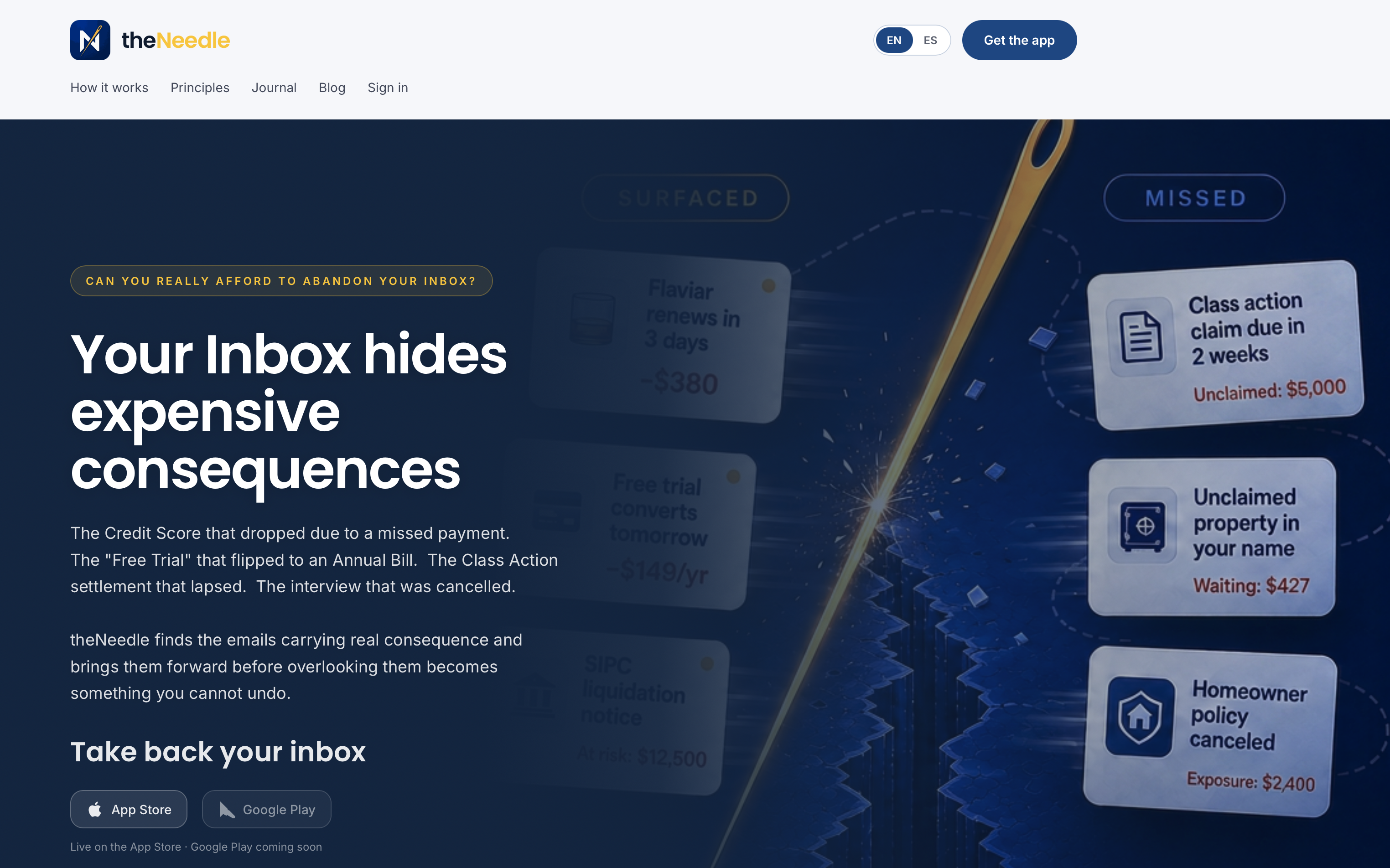
During a theNeedle trial, focus on three things: how accurately consequence detection flags a real deadline or financial alert buried in your backlog, how the multi-inbox view handles accounts you’ve connected together, and whether the built-in unsubscribe tool actually reduces repeat senders rather than just hiding them for a week. Measure the same markers we mentioned above, time-to-acknowledge and missed-deadline incidents, since those are the numbers that tell you whether the tool earned its place in your routine.
Plans run as a subscription, with monthly or annual billing options available. If you want a broader sense of how consequence-first triage fits into a calmer daily routine, our piece on organizing your inbox for productivity and calm is a useful next read before you start your trial.
FAQ
What is the #1 productivity app?
There’s no single app that qualifies as the best productivity app for everyone, since the right pick depends entirely on which problem you’re solving: drafting, prioritization, task management, or focus. For email specifically, a consequence-first prioritizer tends to deliver the most measurable time savings for people with deadline-heavy inboxes.
What is the +1 Gmail trick?
Adding a plus sign and a keyword to your Gmail address (like yourname+receipts@gmail.com) lets you create unique variations of the same address for filtering and tracking purposes. Gmail ignores everything after the plus sign for delivery, but you can build filters around it to automatically label or sort incoming mail.
What is the best app for managing multiple Gmail accounts?
The strongest options for managing multiple Gmail accounts combine unified notifications with per-account filtering, so messages from different inboxes don’t blur together. Tools in the consequence-first prioritization category support multiple connected inboxes specifically to solve this problem.
What are the top 10 productivity apps?
There’s no single authoritative top ten list, since productivity apps split across very different categories like task management, scheduling, drafting, and focus tools. A more useful approach is picking the category that matches your actual bottleneck, then testing one or two tools within it rather than chasing a generic ranked list.
Sources
- The 7 best Gmail add-ons and extensions in 2026 | Zapier
- Google Gemini Review: Is It The Best AI Chatbot I’ve Tested In 2026?
- Workspace add-on scopes and permissions | Google Developers
- Top 10 Gmail integrations to boost email productivity | ClickUp