Catch Overdue Emails in 15–30 Minutes: Best Gmail Cleanup App for Pros

The best Gmail cleanup app for busy professionals is not a bulk-delete or mass-unsubscribe tool. It is a consequence-driven app like theNeedle, built to surface overdue, financial, contractual, or unanswered emails and turn them into a short action queue. If your real problem is missing high-impact messages buried in volume, that focus matters more than a tidier inbox.
TL;DR:
- Consequence signals such as deadlines, payment terms, and contract markers are essential for accurately prioritizing impactful emails over volume-based sorting.
- These apps require proper Gmail API permissions, and users should verify transparency, reasoning, and undo options before trusting flagged messages.
- Pairing the app with scheduled review windows and adjusting sensitivity helps prevent false positives and maintains trustworthiness over time.
- Bulk unsubscribe and spam filtering serve volume management, while consequence-based tools focus on high-impact messages that could otherwise go unnoticed.
- Running a trial against a real missed deadline effectively tests whether the app can spot critical emails and explain their importance.
Table of Contents
- What consequence-based prioritization means (and why Gmail’s own markers fall short)
- A checklist for choosing a consequence-aware Gmail app
- How these apps connect to Gmail, and what that means for your data
- A short workflow to stop missing high-impact emails
- Comparing the main types of Gmail cleanup apps
- Setting up a consequence-driven Gmail app
- Keeping your inbox organized after the first cleanup
- Handling bulk unsubscribe and spam without losing consequence signals
- Why consequence-first triage beats cleanup for cleanup’s sake
- Why theNeedle fits this job, and how to try it
- FAQ
- Sources
What consequence-based prioritization means (and why Gmail’s own markers fall short)
Consequence-based prioritization means ranking emails by what happens if you ignore them, not by how many messages are sitting in your inbox. A missed deadline, an unpaid refund, an expiring contract, or a client question you forgot to answer all carry real weight. A tool built around this idea looks for those signals directly: due dates, dollar amounts, renewal language, and threads where you owe someone a reply, such as managing email with business systems to integrate critical messages into your workflows.
Gmail’s own importance marker works differently. According to Gmail Help, the yellow marker relies on behavioral signals: who you email most, which messages you open and reply to, and keywords you tend to read. It learns from your habits, not from the content’s stakes.
That creates a practical gap. A one-time vendor you rarely email could be warning you about a payment due in three days, and Gmail has no behavioral history to flag it. The marker also will not distinguish:
- A newsletter you open daily but never act on
- A legal notice from a sender you have never replied to
- A thread where you already answered versus one still waiting on you
Closing that gap takes an app that reads dates, financial terms, and thread state, not just your past clicks. That is the specific capability worth searching for when people ask about the best Gmail cleanup app, and it is a different job than sorting or unsubscribing.
A checklist for choosing a consequence-aware Gmail app
Before you authorize any app, run it against a short list of criteria that actually predict whether it will catch the emails that matter.
- Consequence signals: Does it detect deadlines, payment or refund language, and contract or renewal markers, not just sender frequency?
- Action clarity: Does it label the next step plainly (reply, follow up, schedule, delegate) and flag what is overdue?
- Unresolved-thread tracking: Does it notice when you have an open request or an unhandled reply waiting on you?
- Integration and security: Does it use proper Gmail API permissions through OAuth, support push notifications instead of constant polling, and give you undo controls?
- Workflow support: Does it produce a short, ranked action queue with review windows, snooze options, and a one-at-a-time view instead of a long sorted list?
Triage research backs that last point directly. A Microsoft Research study frames email triage as a decision problem: the goal is deciding what to do with each message (reply, follow up, schedule, delegate, or monitor), not simply sorting or deleting it. A tool that hands you a shorter, ranked list of decisions beats one that just empties your inbox faster.
Pro Tip: Run any candidate app against one real deadline you almost missed last month. If it would have caught that email, it passes the test that matters.
How these apps connect to Gmail, and what that means for your data
Any app that reads your inbox for consequence signals needs authorized access, and understanding what that access covers helps you grant it with confidence.
The Gmail API supports filters, labels, and a “watch” system for push notifications, letting an app react to new mail without constantly polling your account. Access always runs through OAuth, meaning you grant specific permissions rather than handing over your password.
To flag consequence, an app typically inspects:
- Subject lines and body text for dates, amounts, and contract terms
- Attachments that might contain invoices or legal documents
- Calendar links or embedded scheduling requests
- Thread state, meaning whether your last message was a reply or still awaits one
That level of access is reasonable for the job, but it is worth confirming a few things before you trust the output. During any trial, check whether the app explains why it flagged a given message, whether it keeps an audit trail you can review, and whether it offers an undo if it mislabels something. Those transparency checks matter more than raw feature counts, because a consequence engine you cannot verify is one you will eventually stop trusting.
A short workflow to stop missing high-impact emails
A consequence-aware app only helps if you pair it with a few habits that keep your attention where it belongs.
- Set two to three review windows per day and silence non-critical alerts in between them.
- Authorize the app and confirm you can see why each message was flagged as consequential rather than just urgent-looking.
- Build a short action queue using plain labels like “deadline,” “financial,” or “reply needed.”
- Apply a quick rule for deferral: if a task takes less than 15 to 30 minutes, handle it now; if longer, schedule it rather than letting it sit unflagged.
- Tune sensitivity during your trial period and watch for false positives so the queue stays short and trustworthy.
That fifteen-to-thirty-minute cutoff is not arbitrary. Research on email triage behavior finds people routinely defer messages that need more handling time, which is fine as long as those messages get scheduled rather than forgotten. The risk is deferring something with a real deadline attached, which is exactly what a consequence-aware queue is supposed to prevent.
Separately, a controlled experiment on email prioritization found that urgency often overrides ordinary importance judgments, meaning people tend to answer time-pressured messages fast while higher-stakes but quieter ones wait. That is exactly the blind spot a short, labeled action queue is built to close.
Pro Tip: Review your false positives weekly for the first month. A consequence engine that over-flags will train you to ignore it, which defeats the purpose.
Comparing the main types of Gmail cleanup apps
Most tools marketed for Gmail cleanup fall into a few camps, and they solve different problems.
Bulk unsubscribe and batch-organizing tools focus on volume: they group senders, auto-archive newsletters, and clear inbox count quickly. They are fast and satisfying, but they are not built to notice that one email in the pile mentions a contract renewal deadline.
Rule-based filtering tools, including Gmail’s own native filters, match messages by sender, subject, or keyword and apply actions like labeling or archiving. They are reliable for repetitive, predictable mail, but as Google’s own developer documentation notes, filters match explicit patterns; they do not interpret likely consequence.
Consequence-driven apps, the category theNeedle belongs to, read content and thread state to surface what carries real risk: unpaid invoices, approaching deadlines, unanswered client requests. The tradeoff is that they ask for more context about your mail to do that job well, which is why transparency about what gets flagged and why is worth checking before you commit.
Each approach has a place. The question is which one matches the actual failure mode you are trying to fix: too much mail, or the wrong mail going unnoticed.
Setting up a consequence-driven Gmail app
Getting a consequence-aware tool running takes less time than most people expect, and the sequence is fairly consistent across apps in this category.
Start by signing up and authorizing Gmail access through OAuth, the standard permission flow that lets the app read your mailbox without exposing your password. Next, let the app complete an initial scan of your inbox. This is when it builds its first pass at flagging overdue items, financial language, and threads where you have not replied.

Once the scan finishes, review the flagged list before trusting it fully. Check whether each flagged message includes a reason, such as a detected due date or payment term, and confirm that reasoning makes sense for your mail. Adjust sensitivity if too many low-stakes messages are showing up, since a queue cluttered with false positives undermines the entire point of consequence-based triage.
From there, set your review windows, the two or three times a day you will actually check the action queue, and turn off push alerts outside them. Finally, spend the first week treating every flag as a test case: did it catch something you would have missed, or did it flag something trivial? That feedback is what makes the tool sharper over time, and it is worth doing deliberately rather than assuming the default settings are tuned for your inbox from day one.
Keeping your inbox organized after the first cleanup
The first cleanup is the easy part. Staying organized afterward depends on a few habits that prevent backslide.
Keep your review windows fixed, even on light days, so checking mail stays a scheduled task rather than a constant background pull. Revisit your action queue labels every few weeks. If “deadline” and “financial” are blending together or missing obvious cases, the categories need adjusting, not abandoning.
Treat your consequence app as something you tune, not something you set once. Sensitivity that felt right in week one often needs loosening or tightening as your mail patterns shift, especially around busy seasons like tax deadlines or contract renewal periods.
It also helps to pair the app with light structural habits: archiving resolved threads promptly, and using a consistent approach to organizing your inbox so the app’s signals have a clean baseline to work from. An inbox that is already a chaotic mix of unread, read, and half-answered threads makes consequence detection harder, not easier.
The goal is not a permanently empty inbox. It is an inbox where nothing consequential slips past you, which is a maintenance habit, not a one-time project.
Handling bulk unsubscribe and spam without losing consequence signals
Bulk unsubscribe and spam filtering still matter, but they serve a different purpose than consequence detection, and conflating the two causes problems.
Automated spam filtering should stay aggressive by default. Spam rarely carries legitimate consequence, so letting your provider’s native filtering handle it, combined with Gmail’s own filters for known noisy senders, keeps that layer separate from your action queue.
Bulk unsubscribing deserves a bit more care. A persistent marketing sender is an easy unsubscribe target, but before batch-unsubscribing from a list, scan for senders that occasionally send something consequential, like a bank that mixes promotional mail with statement alerts. A consequence-aware app built into your workflow can help here by continuing to flag the rare high-stakes message from a sender even after you have unsubscribed from its routine mail.
The practical rule: let bulk tools and filters handle volume and noise, and let a consequence engine handle the question of whether anything in that noise actually matters. Running both at once, rather than treating unsubscribing as your entire cleanup strategy, is what keeps a quiet sender’s one important message from disappearing into a label you never check.

Why consequence-first triage beats cleanup for cleanup’s sake
Most inbox advice optimizes for a number: fewer unread messages, faster zero-inbox. We think that is the wrong target. A controlled study on email prioritization found urgency often overrides importance in how people actually respond, which means a tidy inbox can still hide a costly miss.
The real cost shows up as missed refunds, late replies, and lapsed deadlines, a pattern some call the ADHD tax, though it affects anyone juggling volume. Before picking sensitivity settings on any tool, try estimating what a missed email has actually cost you this year. That number should guide how aggressively you tune for consequence over convenience.
— Glen Bover
Why theNeedle fits this job, and how to try it
We built theNeedle around the exact gap this article describes: the emails that carry real consequence rarely announce themselves through sender frequency or subject-line keywords. Against the checklist above, here is how our approach lines up:
- The app detects overdue, urgent, and high-consequence messages, including unhandled replies.
- It tracks opportunities like credits or refunds that can be lost in a crowded inbox.
- It includes a one-at-a-time focus view, useful if context-switching between flagged items drains more energy than the inbox itself.
- It includes a built-in unsubscribe option for persistent senders, combining volume control and consequence detection.
| What to test during a trial | Why it matters |
|---|---|
| Whether flagged emails explain why they were flagged | Confirms the consequence logic, not just a guess |
| How the action queue behaves day to day | Shows whether it stays short and trustworthy |
| Notification cadence and review windows | Determines if alerts fit your schedule, not the inbox’s |
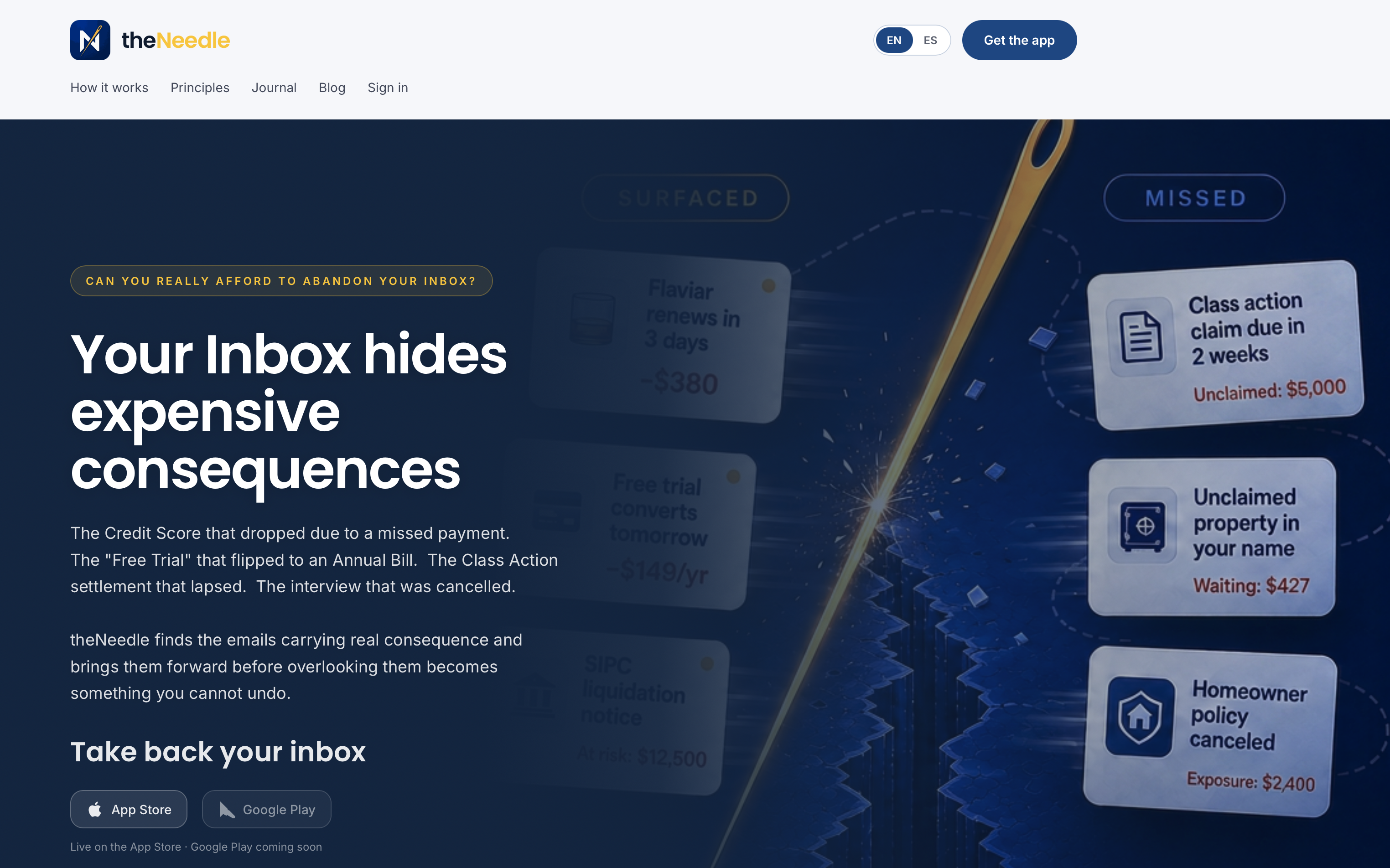
We offer a free trial through our live demo, and plans run $9.99 per month or $99.99 per year on the theNeedle - Monthly plan page. Start the trial and watch your action queue for a few days before deciding how aggressively to tune it.
FAQ
What makes a Gmail app “consequence-based” instead of just a cleanup tool?
A consequence-based app flags emails by what happens if you ignore them, such as missed deadlines or unpaid refunds, rather than sorting by sender or volume. Gmail’s own importance marker relies on your past behavior instead of reading for financial or contractual stakes.
Is it safe to give a third-party app access to my Gmail account?
Reputable apps use OAuth through the Gmail API, which grants specific permissions without exposing your password. Before trusting one, check that it explains why messages are flagged and offers undo or audit controls.
Can a consequence-aware app replace bulk unsubscribe tools?
Not entirely. Bulk unsubscribe tools handle volume and noise well, while a consequence engine like theNeedle focuses on catching the rare high-stakes message that bulk tools would otherwise clear away unnoticed.
How much does theNeedle cost?
theNeedle offers a Monthly plan at $9.99 per month and an Annual plan at $99.99 per year, both following a free trial period.
How do I know if an app’s consequence detection actually works?
Test it against a real deadline or financial email you nearly missed in the past. If the app would have caught that message and explained why, as suggested by research on email triage, it is doing its job.
Sources
- Importance markers in Gmail - Gmail Help
- Manage Gmail filters | Google for Developers
- Exploring email triage: challenges and opportunities - Microsoft Research
- Prioritizing unread emails: an experiment showing that people send urgent responses before important or short ones