Outlook Follow Up Reminders: 3 Checks When Alerts Fail

The fastest way to set a follow-up reminder in Outlook is to open your message, select Message > Follow Up > Add Reminder, choose a date and time, then send. If you want the recipient nudged too, use Follow Up > Custom and check Flag for Recipients. Reminders then pop up like calendar alerts and sync to To Do and Tasks, though what you actually see depends on your Outlook version and your notification settings.
TL;DR:
- Custom reminders let you set start and due dates plus an exact alert time; the No Date preset flags a message without scheduling a reminder.
- Recipient flags may show an alert only for Outlook desktop users with reminders enabled; web and mobile recipients usually see the flag text alone.
- Flagged emails create Tasks and Microsoft To Do items; verify the due date there, since flags can be hard to spot in a crowded inbox.
- Reminder dialogs resemble calendar notifications, but they require enabled alerts; check Outlook Mail and Calendar settings and Windows Focus Assist if none appear.
- IMAP accounts may disable some Custom flag fields; in New Outlook, convert messages to To Do tasks when the Follow Up menu is missing.
Table of Contents
- How to set a follow-up reminder for messages you send
- How to request a follow-up from recipients
- Where follow-up reminders and flagged messages actually show up
- Timing defaults and custom reminder scheduling
- Fixing notifications when reminders don’t appear
- Quick checklist to confirm your reminders are working
- Prioritizing follow-ups when your inbox never slows down
- A simpler alternative for high-consequence follow-ups
- FAQ
- Sources
How to set a follow-up reminder for messages you send
Before you hit send on anything that matters, flag it for yourself. This is quick to set up and saves you from the slow dread of realizing later that nobody ever replied.
- Open or compose the message, then select Message > Follow Up > Add Reminder.
- In the Custom dialog, choose Flag for Me, set a Start date and Due date, then check the Reminder box and pick the exact date and time.
- Click OK, then Send as usual.
If you don’t need a specific time, Outlook’s presets work fine: pick Today, Tomorrow, This Week, or Next Week straight from the Follow Up menu instead of opening the Custom dialog. Microsoft’s own support documentation walks through this exact sequence, and it holds true whether you’re flagging a new draft or something already sitting in your Sent Items.
Pro Tip: Set the reminder time for when you actually check email, not an arbitrary hour. An alert timed to your email-checking schedule beats one you’ll dismiss half asleep.
How to request a follow-up from recipients
Flagging a message for yourself keeps you accountable. Flagging it for the recipient puts a little pressure on them, too, which matters when you’re waiting on a signature, an approval, or a simple yes.
- Before sending, go to Message > Follow Up > Custom and check Flag for Recipients.
- Edit the Flag to text so it tells the recipient exactly what to do, something like “Reply by Friday” instead of a vague “Follow up.”
- Send as normal; the flag and its instructions travel with the message.
Here’s the catch worth knowing before you rely on this: recipient reminder pop-ups generally only trigger reliably when the other person uses Outlook desktop with reminders enabled. If they’re reading mail on the web or on a phone, they’ll likely just see the flag text, not an alert. Treat recipient flags as a polite nudge, not a guaranteed trigger.
Where follow-up reminders and flagged messages actually show up
A flagged email doesn’t just sit quietly in Sent Items waiting to be forgotten. It becomes a task, which means it has a home outside your inbox.
- Flagged messages create items in Tasks and in the Flagged email list inside Microsoft To Do.
- Reminders themselves appear as a pop-up dialog, the same way a calendar alert does, and will surface over whatever else you’re working in if notifications are turned on.
- You can also glance at flags without leaving your inbox by turning on the To-Do Bar under View > Layout.
Behavior shifts a bit between Outlook desktop, Outlook on the web, and mobile, so if a flagged item seems to vanish, check To Do first. That’s especially true if you’ve been migrated to New Outlook, where some of the legacy reminder screens have moved or disappeared entirely.
Timing defaults and custom reminder scheduling
Outlook’s quick-flag presets each carry their own built-in timing, and knowing the defaults saves you from accidentally setting a reminder for the wrong day. **The presets set their own start, due-date, and reminder behaviors. This Week and Next Week use dates within their respective periods. No Date flags the message without attaching any reminder at all.
When you need something more exact, Custom lets you pick a Start date, Due date, and reminder time, which matters when a deadline is genuinely fixed rather than roughly “sometime this week.” Microsoft’s flag documentation lays out each preset’s default behavior and the custom options side by side.

One limitation worth flagging: on IMAP accounts, some flag fields can’t be edited the same way they can on Exchange or Microsoft 365 accounts, so Custom options may appear grayed out depending on your setup.
Fixing notifications when reminders don’t appear
Few things are more frustrating than setting a reminder, trusting it, and then missing it anyway because nothing ever popped up. Usually the cause is a setting, not a bug.
- Check Outlook Settings > General > Notifications, expand Mail and Calendar, and make sure pop-up alerts are turned on.
- Confirm Windows Focus Assist (or Do Not Disturb) isn’t silently suppressing alerts in the background.
- If the Follow Up menu seems to be missing entirely in New Outlook, convert the message into a task in To Do or pin it to My Day as a workaround until the interface catches up.
Recipient reminders have their own quirks: they often don’t show because the recipient isn’t using Outlook desktop, has reminders disabled, or is on an IMAP account where flag behavior is more limited. None of that means your flag failed, it just means the pop-up never had a path to appear on their end.
Pro Tip: If New Outlook keeps hiding the reminder dialog you’re used to, search “My Day” in the sidebar. It’s often the fastest route to the same information.
Quick checklist to confirm your reminders are working
Run through this right after you set a reminder, especially the first few times, so you’re not trusting a system you haven’t actually tested.
- Look for the flag icon on the sent message inside Sent Items.
- Open To Do or Tasks and confirm the Flagged email item is there with the right due date.
- Open the item’s Custom dialog to double-check the reminder time, then wait for a test alert to confirm notifications are actually firing.
If all three check out, your follow-up is genuinely scheduled, not just flagged and forgotten.
Prioritizing follow-ups when your inbox never slows down
Flags and reminders solve the mechanics, but they don’t solve the deeper problem: a buried sent message can quietly become a forgotten task no matter how well you’ve tagged it. Task integration through To Do is a sturdier place to track follow-ups than hoping you notice a flag icon scrolling past in a crowded inbox. What flags can’t do is tell you which follow-up actually carries financial or deadline weight versus which one is just noise, and that’s the gap a consequence-first approach is built to close.
— Glen Bover
A simpler alternative for high-consequence follow-ups
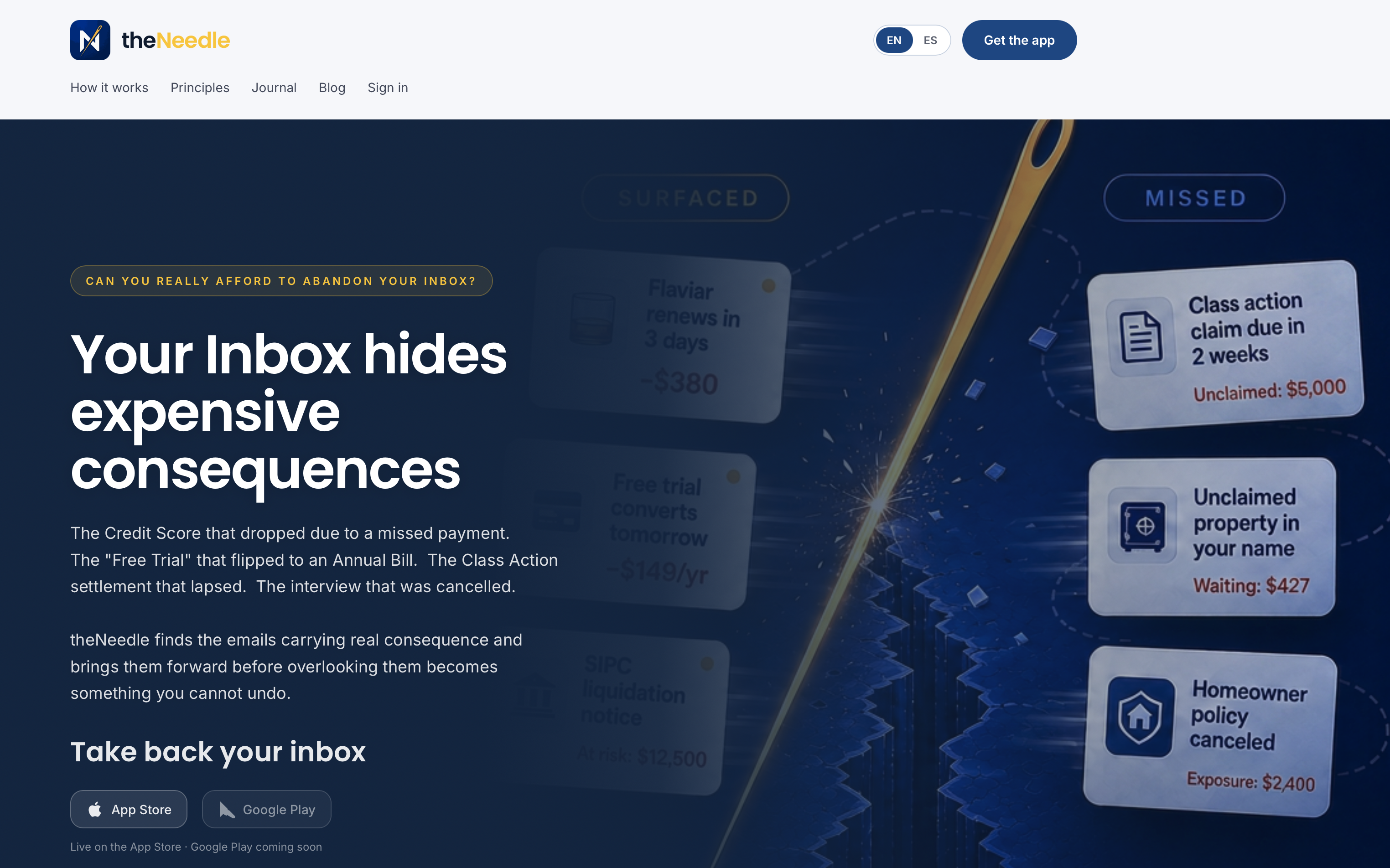
Outlook’s flags work, but they ask you to remember which messages matter enough to flag in the first place. We built theNeedle to skip that step: it connects to your inbox and surfaces emails tied to real consequences, missed deadlines, financial alerts, unanswered threads that are quietly costing you, rather than treating every message as equally urgent.
- Try theNeedle Monthly if you want consequence-based prioritization running alongside your existing Outlook setup.
- Read more about the one-thing-at-a-time approach we use to keep focus on a single follow-up instead of a sprawling list.
For readers juggling financial follow-ups specifically, a tool like Bookwren handles receipts and subscription charges pulled straight from Gmail, which pairs well with consequence-first email triage.
FAQ
How do I create a reminder in Outlook?
Open the message, go to Message > Follow Up, then choose a preset like Tomorrow or select Custom to set an exact date and time. Click OK, then send the message as usual.
How do I turn on Outlook notifications?
Go to Settings > General > Notifications, expand the Mail and Calendar sections, and enable pop-up alerts. If nothing appears, check that Windows Focus Assist isn’t set to silence notifications.
What is a good follow-up reminder email?
A good follow-up reminder is specific about the action you need, such as “Reply with approval by Friday” rather than a generic nudge. Pairing that clear ask with a Flag for Recipients setting gives the other person both context and a visible prompt.
How do I make a follow-up meeting in Outlook?
From the original email, use Reply with Meeting or create a new calendar invite referencing the thread, then set a reminder on the invite itself under the meeting’s own notification options. This keeps the follow-up tied to a specific time slot rather than an open-ended task.
Why don’t my recipients see my follow-up reminder?
Recipient pop-up reminders only trigger reliably when the recipient uses Outlook desktop with reminders turned on. On web or mobile, they typically see only the flag text you wrote, not an active alert.