Intelligent Email Sorting: Find Deadlines Buried in Paragraph Three

Intelligent email sorting uses machine learning to read, categorize, and rank your messages by what actually matters, not just by sender or keyword. Instead of dumping everything into one feed, it separates the deadline you cannot miss from the newsletter you can skip. The result is faster triage, fewer overlooked bills or contracts, and an inbox that works more like a filter for consequence than a pile of unread numbers.
TL;DR:
- Use fixed rules for predictable tasks such as routing receipts, and add AI when unfamiliar senders or changing thread context hide deadlines.
- Correct misclassified messages promptly so the system can learn your handling patterns and the language used in your industry.
- Before enabling AI, check whether it explains each decision, supports corrections and audits, and clearly states where content is processed and retained.
- Basic filters typically process messages locally, so readers prioritizing privacy can start with rules and let AI catch consequential exceptions.
Table of Contents
- What Intelligent Email Sorting Is (and How It Differs From Simple Filters)
- How Intelligent Sorting Works: Common Algorithms and Techniques
- Feature Patterns: The UI and Actions Users Rely On
- Rule-Based vs AI-Based Sorting: When to Pick Which
- Privacy, Trust, and Oversight: What to Check Before You Enable AI Sorting
- Who Benefits and Common Use Cases
- Example in Practice: How theNeedle Approaches Consequence-First Sorting
- Where Intelligent Sorting Is Headed and What to Watch Next
- How theNeedle Helps You Catch What Actually Matters
- FAQ
- Sources
What Intelligent Email Sorting Is (and How It Differs From Simple Filters)
Intelligent email sorting combines text classification, intent detection, and what we’d call consequence-aware signals, meaning the system looks for cues like due dates, dollar amounts, or legal language, not just who sent the message. A simple rule (“move anything from this address to this folder”) cannot do that. It reacts to fixed patterns, nothing more.

Gmail and Outlook’s built-in category tabs work the same way: useful for separating promotions from social updates, but blind to context. A rule cannot tell the difference between a routine invoice and a cancellation notice; an intelligent system can read the thread and weigh it accordingly.
AI-powered sorting earns its keep when:
- A message is part of an ongoing thread and its urgency shifts with each reply
- The sender is unfamiliar, so no rule exists yet to catch it
- Timing matters more than the topic, as with a deadline buried in paragraph three
How Intelligent Sorting Works: Common Algorithms and Techniques
Most AI-powered email sorting tools lean on a handful of proven techniques. Text classification models sort messages into categories. Intent detection figures out whether a message asks for action, confirms a transaction, or just informs. Entity extraction pulls out dates, amounts, and names, and thread analysis tracks how a conversation evolves so the system does not treat every reply as a fresh message.
Several feature signals typically feed these models:
- Sender identity and history, including how you have handled similar senders before
- Subject lines and body phrasing that hint at urgency or consequence
- Dates and deadlines mentioned in the text
- Attachments, which often flag invoices, contracts, or statements
- Your own past actions, like what you archived, replied to, or flagged
Supervised learning trains these systems on labeled examples, and lighter transformer models increasingly handle the language understanding without needing huge computing power. The quality of that training data matters enormously: a model fed only generic email examples will struggle with the specific vocabulary of your invoices, your clients, or your industry. Continuous learning, where the system adjusts based on your corrections, is what keeps accuracy from plateauing.
Pro Tip: Correct a misclassified email as soon as you spot it. That single action often teaches the model faster than a week of passive use.
Feature Patterns: The UI and Actions Users Rely On
Once the sorting happens behind the scenes, you interact with it through a handful of familiar patterns. A priority inbox surfaces what needs attention first. Smart folders or tags group messages by topic or urgency automatically. Snooze pushes something out of sight until it is actually relevant again.
Common features you will see across intelligent sorting tools include:
- A priority view that separates consequential messages from routine ones
- Smart tags or folders that update without manual filing
- Snooze or defer options for messages that matter later, not now
- One-at-a-time focus modes that present a single message instead of a flooded list
- Unsubscribe suggestions for senders you consistently ignore
The meaningful difference shows up in the logic. A generic “importance” signal might just flag messages from your boss or starred senders. Consequence-aware sorting looks deeper, catching a refund deadline from an unfamiliar airline or a contract renewal buried in a long thread, because the content itself carries the weight, not just who sent it.
Rule-Based vs AI-Based Sorting: When to Pick Which
Rules and AI solve different problems, and most people benefit from both at different points.
- Choose rules when your workflow is simple and repeatable, like routing all receipts from one store into a single folder.
- Choose rules when privacy is your top concern, since basic filters typically process everything locally with no content sent anywhere for analysis.
- Choose AI-powered sorting when context matters more than the sender, such as catching a lease renewal notice from a landlord who emails rarely.
- Choose AI-powered sorting when you are drowning in volume and manually writing rules for every scenario has become its own chore.
- Combine both: let rules handle the predictable traffic and let intelligent sorting catch the exceptions that carry real consequences.
Starting with rules keeps setup light and gives you full visibility into what is happening. Layer in AI-powered sorting once you notice the same kind of important message slipping through the cracks more than once.
Privacy, Trust, and Oversight: What to Check Before You Enable AI Sorting
Handing your inbox to an algorithm means trusting it with sensitive content, so a few checks matter before you flip the switch, including practical steps to deploy AI data classification safely for security teams. Explainability is the first one: can the tool tell you why it flagged a message as urgent, or does it just present a verdict with no reasoning? The NIST AI Risk Management Framework names explainability, interpretability, accountability, and transparency as core characteristics of trustworthy AI, and email tools are no exception to that standard.
Human oversight is the second check. A trustworthy system lets you correct a wrong classification in one tap and actually learns from that correction, rather than repeating the same mistake. Look for:
- A visible reason for each sort decision, not a black-box label
- Easy manual correction that feeds back into future sorting
- Some form of audit trail showing what the system has acted on
- Clear statements about where your email content is processed and how long it is retained
NIST’s framework explicitly ties trustworthiness to governance practices like documentation and continual improvement, guidance laid out in the generative AI risk profile, which recommends measurement and oversight as AI systems evolve. A provider that publishes how it handles data minimization and retention is giving you a concrete way to judge trust, not just a promise.
Who Benefits and Common Use Cases
Intelligent sorting pays off most for people whose inboxes carry real stakes: freelancers tracking client approvals, professionals juggling multiple accounts, or anyone who has missed a renewal deadline buried under promotional noise.
Typical use cases include:
- Tracking contract or application deadlines that arrive without warning
- Catching financial alerts, like refund windows or payment confirmations, before they expire
- Triaging client messages by urgency instead of reading everything in arrival order
- Supporting one-at-a-time focus workflows that work well for ADHD-friendly productivity
Success here does not look like an empty inbox. It looks like zero missed high-consequence messages and a faster response time on the ones that actually required one.
Example in Practice: How theNeedle Approaches Consequence-First Sorting
We built theNeedle around a simple observation: the average worker receives around 117 emails a day, and buried somewhere in that flood is usually one message with a real deadline, a refund window, or a contractual consequence. Most sorting tools organize by volume or sender. We sort by consequence instead.
Here’s what that looks like in practice:
- We flag overdue, urgent, and high-priority messages based on what they actually say, not just who sent them
- We surface unhandled replies so a client question never quietly ages out
- We track opportunities like credits or refunds that have expiration windows
- We offer built-in unsubscribe tools for senders who keep adding to the noise
After connecting an inbox, expect a short setup period while the system learns your patterns, and the option to correct any sort it gets wrong. You can read more about how we prioritize important emails by consequence.
Where Intelligent Sorting Is Headed and What to Watch Next
The next wave of intelligent sorting leans toward on-device inference, which keeps more of your email content off external servers, paired with better explainability so a flagged message comes with an actual reason attached. Expect tighter integration with calendars and to-do lists, so a deadline buried in an email becomes a scheduled reminder automatically.
For you, that means faster sorting, more privacy, and less guessing about why something got flagged.
Pick tools that publish their explainability practices and update cadence. That transparency is the clearest signal of how seriously a provider takes trustworthy AI.
— Glen Bover
How theNeedle Helps You Catch What Actually Matters
If you are tired of scrolling past 117 emails to find the one that carries a real deadline or financial consequence, that is exactly the problem we built theNeedle to solve. Our system connects to popular email providers, works across multiple accounts, and prioritizes by consequence rather than sender volume.
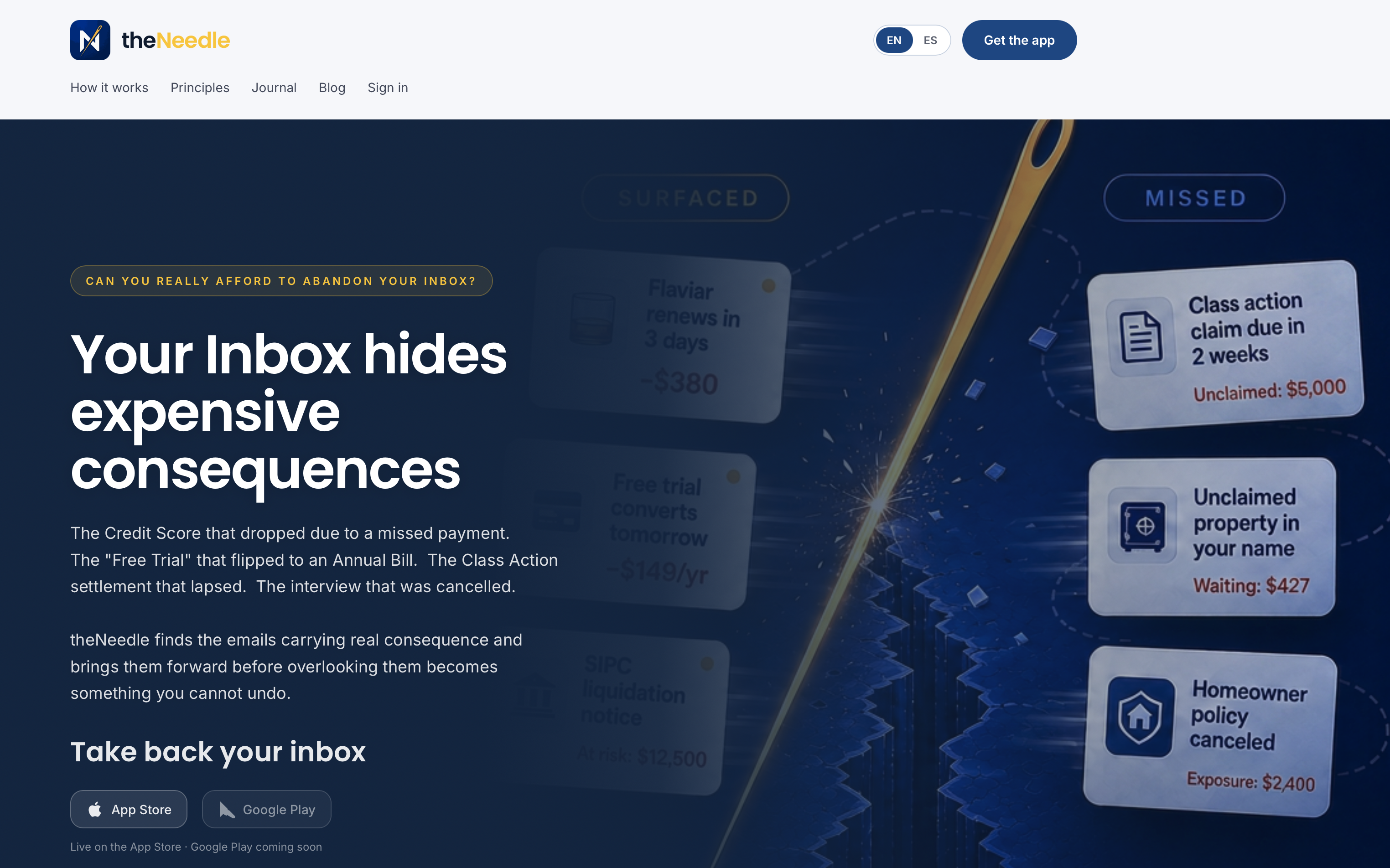
Here’s what you get when you start:
- Overdue and high-priority messages surfaced automatically, without manual rules
- Opportunity tracking for credits, refunds, and time-sensitive offers
- One-at-a-time focus mode built for people managing chaotic inboxes
A monthly plan is available for $9.99 per month, or you can save with the annual plan at $99.99 per year. Start your trial and see which messages you have been missing.
FAQ
Is there an AI that can sort my emails?
Yes, several tools use AI to classify, prioritize, and tag emails automatically based on content, sender history, and context rather than fixed rules. These tools range from built-in category features in Gmail and Outlook to dedicated consequence-first sorters like theNeedle that focus on deadlines and financial alerts.
What does the 3-21-0 email rule mean?
This is not a recognized or standardized email management framework, and definitions of it vary widely depending on the source. Rather than relying on an undefined rule, focus on proven practices like consequence-based prioritization and regular inbox triage.
What is the best email sorter?
The best choice depends on what you need: rule-based tools like Gmail filters work well for predictable, repeatable tasks, while AI-powered sorters add value when context and consequence matter more than sender identity. For catching high-stakes messages like deadlines and financial alerts, theNeedle focuses specifically on consequence over volume.
What is the 12-second rule for emails?
Like other numbered email rules circulating online, this is not a standardized or widely documented framework. If your goal is faster decision-making on emails, intelligent sorting tools that flag consequence upfront tend to cut triage time more reliably than a fixed timing rule.