4 min readEN
Mutual Accountability, Singular Point of Failure
When couples decide together but only one partner sees the bills, a shared decision can become a single point of failure. How to share visibility without sharing an inbox.

#The Ford Bronco was a joint decision. The insurance bill was not.

You agreed to buy the vehicle together. One partner took responsibility for the lease and insurance payments. Then the insurance bill was forgotten. Did the other partner know it was due?
Not necessarily. There may have been no mechanism to tell them.
That gap, between deciding together and seeing what happens next, is where a shared financial responsibility can become a singular point of failure.
The decision was shared. The visibility was not.
Couples often make financial decisions together. They choose a vehicle, plan a purchase, set a budget, or decide how to invest. Once the accounts are set up and bill pay is in place, though, visibility can narrow to one person.

One partner sees the insurance notice. One gets the monthly statement. One knows whether a transfer went through. The other may believe everything is settled because the decision was shared and a person was assigned to handle the next step.
That person may be capable and conscientious. They may simply be carrying a lot. The problem isn’t that one partner has a task. It’s that the household can mistake shared agreement for shared awareness.
A decision can be mutual while its execution is visible to only one person. The obligation outlives the email, but the email may stay in one inbox.
One name on the account is a single point of failure.
A single point of failure is one component whose failure can disrupt everything that depends on it. In household finances, that component can be a person’s inbox.
Many systems designate one person as the Primary Contact or send notices to one email address. That can include insurance and lease portals, proxy voting materials, monthly statements, trade confirms, or an IRS contact email designation. Some services allow multiple contacts. Many still give one person the main line of sight.
That doesn’t mean the named person is unreliable. It means the system depends on them being available, noticing the right message, understanding its importance, and remembering to follow through.
If any link in that chain breaks, the other partner may not know there’s a problem.
A single point of failure can have lasting costs.
The consequences are not limited to a late fee. A missed insurance notice can mean discovering lapsed coverage at the worst moment. Debt may remain unknown until a crisis brings it to light. Loans against retirement accounts can quietly hollow out the savings a couple thought they had. Credits, claims, and other opportunities can expire unseen.
These outcomes are different, but the visibility problem is similar: an important message reaches one person, and the household has no reliable way to know whether the obligation is still open.
In engineering, the response to a single point of failure is not to blame the component. It is to redesign the system so one missed signal does not take everything downstream with it.
Household financial life deserves the same kind of thinking.
The bill gets caught at the funeral.

One family learned this the hardest way. After her husband died, a woman knew very little about how much debt he had incurred or how much he had borrowed against retirement accounts. Those loans had effectively rendered the accounts useless.
There is no need to add invented details to understand the lesson. The information that shaped the household’s financial reality was not visible to both people while they could still discuss it and act.
The point is not to turn a painful experience into a warning about every couple. It is to ask a practical question before a crisis: Can both partners see the obligations that affect their shared life?
That question belongs in the present. Not at a funeral.
Plausible deniability is not a household financial strategy.
A founder of ours puts it this way: “Plausible deniability may work in the White House, but it should not have to be something couples think is normal.”
Not knowing about a consequential bill or loan does not always mean someone hid it. Sometimes the information went to one address, one person read it, and no shared process kept the matter visible.
But “I didn’t know” should not be the normal endpoint for a household financial obligation. Transparency doesn’t require suspicion. It gives both partners enough information to understand what is open, what is due, and what could be at risk.
Our earlier post on household inbox transparency explores how couples can share awareness without sharing an inbox. The distinction matters: visibility is not the same as taking over.
Three things couples try, and why they fall short
Share a password. This can expose more messages, but it merges private inboxes and keeps the bottleneck. One person may still be the one who checks, interprets, and remembers. A shared password also blurs personal boundaries.
Create one joint email address. This gives household notices a common destination, but it creates another inbox to monitor. If one partner is the one who reads it, the household still depends on that person noticing and relaying what matters.
Review statements together every month. A regular review can help you discuss balances and spot issues. But it depends on both people remembering to do it, and it may leave a long gap between a consequential email and the next review.
Each approach can be useful for some things. None automatically provides a standing view of consequential messages from both partners’ accounts.
Compare the approaches by what each partner can see.
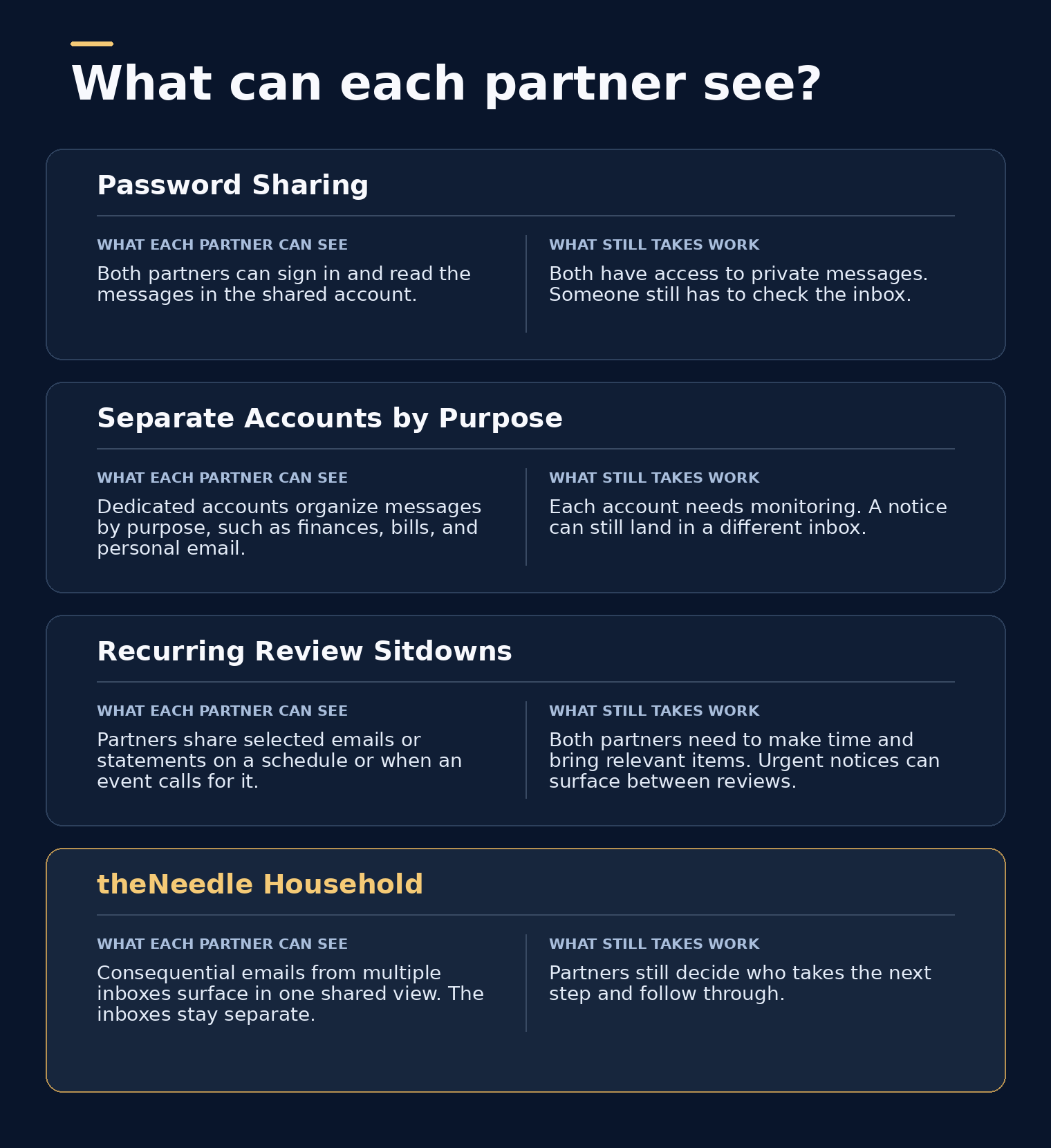
True transparency keeps accounts separate and obligations visible.
Transparency does not require one partner to surrender a private inbox or take on the other person’s tasks. It requires a useful shared view of the consequential items that affect the household. Our name for that setup is Household.
A practical approach has four parts:
- Keep separate email accounts. Each partner retains their own account and access.
- Bring consequential items into a shared view. Add every household email to a single theNeedle account, so both people can see what is open, what is due, and what may be at risk.
- Agree on the handoff. Decide who will pay, call, respond, or transfer funds. Visibility does not make both people responsible for the same action.
- Keep execution where it belongs. Continue using the bank, insurer, lender, or other service’s existing payment and account channels.
This is a transparency argument, not a “split the chores” argument. One partner may continue paying the insurance bill. The other should not have to become the bill payer to know whether an important obligation is still open.
Where theNeedle fits, plainly.
theNeedle is a read-only email accountability app for Gmail, Yahoo, iCloud, and Outlook. It identifies consequential messages, keeps them in view until resolved, assigns a RiskScore based on urgency and the cost of inaction, and sends escalating reminders as deadlines approach.
With Household, your emails stay separate, but adding all household emails to a single theNeedle account surfaces the consequential ones for everyone to see and understand. What it creates is a keep-me-honest checklist the household shares, so an open obligation is visible to more than the one person who happened to receive the email.
theNeedle does not merge your accounts. It does not send, reply, delete, or archive anything. Execution stays where it already is, and so does the decision about who does what.
For credits, vouchers, and gift cards that you want to use later rather than close now, Remind Me helps keep the future opportunity in view. Household is the mechanism for a couple or a family; Friend Support remains an optional add-on for wider accountability beyond the home.
The goal is not to watch each other. It is to make sure one person’s inbox is not the only place a household obligation exists. To learn more about the difference between message organization and ongoing accountability, read How to Choose the Best Email Management Software.
Download theNeedle: App Store · Google Play
One obligation at a time, from the inbox you already have.
theNeedle is live on the App Store and Google Play.
Get the app