4 min readEN
"I Thought You Took Care of That": How Couples Can Share What Matters Without Sharing an Inbox
You can keep separate email accounts and still make consequential household messages visible to both partners. The key is sharing awareness without quietly transferring responsibility.

“I thought you took care of that.”
The registration deadline passed. The insurance renewal is still open. A school form is due Friday, and neither of you knows who has it.
Usually, nobody meant to let it slip. One person received the email. The other assumed it was handled. The message was visible to one inbox, but the obligation belonged to the household.
That’s the gap. A shared life does not automatically create shared visibility. And a shared inbox is not the only way to close it.
One inbox creates one point of visibility, not shared responsibility
Email accounts are built around individual access. Your inbox sends notifications to you. But household obligations don’t always follow that pattern. A credit-card statement may go to one partner. A claim notice may be addressed to the other. A school email might reach whichever parent filled out the form.
The partner who doesn’t receive the message can be structurally unaware of it. That’s not carelessness. It’s a blind spot created by where the email landed.
Research on household cognitive labor (the planning, remembering, and monitoring that keeps everyday responsibilities moving) helps explain why this matters. A 2023 review of 31 studies found that women often carry a larger share of this mental work, especially around household and childcare responsibilities. The authors also note limits in the research samples, so the finding should not be treated as a description of every couple. But it points to a familiar risk: if one person is the only one who sees the obligations, they may also become the person expected to remember and monitor them. Read the review.
Transparency helps. But transparency is not the same as taking over.

Two common workarounds can create new problems
Share one account’s password. This can make more messages visible, but it blurs personal boundaries and turns one inbox into a bottleneck. It can also quietly make the person who checks it responsible for spotting, interpreting, and following up on everything.
Relay important emails by memory. “I’ll tell you when something comes in” sounds simple. But it depends on one partner noticing the message, remembering to mention it, and making the urgency clear, often while juggling other demands.
Neither workaround reliably answers the questions that matter: What needs to happen? By when? Who owns the next step? Has it been completed?
The goal isn’t to combine every message or monitor each other’s personal correspondence. It’s to give both partners a clear view of the obligations that affect them both.
Account Linking - Share consequential follow-through, not the whole inbox
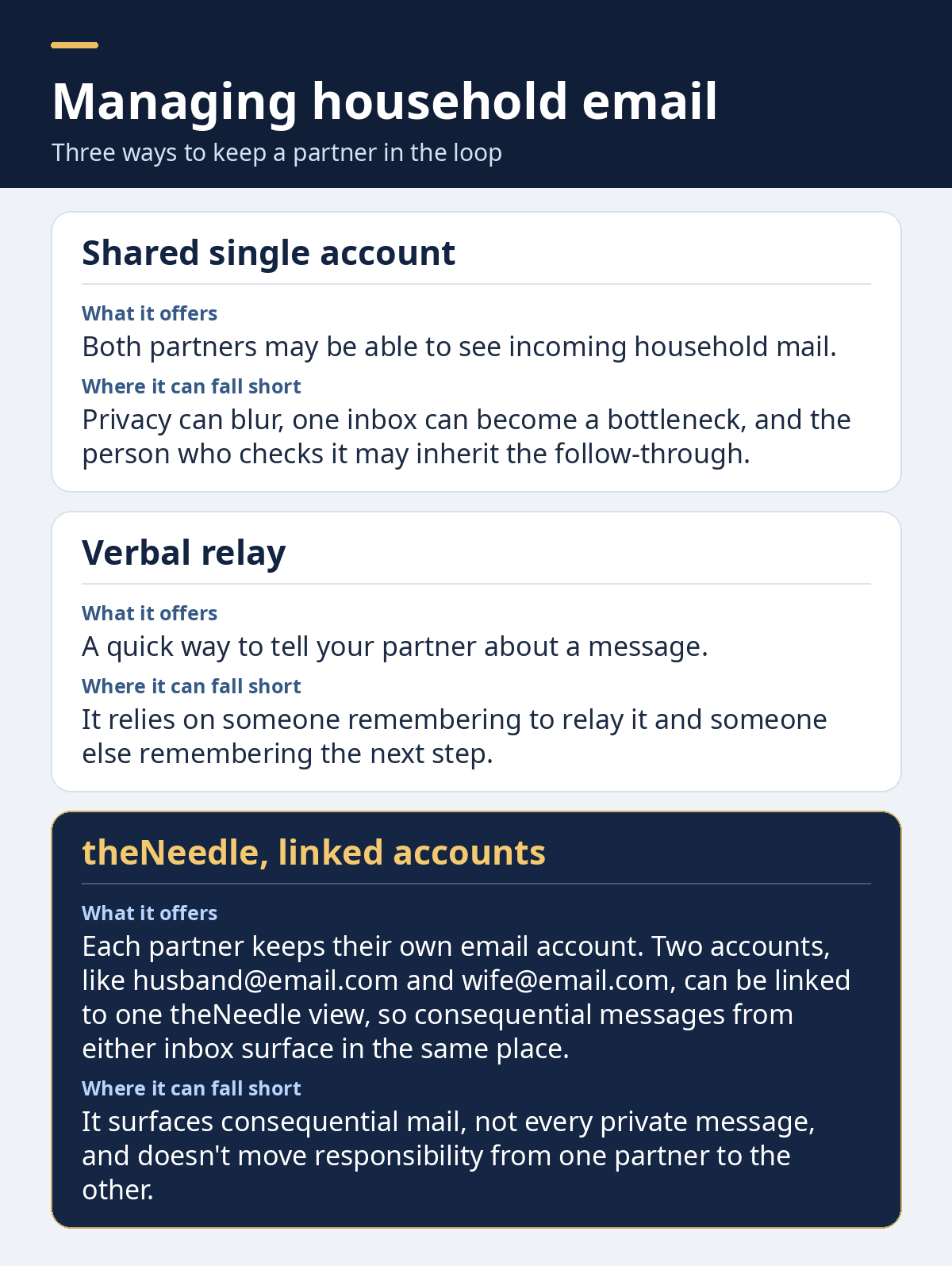
That last distinction matters. Friend Support is optional and consent-based. It’s meant to create a human check-in when an important message may be falling through, not to give one partner surveillance access to the other’s inbox.
theNeedle is a read-only email accountability app for Gmail, Yahoo, iCloud, and Outlook. It identifies consequential messages, keeps required actions in view, and uses a RiskScore and escalating reminders to signal when inaction could matter. Each partner connects their own account. A partner who doesn’t carry the household email can be invited as a support person to see when follow-through is slipping and check in.
theNeedle does not send, reply to, delete, or archive email. You stay in control of your account and your actions. For details, see how theNeedle works and theNeedle’s overview.
Five household emails show why visibility matters
- The statements: All the credit-card statements go to him. She never sees the fraud alert on the household account. A second set of eyes can help surface that follow-through needs attention.
- The renewal: “I thought you took care of that.” The registration, insurance, or permit is still open. The email being read is not the same as the renewal being completed.
- The school notice: An interview confirmation or form due Friday arrives in one inbox, while both parents are working from separate calendars. Shared awareness gives them a chance to agree who will respond and when.
- The claim window: A settlement or unclaimed-property notice is addressed to either partner, but opened by neither. A consequential message can be missed even when nobody is deliberately ignoring it.
- Getting time back: Instead of spending an evening digging through statements and asking who received what, both partners have a clearer way to spot what may still need attention.

Make visibility useful with a clear handoff
A surfaced email is a starting point, not a completed task. Use a simple sequence to turn awareness into follow-through:
- Agree what counts as shared. Decide which obligations (household bills, insurance, school notices, renewals, claims) need visibility to both of you.
- Keep personal accounts personal. Each partner connects their own account. Invite a partner as a support person only if both of you want that arrangement.
- Name the owner. Say who will take the next step. “I’ll call the insurer today” is clearer than “We should deal with this.”
- Define done. Does the task end when the form is sent, the appointment is booked, or the payment is confirmed? Make the finish line clear.
- Check in without turning it into an audit. If an important item is still open, ask what it needs and whether the owner wants help. Keep the conversation about the obligation, not blame.
This distinction protects both partners. Shared visibility does not mean shared access to everything. Support does not mean taking over. And an invitation to help does not make the support person responsible for completing the task.
The point is to replace “I thought you took care of that” with a clearer exchange: “We both know this matters. Who’s handling the next step?”
Keep the accounts separate. Bring the important obligations into view.
Couples do not need one inbox to share responsibility. They need a way to surface consequential messages, disclose what needs attention, and agree on who will act.
That’s the difference between seeing more email and knowing what still needs doing.
Download theNeedle on the App Store. For another perspective on choosing tools that support follow-through, read How to Choose the Best Email Management Software.
One obligation at a time, from the inbox you already have.
theNeedle is live on the App Store and Google Play.
Get the app