2026-03 · 4 min readEN
Buried Alive: Why Information Overload Is Costing You Money (and What to Do About It)
Every week, something in your inbox is worth real money — or worth protecting your rights over. Here's why most people miss it, and what actually fixes that.
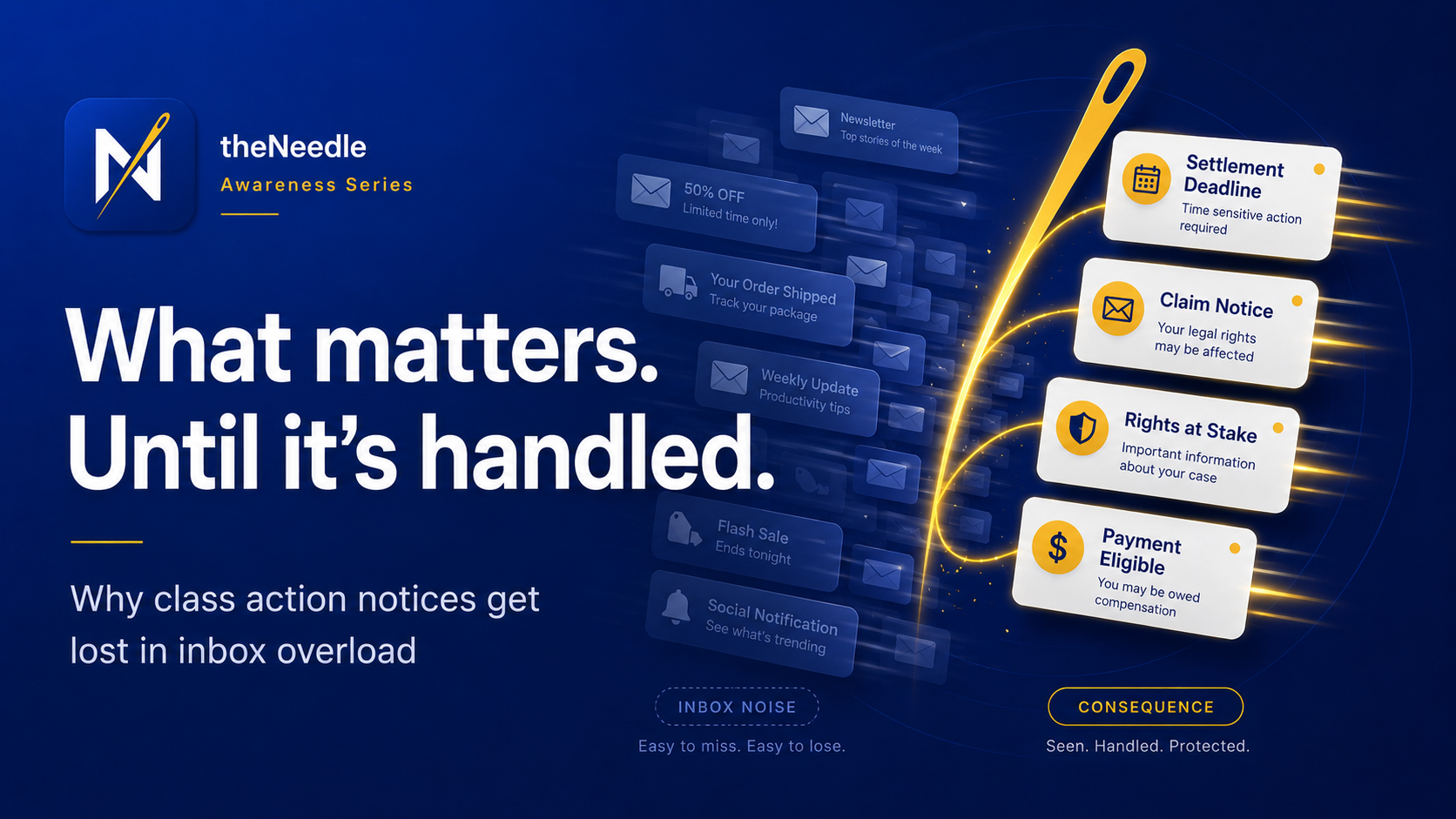
Every week, something in your inbox is worth real money — or worth protecting your rights over — and every week, most of us miss it. Not because we don't care. Because it's one message among hundreds, indistinguishable at a glance from a shipping notification or a newsletter we forgot to unsubscribe from.
This is the quiet cost of information overload: it's not that we're careless, it's that our attention was never built to triage at this volume. And nowhere is that gap more expensive than with class action settlements.
The problem isn't awareness. It's surfacing.
Most people already know, in the abstract, that class action notices exist — that companies settle lawsuits over data breaches, billing overcharges, and mishandled personal information, and that consumers named in the class are entitled to a share. What they don't have is a reliable way to know when it's their turn.
That's the gap ClassAction.org exists to close. Their weekly newsletter is built around three things: new cases and investigations, settlement deadlines, and news — delivered as a standing feed rather than something you have to go looking for. And the deadlines matter more than people expect. Most large class action settlements have a claim deadline, and if you don't get your claim in before then, you've most likely missed out on your chance at receiving payment — and in many cases, missing that window while being a covered class member also means giving up your right to file your own lawsuit over the same allegations.
In other words: the cost of not seeing the email isn't just a missed payout. It can be a forfeited right.
And the flow of these notices isn't slowing down. Scan ClassAction.org's own settlement wire and you'll find a steady cadence of live, dated entries — a BackChecked settlement offering cash and credit monitoring to people affected by a 2024 data breach, a Furmano's settlement tied to a separate 2024 breach, a Penn Medicine settlement worth up to $9.25 million for users whose information was shared without consent — new ones landing multiple times a week. Multiply that across data breaches, junk fees, product defects, and mishandled personal data, and you start to see why "I'll deal with it later" so often becomes "I never dealt with it at all."
Why this happens to capable, organized people
This isn't a discipline problem. It's a systems problem. Human attention is a finite, shared resource — and modern inboxes are optimized for volume, not consequence. A $9.25 million settlement notice and a coupon code for 15% off arrive with the same visual weight, the same font, the same swipe-to-dismiss gesture. Nothing about the interface tells you which one still needs you.
Left unaided, most of us default to recency and noise-reduction — we act on what's loudest or newest, not what's most consequential. Settlement deadlines, unlike urgent-sounding spam, are quiet. They don't escalate themselves. They just expire.
What actually helps: external scaffolding, not more willpower
The fix isn't "pay closer attention." It's building a layer around your attention that does the noticing for you — one that keeps consequential things visible until they're actually resolved, rather than letting them scroll out of view the moment something newer arrives.
A few ways to build that scaffolding starting today:
- Subscribe to a dedicated source of truth for class actions. ClassAction.org's free newsletter is built specifically to surface open settlements, filing deadlines, and new investigations in one weekly digest — rather than expecting you to notice a one-off notice buried among hundreds of other emails.
- Separate "seen" from "handled." Read receipts and inbox zero measure whether something crossed your eyes. They say nothing about whether it got resolved. Build (or use) a system that distinguishes the two.
- Let deadlines drive follow-up, not memory. If a settlement notice has a claim deadline, that date belongs on a calendar or a task list the moment you see it — not filed away under "I'll remember."
- Treat financial and legal notices as a category, not an inbox. Grouping settlement notices, account alerts, and time-bound legal mail together — separate from routine correspondence — makes it much easier to spot what's actually at stake.
The bigger pattern
Class action notices are just one visible example of a much larger problem: important things get lost not because people are irresponsible, but because nothing in our tools distinguishes important from loud. The fix is the same whether it's a settlement deadline, a certified letter, or a bill dispute window closing — build (or adopt) systems that keep consequential items visible until they're actually resolved, not just until they're read.
What matters. Until it's handled.
One obligation at a time, from the inbox you already have.
theNeedle is live on the App Store and Google Play.
Get the app