ADHD Awareness — 2026-10 · 3 min readEN
Getting Assessed: Recognition Isn't a Diagnosis
Reading your own life into a symptom checklist is the first honest look. An actual evaluation is what turns that recognition into a plan.
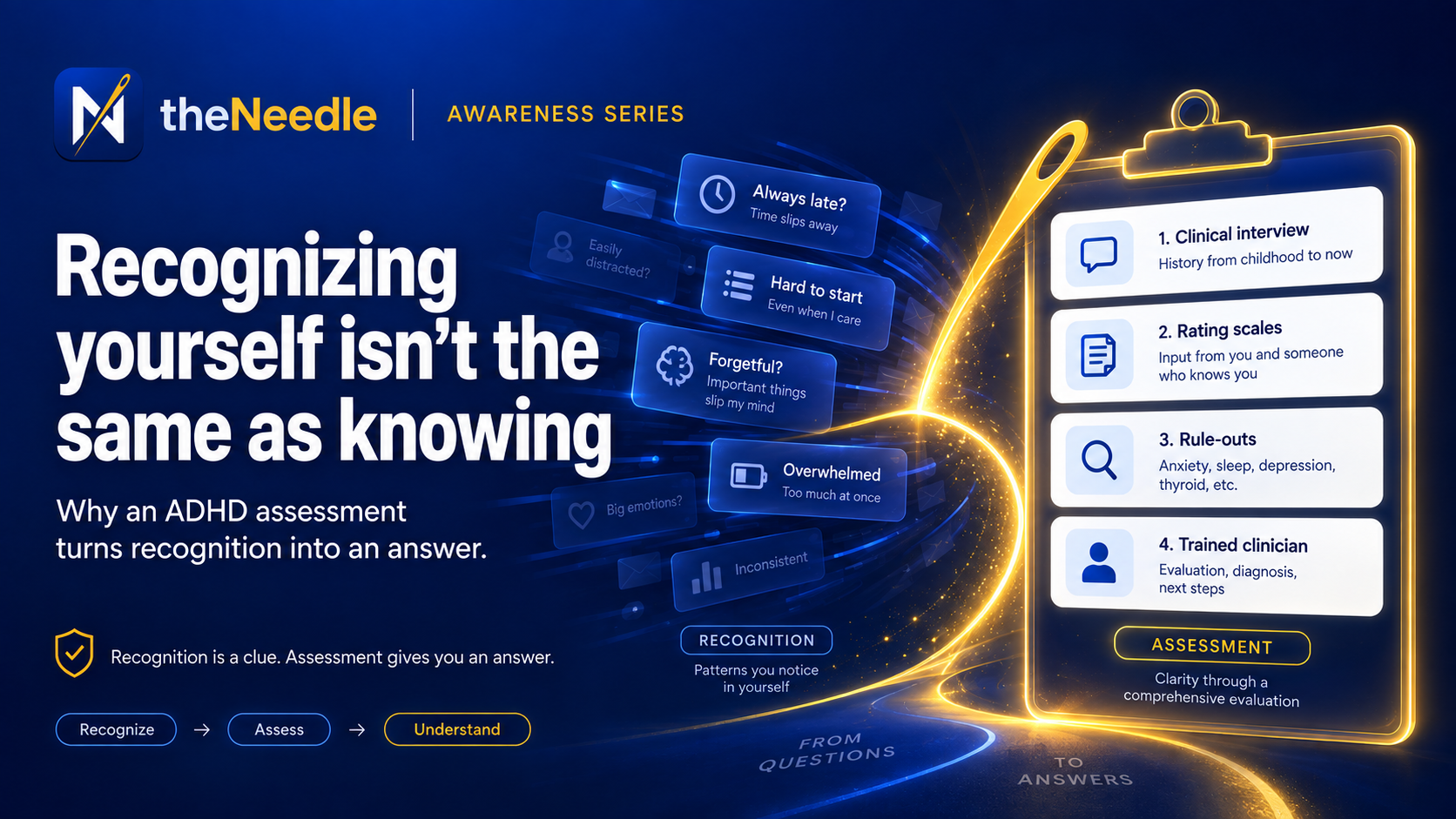
Recognizing yourself isn't the same as knowing
Every post in this series has probably landed somewhere personal — a pattern you know intimately, described back to you with more precision than you're used to. That recognition matters. It's the moment the self-blame story ("I'm just bad at this") starts to look like the wrong story. But recognizing yourself in a list of behavioral tells is a hypothesis, not an answer. What turns it into an answer is an actual assessment.
What an assessment actually involves
A proper ADHD evaluation isn't a five-minute quiz. It typically includes a structured clinical interview covering your history back to childhood (ADHD is, by definition, present before age 12, even if it wasn't named until now), standardized rating scales completed by you and often someone who's known you a long time, and a review that rules out other explanations — anxiety, sleep disorders, thyroid issues, depression — that can produce overlapping symptoms. It's done by a psychiatrist, psychologist, or other clinician trained to make the distinction, not inferred from a checklist online.
That distinction matters practically, not just semantically. A diagnosis is what opens the door to medication if you want to explore it, formal workplace or school accommodations, and treatment that's actually matched to what's going on — instead of a stack of productivity hacks aimed at the wrong problem.
Why this step gets skipped
The same executive-function gap this series has been describing also makes the assessment itself hard to start: it's a multi-step task with a wait time and some paperwork, aimed at a topic that already carries some shame. That's a task-initiation freeze with extra weight on it. Naming that up front doesn't make the appointment book itself, but it does mean the delay isn't a character flaw either — it's the exact pattern this series has been pointing at, aimed at itself.
Start here
CHADD's provider directory (chadd.org) lists clinicians who evaluate and treat ADHD, searchable by location — a concrete first step that doesn't require you to already know who to call.
Next: the series continues — ADHD coaching and systems, and self-compassion as a strategy.
This is an awareness series, not medical advice. A licensed clinician can help you understand what's going on.
One obligation at a time, from the inbox you already have.
theNeedle is live on the App Store and Google Play.
Get the app