ADHD Awareness — Bonus · 4 min readEN
The Enthusiasm Tax: What You Paid For and Never Used
The gym membership. The course you were going to finish. The planner system bought in a wave of motivation. ADHD doesn't spend less money — it spends in one very specific, very expensive pattern: all-in at the start, gone by week three.
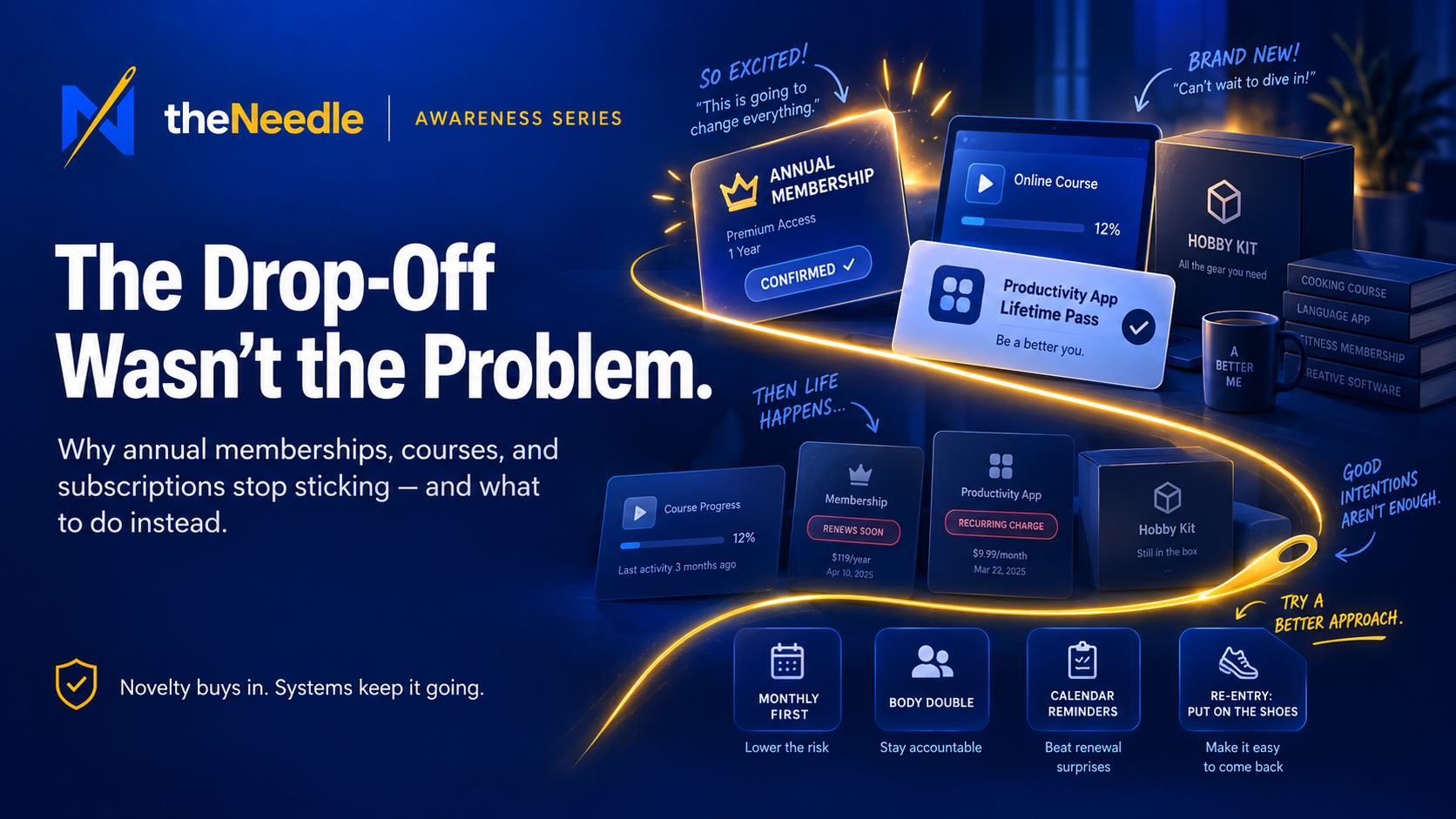
The pattern has a shape
You didn't buy the annual membership carelessly. You bought it certain — this was the year, this was the system, this was finally going to stick. Three weeks later the certainty is gone and the charge keeps showing up anyway. Multiply that by the online course still at 12%, the productivity app you paid for a lifetime license to, the hobby kit still in its box. None of it was a mistake in the moment. The mistake, if there is one, is thinking the drop-off means the purchase was wrong.
Why the drop-off isn't a discipline problem
Starting something new lights up the brain in a way that finishing rarely does — novelty is its own reward, and for an ADHD brain that reward system runs the show more than it does for most people. That's not a character flaw, it's wiring. The problem isn't that you don't want the gym results or the finished course. It's that the motivation that got you to buy and the motivation that gets you to show up in week four are two different systems, and only one of them came free with the purchase.
What actually breaks (and what doesn't)
Nothing about you broke. What broke is the assumption baked into every subscription and course platform: that interest at checkout predicts behavior a month later. It doesn't, for anyone, and especially not for ADHD brains. The fix isn't finding the willpower to want it as much in week four as you did on day one. It's building the follow-through into the purchase itself, before the enthusiasm has a chance to fade.
The fix isn't "want it more"
A few things that actually change the pattern:
- Shrink the first re-entry. Not "go to the gym" — "put on the shoes." The barrier that kills follow-through is almost never the big task, it's the first thirty seconds of it.
- Attach a body double. A class, a friend, a scheduled call — anything that makes showing up a commitment to another person, not just to your own memory.
- Audit before you renew, not after. Put every subscription and membership renewal on a calendar alert now, while you still remember why you bought it, so the decision to continue is a real one instead of a default.
- Buy monthly before annual. The lifetime deal is cheaper per month only if month four happens. Until you've got a few of those in a row, the smaller commitment is the honest price.
Start here
Goblin Tools' free task breakdown is built for exactly this — the gap between "I should use this thing I bought" and actually opening it. And a once-a-quarter subscription audit (list everything you're paying for, cancel or recommit to each one deliberately) turns the enthusiasm tax from a silent leak into a decision you're actually making.
This is an awareness series, not medical advice. If you recognize yourself here, a licensed clinician can help you understand what's going on.
One obligation at a time, from the inbox you already have.
theNeedle is live on the App Store and Google Play.
Get the app