ADHD Awareness — Bonus 2 · 4 min readEN
Open Loops Everywhere: The Doom Pile Isn't Laziness
Forty-three browser tabs. A dozen half-finished projects. A notification badge you stopped reading. Each one is proof that starting was never the hard part.
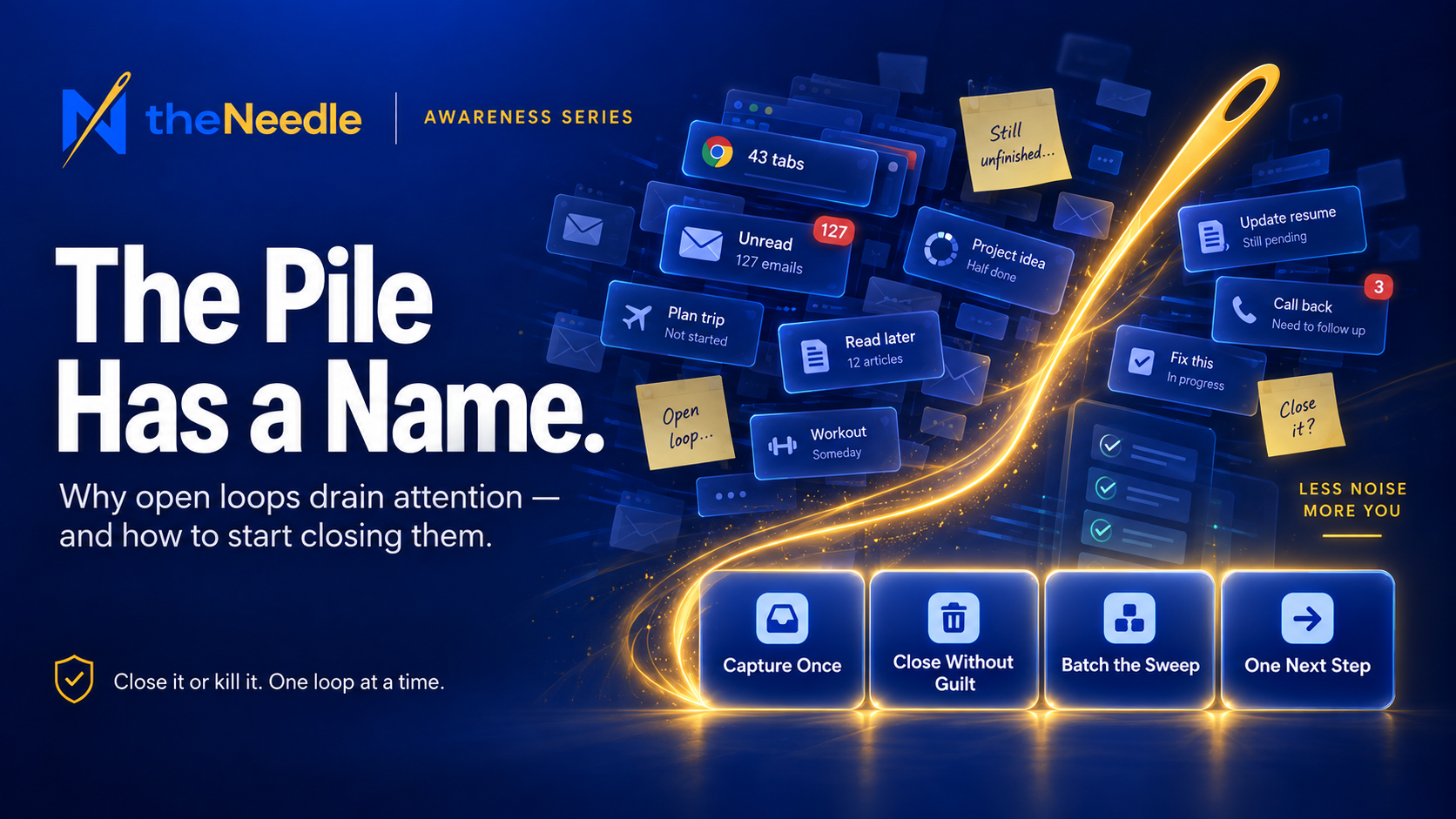
The pile has a name
Forty-three tabs you swore you'd read. A dozen projects at eighty percent. A notification badge that stopped meaning anything the day it crossed twenty. None of it happened because you don't care about finishing things. It happened because starting is easy and closing the loop takes a second act of attention that never showed up — so the loop just stayed open, quietly, forever.
Why loops don't close themselves
Starting something gives you a hit of novelty; your brain rewards the decision to begin more than it rewards the boring work of wrapping up. For an ADHD brain, that imbalance is sharper — which is exactly why the "started" pile grows faster than the "finished" pile, for everyone in this position, not just you. The open tab isn't forgotten. It's suspended, waiting for a second wind that isn't coming on its own.
What the pile actually costs
It's not just clutter. Every open loop is a small, low-grade tax on attention — a background process your brain keeps half-running "just in case." Forty-three tabs isn't forty-three tasks, it's forty-three tiny alarms, all quietly ringing at once. That's where the overwhelm comes from: not the size of any one thing left undone, but the sheer number of things still technically open.
Closing loops without shame
- Capture once, in one place. Twelve half-systems (tabs + notes app + email flags + sticky notes) guarantee loops get lost between them. One trusted list beats four imperfect ones.
- Give yourself permission to kill a loop. Not every open tab deserves to become a task. A "close without guilt" pass — delete, archive, unsubscribe — is not failure, it's honest bookkeeping.
- Batch the sweep. Ten minutes, once a week, just for closing: tabs, notifications, the doom pile. Same time, same day, so it isn't relying on remembering to remember.
- Convert only what still matters into one visible next step. A surviving loop only stays alive if it has an actual next action attached — otherwise it's just another tab.
Start here
Goblin Tools' free task breakdown turns a vague open loop into one small next step you can actually do. Pair it with a standing weekly "close it or kill it" sweep — ten minutes on the calendar, not a New Year's resolution — and the pile stops growing before it stops shrinking.
This is an awareness series, not medical advice. If you recognize yourself here, a licensed clinician can help you understand what's going on.
One obligation at a time, from the inbox you already have.
theNeedle is live on the App Store and Google Play.
Get the app