Beat 117 Daily Emails with theNeedle: Spark Mail Alternatives for Pros

theNeedle is the strongest replacement for readers who need consequence driven prioritization rather than another inbox that just sorts by sender or date. If privacy is your main concern, look at native local token clients. If you run a team, look at shared inbox platforms. Most alternatives cover iOS, macOS, Android, Windows, and web to varying degrees, so check platform parity before you commit and test one account before a full migration.
TL;DR:
- TheNeedle is ideal for professionals who prioritize consequence-based email filtering, surfacing urgent messages like deadlines and financial alerts across multiple accounts without migration.
- Privacy-conscious users should consider local token clients like Thunderbird or Mimestream, which keep credentials on their device and avoid server-side token handling.
- AI-centered Gmail clients and speed-focused apps are better suited for users seeking fast triage and automation but usually store tokens on servers, making them less suitable under strict security policies.
- Teams with shared inbox workflows need tools like Missive or Microsoft Outlook, which incorporate assignment features and per-seat pricing, especially for larger groups.
- Migrating from Spark involves reviewing import capabilities for folders and rules, exporting shared configurations, and testing new clients in parallel to prevent disruption.
Table of Contents
- How the leading Spark alternatives compare
- Shortlisted alternatives worth testing first
- How to choose a Spark replacement without regretting it
- Why consequence based prioritization changes how you triage mail
- Moving your mail from Spark to a new client
- How the interfaces actually feel day to day
- Getting help when something breaks
- When it still makes sense to stay on Spark
- Try theNeedle before you commit to anything else
- Where these comparisons come from
- Sources
- FAQ
How the leading Spark alternatives compare
The market for Spark replacements splits into four groups: consequence driven prioritization, privacy first native clients, Gmail centered productivity tools, and team oriented shared inbox platforms. Each group solves a different problem, and the table below lines up the dimensions that actually matter when you are deciding which one to test first.
| Tool | Best for | Platforms | Privacy model | Team support | AI features | Pricing model |
|---|---|---|---|---|---|---|
| theNeedle | Professionals who cannot afford to miss consequential emails | Connects to Gmail, Outlook, Microsoft, Yahoo, iCloud | Consequence based prioritization layer on existing accounts | Individual focused | Consequence ranking and unhandled reply detection | Monthly or annual subscription |
| Canary Mail | Privacy conscious users wanting AI on device | iOS, macOS, Android, Windows | Local processing emphasis | Limited | AI writing and summarization | Freemium with paid tier |
| Apple Mail | Apple only households wanting a built in client | macOS, iOS, iPadOS | Local, tied to Apple ID | None native | Minimal | Free with device |
| Airmail | Power users who want deep customization | macOS, iOS, Windows | Mixed, some server sync | Basic | Light automation | One time or subscription |
| Shortwave | Gmail users wanting AI triage | Web, iOS, Android | Server side, Gmail API | Shared channels | AI summaries and search | Freemium with paid tier |
| Superhuman | Speed focused professionals | Web, iOS, Android, macOS | Server side | Shared workflows on higher tiers | AI triage and snippets | Premium subscription |
| Missive | Teams needing shared inbox chat | Web, macOS, Windows, iOS, Android | Server side | Strong, built for teams | Basic automation | Per seat subscription |
| Microsoft Outlook | Enterprises already on Microsoft 365 | Windows, macOS, iOS, Android, web | Server side, enterprise governed | Strong, enterprise grade | Copilot integration on eligible plans | Bundled with Microsoft 365 |
| Spike | Users wanting a chat style inbox | iOS, Android, macOS, Windows, web | Server side | Team channels available | Light AI summaries | Freemium with paid tier |
| Mimestream | Mac users wanting a native Gmail client | macOS only | Direct Gmail API, local | None native | Minimal | Subscription |
| Thunderbird | Open source and self hosted preferences | Windows, macOS, Linux | Local, open source | None native | None | Free |
| Mailspring | Budget conscious multi platform users | Windows, macOS, Linux | Mixed | Basic | Light automation | Free with paid Pro tier |
If privacy is the deciding factor, Mimestream and Thunderbird lean hardest on local or direct API handling instead of routing your credentials through a vendor’s servers. If your team lives in shared inboxes, Missive and Microsoft Outlook are built around that workflow. Before trusting any claim about token handling, check the vendor’s own security or privacy page rather than a marketing page, since architecture details change between releases.
Shortlisted alternatives worth testing first
theNeedle takes a different starting point than every client on this list. Instead of sorting mail by sender, folder, or arrival time, it scans your inbox for messages that carry a real world consequence: a deadline, a financial alert, an unpaid refund, a contract term you have not responded to. It connects to Gmail, Outlook, Microsoft, Yahoo, and iCloud, so you keep your existing accounts and add a prioritization layer on top rather than migrating your whole mail history. For someone managing several inboxes and a schedule that punishes missed replies, that consequence first filter solves a problem that folder based or AI summary tools were never built to solve. It also includes a built in unsubscribe option for persistent senders and a one at a time focus mode that suits readers who find a crowded inbox mentally noisy, including those with ADHD.
The privacy first native clients solve a narrower, more specific problem: they keep your credentials off a third party server. This category includes Mac native Gmail clients that talk directly to Google’s API without a middleman, and fully open source desktop clients that store everything locally and publish their code for anyone to audit. If your employer runs security reviews or you simply do not want a vendor holding a token that can read your mail, this is the category to test. The tradeoff is usually platform reach: the strongest privacy options tend to run on one operating system only, so a mixed Windows and Mac household may need to pick a different client for each machine.
- Local token clients keep credentials on your device and talk to your provider’s API directly, which is the model security reviewers prefer.
- Open source clients let you or your IT team read the code that handles your mail, which server side tools cannot offer.
Gmail centered AI clients form the next category, and they are built for people who want an assistant summarizing threads, drafting replies, and surfacing what to read first. These tools generally store your tokens on their own servers to power features like cross device snooze, search, and send later, which is a fair trade for many users but a blocker for anyone under a strict security policy. Pricing here tends to run freemium, with a usable free tier and a paid tier that unlocks the deeper AI features. Platform coverage is usually broader than the privacy first category, often spanning web, iOS, Android, and desktop, since these products are built around syncing your inbox everywhere you check it.
Speed obsessed clients occupy an adjacent lane. These are built for people who process hundreds of emails a day and want a keyboard driven, near instant interface with AI assisted triage baked in. They are premium priced, usually a flat monthly subscription with no free tier, and the pitch is time saved rather than any specific privacy stance. Token handling on these tools is server side, the same as the AI Gmail clients, so the privacy conscious reader will want to weigh speed against where their credentials live.
Team oriented shared inbox platforms are the right fit if your actual problem is not personal overload but a group of people replying to the same support or sales address. These platforms build in assignment, internal comments, and shared drafts so a team does not double reply to the same customer. Some extend into full chat and task management around the inbox, which suits companies that want one tool instead of stitching email to a separate chat app. Pricing here is almost always per seat, which changes the math significantly for a five person team versus a fifty person one, and it is worth modeling that cost before you sign an annual contract.
- Shared inbox tools add assignment and internal notes so a team never double replies to the same customer.
- Per seat pricing means the total cost scales directly with headcount, so model it before signing an annual plan.
Enterprise grade clients round out the list for readers who are not shopping freely but working inside a company’s existing Microsoft 365 or Google Workspace contract. Microsoft’s own product page positions its client around calendar integration and organization wide consistency rather than any particular privacy stance, and that is a reasonable description of what enterprise tools optimize for: predictability across thousands of accounts, not individual control over where a token lives.
Finally, there is the fully free, no cost tier of alternatives: a native Apple client bundled with the operating system, and an open source desktop option maintained by a nonprofit foundation. Neither charges a subscription, neither offers team features out of the box, and both are reasonable defaults for someone who checks mail on one device and does not need cross platform sync or AI assistance.
How to choose a Spark replacement without regretting it
Before you migrate anything, run through a short checklist. The wrong pick costs you a second migration in six months, so it is worth ten minutes now.
- Ask whether the client stores your credentials as a server side token or connects through a local or direct API model, and get that answer from the vendor’s security page, not its marketing copy.
- Check whether the client offers end to end encryption for message content, or only encrypts data in transit, since these are different guarantees.
- Confirm platform parity: if you switch between a Windows laptop, an Android phone, and a work Mac, verify the client actually supports all three rather than treating one as an afterthought.
- If you work with others, check whether shared inbox or team assignment is a core feature or a bolted on add-on with a separate price tier.
- Map out the migration path: does the client import existing folders, labels, and rules, or do you start from a blank inbox.
- Calculate the real cost over twelve months, including per seat charges if you are buying for a team, not just the advertised monthly rate.
Watch for a few red flags while you compare options. A client that forces cloud based token storage with no local alternative is a nonstarter for anyone under a security policy. Opaque seat pricing, where the advertised rate applies only to a minimum seat count or a specific tier, tends to surprise teams at renewal. And a client that cannot unify multiple accounts into one inbox will leave you toggling between apps all day, which defeats the point of switching in the first place.
Pro Tip: Run a parallel pilot for a week: keep Spark installed, set up the candidate client on a second device or a secondary account, and compare how each handles a normal day of mail before you touch your primary inbox.
Why consequence based prioritization changes how you triage mail
Most email clients sort by sender, folder, or time received, which treats a newsletter and a lease renewal notice as equally worth your attention until you open both. theNeedle instead scans for messages tied to a deadline, a financial alert, or another consequence and surfaces those first, so the ranking reflects what happens if you ignore a message rather than who sent it or when it arrived. That distinction matters because inbox volume itself is not the real problem: an average worker receives 117 emails daily, and no amount of folder organizing changes which ten of those actually carry a cost if missed.
theNeedle also flags unhandled replies, so a message you opened and meant to answer does not silently drop out of view, and it tracks time sensitive opportunities like refunds or credits that are easy to lose in a crowded inbox. The built in unsubscribe feature targets persistent senders directly, cutting volume at the source rather than asking you to build more filters. For someone managing several accounts across Gmail, Outlook, Microsoft, Yahoo, and iCloud, a single consequence ranked view removes the need to check each inbox separately for what actually matters.
The average worker receives 117 emails a day, and the real cost is not the volume itself but the handful of messages in that pile with a deadline, a financial consequence, or a relationship attached.
The one at a time focus mode is built with ADHD friendly workflows in mind, presenting a single prioritized message rather than a wall of unread counts, which suits readers who find a busy inbox genuinely hard to process rather than merely annoying.
Glen Bover writes about email management and productivity tools for busy professionals.
If you want to see how this looks against your own inbox rather than a demo account, theNeedle’s live product connects to your existing accounts in a few minutes.
Moving your mail from Spark to a new client
Migrating off Spark is mostly a question of what your new client imports automatically versus what you rebuild by hand. Most alternatives support standard IMAP, so your existing folders, read and unread status, and sent history typically transfer without extra steps. What rarely transfers cleanly are Spark specific features: smart inbox categories, saved reply templates, and any team pipeline delegation you built inside Spark Teams. Expect to recreate rules and filters manually in the new client, since rule logic is rarely portable between vendors.

For a Gmail or Outlook account, the safest sequence is to add the account to the new client first, let it sync fully in read only observation, and only then remove Spark or change your default mail app. This avoids the failure mode where a rule fires twice or a message gets marked read in one client but not the other during the transition window.
If your team used Spark’s shared inbox features, plan the migration as a project rather than a weekend task. Export any shared drafts or delegation assignments you can, document who owns which shared alias, and rebuild the assignment structure in the new platform before you cut over, since most shared inbox tools do not import another vendor’s team configuration directly.
Back up your mail locally before starting, even though IMAP sync is generally reliable, since a failed sync mid migration is far easier to recover from with a local export in hand.
How the interfaces actually feel day to day
Interface preference is genuinely personal, but a few patterns hold across this list. Chat style clients present your inbox as a stream of message bubbles rather than a traditional list, which some readers find faster to scan and others find harder to search. Traditional three pane layouts, the kind Apple Mail and Thunderbird use, keep a folder list, a message list, and a reading pane visible at once, which suits anyone who thinks in folders rather than in threads.
AI forward clients add a summary or suggested reply layer above the message itself, which speeds up triage for high volume inboxes but adds a step for anyone who prefers to read the original text first. Speed focused clients lean hard on keyboard shortcuts and command palettes, trading a learning curve for genuinely fast processing once you know the shortcuts.
theNeedle’s interface skips the traditional list entirely in favor of a one at a time consequence ranked view, which is a deliberate departure from folder based scanning. Instead of asking you to hold the whole inbox in your head, it hands you the next message that actually matters and lets the rest wait. Readers who find a full inbox visually overwhelming tend to prefer this over a dense three pane layout, while readers who like to see everything at once may need an adjustment period.

Getting help when something breaks
Support quality varies by category more than by individual product. Free and open source clients rely on community forums and public issue trackers rather than a dedicated support line, which works well for technical users comfortable searching a forum thread but poorly for anyone who wants a direct answer fast. Paid subscription clients generally offer email based support with response times tied to your plan tier, and the higher priced speed focused tools tend to advertise faster response windows as part of the premium pricing.
Enterprise platforms like Microsoft Outlook come with the broadest support infrastructure, including documentation, admin tools, and IT department escalation paths, since they are built to be deployed and supported at organizational scale rather than by an individual user searching for help alone.
theNeedle offers a blog with practical guidance on organizing your inbox and ongoing product updates for readers who want to understand the reasoning behind its prioritization model, alongside direct support for account and billing questions.
Whichever client you choose, check its support page before you migrate rather than after something goes wrong. A tool with an active community forum and transparent documentation is usually a safer long term bet than one with a support inbox and no public knowledge base at all.
When it still makes sense to stay on Spark
Switching email clients is not automatically the right move for every reader. If you are a single Apple user with a simple setup and no team dependency, Spark’s native feel may still work fine for you, and the friction of migrating rarely pays off unless you are actively hitting one of the pain points this article covers. Teams already deep into Spark Teams, with shared aliases and delegation rules built out, face a real switching cost too, and that cost is worth weighing honestly rather than assuming newer automatically means better.
That said, the smart move for most uncertain readers is not an all-or-nothing decision. Run your top pick in parallel with Spark for a week or two, export your existing mail as a backup first, and confirm the new client’s migration path actually covers your folders and rules before you commit. A seven to fourteen day pilot on a secondary device gives you a real answer without risking your primary inbox, and it is the same low-risk test worth running whether your priority is privacy, team workflow, or simply not missing another deadline.
— Glen Bover
Try theNeedle before you commit to anything else
theNeedle fits a specific reader best: someone juggling multiple inboxes across Gmail, Outlook, Microsoft, Yahoo, and iCloud who has missed a deadline or a financial alert buried in unread mail before and does not want to repeat it. Rather than asking you to reorganize folders or write new filters, it adds a consequence ranked layer on top of the accounts you already use.
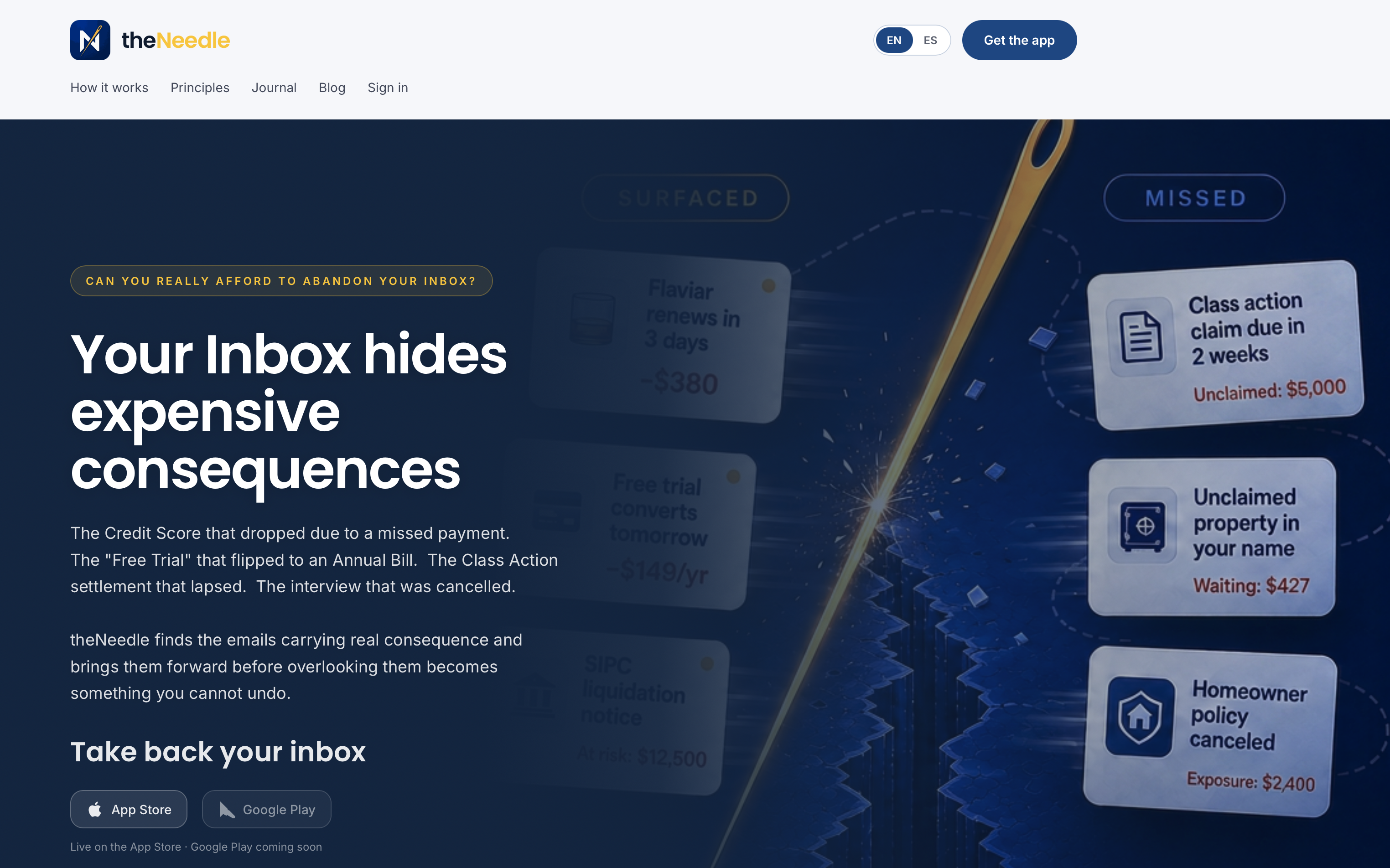
- Consequence driven prioritization surfaces deadlines, financial alerts, and unhandled replies before routine mail.
- Multi-account support covers major mail providers from one view.
- A built in unsubscribe tool and one at a time focus mode cut volume and mental noise at the same time.
You can test it against your real inbox rather than a demo account: start at theNeedle’s live product page and see what it flags in your own mail within minutes.
Where these comparisons come from
The comparisons above draw on published product pages, pricing reviews, and community roundups rather than internal testing claims. Microsoft’s product page describes Outlook’s own positioning around calendar integration and enterprise reach. A pricing review of Spark Mail covers the plan changes and reliability concerns that drive many users to look elsewhere, and the Product Hunt alternatives listing shows how the community itself groups replacement options by privacy, AI features, and team collaboration.
For readers interested in how AI is reshaping email workflows more broadly, this practical playbook on AI email personalization is a useful next read on where automated triage and personalization are heading.
FAQ
Which email service is better, Thunderbird or Spark Mail?
Thunderbird is the stronger pick for anyone prioritizing local, open source privacy since it stores data on your device and publishes its code for review. Spark historically leaned on server side token handling for cross device features, so the better choice depends on whether privacy or synced convenience matters more to you.
Which email app is better, Edison Mail or Spark?
Both are consumer focused clients with broadly similar feature sets, so neither has a clear structural advantage over the other for most everyday users. The better fit comes down to interface preference and which platforms you actually use daily, since coverage and design vary between the two.
Is there a free version of Spark email?
Spark has historically offered a free tier alongside paid plans, though pricing and plan details change over time, so check the current pricing review before assuming any specific feature is included at no cost. Paid tiers generally unlock team and advanced features not available on the free plan.
Is Spark Mail better than Gmail?
Spark is a third party client that connects to your existing Gmail, Outlook, or other accounts and adds features like smart categorization on top, while Gmail is the underlying email service itself. Whether Spark improves on Gmail’s native web and app experience depends on whether you value its added organization features enough to accept its own pricing and token handling model.