Busy Professionals: 5–9 Outlook Categories That Prioritize Consequences

Start with five to nine action-first categories, tied to keyboard shortcuts and Quick Click, then automate the repetitive ones with Rules and view everything through Search Folders. That combination turns categories from cosmetic labels into a real triage system, cutting the time you spend deciding what an email means before you decide what to do with it. Given that the average professional receives 117 emails a day, a lean, automated setup like this is what separates a calm inbox from a permanent backlog.
TL;DR:
- Use six to ten well-defined categories, prioritized with symbols or numbers, to minimize decision fatigue during email triage.
- Apply categories quickly via shortcuts, right-click, or Quick Click, especially for high-frequency labels like “Action” or “Waiting.”
- Create Search Folders and custom views to surface categorized items efficiently, with weekly routines to review key tags like “Waiting” or “Action.”
- Automate tagging rules based on sender or keywords for recurring issues but avoid over-tagging to maintain category reliability.
- Rely on categories for active work states and folders for long-term storage, ensuring a clear boundary between workflow and archive management.
Table of Contents
- Setting Up Your Outlook Categories Strategy: Creation, Color, and Shortcuts
- How Do You Apply Categories to Emails, Events, and Tasks?
- Turning Categories Into Views You Actually Use
- Automating Categories With Rules and Quick Steps
- Categories vs. Folders: When to Use Each
- A Ready-to-Use Category Taxonomy and Maintenance Routine
- Account Limits and Common Category Problems
- How theNeedle’s Prioritization Complements a Categories Strategy
- What I’ve Learned About Categories That Actually Stick
- Let theNeedle Handle the Triage Your Categories Can’t
- Sources
Setting Up Your Outlook Categories Strategy: Creation, Color, and Shortcuts
Before you tag a single message, build the taxonomy once and make it fast to use forever. Everything starts in the same place regardless of which Outlook you run: open Categorize > All Categories. In classic Outlook for Windows, that command lives on the Home ribbon or in the right-click context menu. In New Outlook and Outlook on the web, look for the tag icon in the ribbon or right-click a message and choose Categorize. From there, Microsoft’s own documentation walks through the mechanics: click New, name the category, assign a color, and optionally set a keyboard shortcut.
The naming and coloring choices matter more than they seem to. A category called “Follow Up” tells you nothing about urgency or ownership. A category called “Action” does. Microsoft’s own best-practices guidance recommends organizing categories around project, topic, or activity type rather than vague emotional labels like “Important,” which everyone overuses until it means nothing.
Here’s the setup sequence that works for most professionals building this from scratch:
- Open Categorize > All Categories and click New for each category you’re adding.
- Pick colors that are visually distinct at a glance, not just different shades of the same hue.
- Assign keyboard shortcuts (Ctrl+F2 through Ctrl+F12 in classic Outlook) to your three or four highest-frequency categories.
- Set Quick Click to your single most-used tag, usually “Action,” so one click on the category column applies it instantly.
- Save the list and resist adding more categories for at least two weeks of real use.
Nine categories is roughly the ceiling before the system collapses under its own weight. Research on categorization habits suggests six to ten well-defined categories tends to outperform larger lists, because every additional option adds a decision point during triage, the exact moment you’re trying to move fast.
Pro Tip: Prefix your highest-priority categories with a symbol like @ or a number (1: Action) so they sort to the top of the category list alphabetically. It sounds trivial until you’re scanning a fifteen-category dropdown at 8 a.m. and the one you need is buried at the bottom.
Once the list exists, leave it alone. The temptation to add a new category for every new project is strong and almost always counterproductive. Add categories when a genuine new workflow demands one, not because a single email felt like it deserved its own label.
How Do You Apply Categories to Emails, Events, and Tasks?
Categories only earn their place in your workflow if applying them takes less time than deciding whether to bother. Outlook gives you four ways to do it, and which one you use should depend on where you already are in the interface.
- Right-click the item (email, calendar event, or task) and choose Categorize, then select from the list or hit All Categories for the full menu.
- Use the ribbon while an item is open or selected. The Categorize button sits in the Tags group on the Home tab in classic Outlook.
- Click directly in the reading pane or category column if you’ve enabled Quick Click, applying your default tag with a single click.
- Press the assigned keyboard shortcut (Ctrl+F2, for example) while the item is selected, which is by far the fastest method once shortcuts are set.
You can stack multiple categories on one item, and this is where the system starts doing real work. An email from a client about an overdue invoice might carry both “Action” and “Project-Acme,” giving you two ways to find it later: by urgency when you’re triaging, or by project when you’re prepping for a client call. Microsoft’s guidance on categories confirms this multi-tagging is intentional, not a workaround.
The same mechanics extend to your calendar and your task list. Tag a recurring status meeting “Waiting” if you’re expecting deliverables from it, or tag a task “Reference” if it’s really documentation you’ll need later rather than something requiring action. This is where categories start doing something folders can’t: your calendar, your inbox, and your to-do list all speak the same taxonomy, so a search for “Project-Acme” surfaces everything related, regardless of which Outlook module it lives in.
Two caveats worth knowing before you build your whole system around this. First, categories are private. Recipients never see the tags you apply to their emails, so don’t rely on categories for any kind of shared status signal, that’s a job for flags or a shared task list. Second, IMAP accounts generally don’t support color categories the way Exchange and Microsoft 365 accounts do. If you’re tagging away and nothing sticks, check your account type before you assume the feature is broken.
Turning Categories Into Views You Actually Use
A category that only exists as a colored dot next to a subject line is barely more useful than no category at all. The real payoff comes from building views and Search Folders that surface tagged items on demand, so “Action” becomes a place you go, not just a label you glance at.
Search Folders are the simplest way to do this. They’re virtual folders that pull matching items from wherever they actually live, without moving anything. To build one for a category, right-click Search Folders in your folder list, choose New Search Folder, select Categorized mail, and pick the category you want it to track. The item stays in your inbox or wherever it lives; the Search Folder just gives you a permanent, live filter.
A basic checklist for setting one up:
- Right-click Search Folders and choose New Search Folder.
- Select the Categorized mail template.
- Click Choose Categories and pick the one you want to track (start with “Action”).
- Name it something you’ll recognize instantly, like “Action Items” rather than the generic default.
- Repeat for “Waiting” if you run a weekly follow-up review.
Beyond Search Folders, you can sort and filter the standard Inbox view by category directly. Click the View tab, choose View Settings, and add category as a sort or group field. Grouping by category and then by date turns your inbox into something closer to a daily worksheet than a wall of chronological noise.
In practice, this supports two different rhythms. A daily “Action” mode means checking your Action Search Folder first thing, working through it, and only then opening the general inbox. A weekly “Waiting” review means a Friday afternoon pass through everything tagged “Waiting,” to catch anything that’s gone quiet and needs a nudge. Neither rhythm works if you’re hunting for tagged items manually every time, which is exactly the friction Search Folders eliminate.
Automating Categories With Rules and Quick Steps
Manual tagging works fine for the first fifty emails. After that, the friction adds up, and automation is what keeps a categories strategy alive past week one. Outlook gives you two tools for this: Rules, which run automatically on incoming mail, and Quick Steps, which run manually with a single click.
Setting up an automated Rule follows a consistent pattern:
- Go to Rules > Manage Rules & Alerts and click New Rule.
- Choose a condition based on sender, subject keywords, or header text (for example, “from specific people” for a recurring client).
- Set the action to assign it to the category and pick the category name.
- Add a second action if needed, like marking it as read or moving it to a folder.
- Run the rule on existing mail if you want it applied retroactively, not just to future messages.
Quick Steps solve a slightly different problem. Rather than running silently in the background, they let you combine actions like apply category, move to folder, and mark as read into a single click you trigger yourself. Microsoft’s best-practices documentation recommends this specifically for repetitive multi-step actions, which describes most email triage decisions.
Three recipes that hold up well in daily use:
- Invoices and receipts: a Rule that scans subject lines for “invoice” or “receipt” and tags the category “Reference,” so financial paperwork never gets lost in the general noise.
- Recurring client threads: a Rule based on sender domain that tags “Project-
” automatically, keeping every message from that relationship in one searchable bucket. - Newsletters and digests: a Rule that tags “Read Later” and skips the inbox entirely, landing straight in a Search Folder you check once a week, not once an hour.
Pro Tip: Automation works best on categories that describe topic or source, not urgency. Let a Rule decide that an email is from a specific vendor; don’t let it decide that something is “Action,” because urgency is contextual and a Rule can’t read the message the way you can.
The failure mode to watch for is over-tagging. A Rule with loose keyword matching will happily mislabel unrelated emails, and once your categories stop being trustworthy, you stop checking them. Review your Rules every few months and tighten the conditions if you’re seeing false positives creep in.
Categories vs. Folders: When to Use Each
Categories and folders solve different problems, and the confusion between them is one of the most common reasons an Outlook organization system quietly falls apart. Microsoft’s own community guidance draws the line clearly: folders are for storage, categories are for meaning.
A folder is a single location. An item lives in exactly one folder at a time, which makes folders great for archival and compliance, anywhere you need one definitive home for a record. A category is a label, not a location. The same email can be tagged “Action” and “Project-Acme” and “Waiting” all at once, sitting in your inbox the entire time. That multi-dimensional quality is what makes categories suited to active workflows and folders suited to things you’re done with.
The practical rule of thumb: use categories while something is live and use folders once it’s resolved. Triage in the inbox with categories doing the sorting, then move the thread to a project folder for the record once it’s closed. You get the speed of tagging during the busy phase and the tidiness of archival once the work is over.
Do:
- Use categories for anything that changes state (open, waiting, resolved).
- Use folders for anything you need to retain long term or reference during an audit.
- Combine both: category during active work, folder after resolution.
Don’t:
- Build a folder for every project when a category would let you see the same items alongside everything else in your inbox.
- Rely on categories for anything a colleague needs to see, since they’re private to your view only.
- Let folders multiply past the point you can remember where anything lives.
A Ready-to-Use Category Taxonomy and Maintenance Routine
Most professionals overbuild their first category list, then abandon it within a month because it’s too granular to maintain. A smaller, action-first taxonomy holds up better over time. Here’s a starting set that maps to how work actually moves through an inbox:
- Action: requires a response or decision from you, no exceptions.
- Waiting: you’re expecting something back from someone else.
- Reference: informational, no action needed, but worth keeping searchable.
- Project-
: one category per active client or initiative, retired when the work ends. - Personal: anything outside work that still lands in the same inbox.
Color choice should reinforce urgency at a glance. Red or orange for “Action,” yellow for “Waiting,” a neutral gray or blue for “Reference,” distinct but calm colors for each active “Project” tag. Naming should stay short and literal. “Action” beats “Needs My Attention ASAP,” both because it’s faster to scan and because a shorter label leaves more room for the subject line in a crowded view.
Maintenance is where most systems quietly die, and it’s the step people skip. Set a recurring quarterly review, fifteen minutes, calendar reminder, whatever gets it done, to retire project categories for closed work and merge any duplicates that crept in. Best-practices guidance from Microsoft specifically calls out this kind of periodic housekeeping as part of what keeps a category system usable rather than bloated.
Pair the taxonomy with a routine, because a category with no scheduled review is just decoration. A workable rhythm looks like this: triage the “Action” Search Folder every morning between 9:00 and 9:30, before the rest of the day’s meetings start pulling attention elsewhere. Reserve Friday afternoon for a “Waiting” review, scanning for anything that’s gone quiet and needs a follow-up nudge before the weekend.
By the numbers: A stable vocabulary of six to ten well-defined categories, paired with Search Folders and Quick Steps, produces measurably faster triage than either a sprawling category list or no categorization system at all. Given that the average professional gets 117 emails a day, that efficiency compounds fast.
Categories work best alongside flags and reminders, not instead of them. Microsoft’s guidance on the combined system treats categories as classification, flags as the trigger for follow-up items that surface in Microsoft To Do, and reminders as the date-based backstop. Use all three together and none of them has to do more work than it’s suited for. A partner resource on team task collaboration covers a similar layered approach for shared workflows, worth a look if your categories need to interact with a team’s task system rather than just your own inbox.
Account Limits and Common Category Problems
Not every account type plays nicely with categories, and the mismatch usually shows up at the worst possible moment, mid triage, when a tag just won’t apply. IMAP accounts generally don’t support color categories the way Exchange and Microsoft 365 accounts do, so if you’re connecting a personal IMAP mailbox and categories aren’t sticking, that’s the likely cause, not a bug in your setup. Categories sync properly across devices only when you’re on Exchange or Microsoft 365, which is worth confirming before you build an elaborate system on an account that can’t carry it.
New Outlook and classic Outlook place the Categorize controls in slightly different spots, ribbon icon versus right-click menu, but the underlying behavior is the same. One detail that trips people up: category names are stored on the item itself, not just referenced from a master list. That means deleting or renaming a category in All Categories doesn’t retroactively clean up items already tagged with the old name, they’ll keep the orphaned label until you manually reapply the corrected one.
Quick troubleshooting checklist:
- Categorize command missing: confirm you’re not on an unsupported IMAP account.
- Categories not syncing across devices: verify the account is Exchange or Microsoft 365, not a local PST-only setup.
- Recurring meetings behaving oddly: categorizing one instance of a series doesn’t always apply to the whole series, apply it to the series explicitly if you want consistency.
How theNeedle’s Prioritization Complements a Categories Strategy
A well-built category system tells you what an email is. It doesn’t tell you what an email costs if you ignore it. That’s the gap theNeedle is built to close, and it’s why the two approaches work better together than either does alone.
theNeedle scans your inbox for messages with real consequences, deadlines, financial alerts, unanswered questions from people waiting on you, and surfaces those first, ahead of the volume. Given that the average worker receives 117 emails daily, the practical question isn’t whether you can read all of them, it’s whether you’re reading the right five before the rest.
The workflow pairs cleanly with everything covered above: theNeedle surfaces the highest-consequence item first, you tag it “Action” in Outlook the moment you see it, then you process it and archive or file it once it’s resolved. theNeedle handles the “what matters right now” question; your category taxonomy handles the “where does this live in my workflow” question. Neither replaces the other.
This matters most for the exact reader building this system in the first place: someone managing multiple inboxes, deadlines, and a category taxonomy they’re trying to keep lean. A focused, one-thing-at-a-time approach to email, rather than trying to process everything in arrival order, is the same principle behind both a disciplined category list and theNeedle’s consequence ranking. For more on how deliberate inbox habits compound over time, theNeedle’s journal covers related productivity techniques worth reading alongside this setup.
What I’ve Learned About Categories That Actually Stick
Most category systems fail for the same reason most New Year’s resolutions fail: they start too big. Someone builds twenty-two categories in an afternoon of enthusiasm, uses twelve, forgets the rest exist, and abandons the whole thing within a month. The systems that survive are almost always smaller than their creator initially wanted.
Start with five categories, not fifteen. Automate the ones that describe a source or topic (client threads, invoices, newsletters), because a Rule can reliably detect where an email came from. Leave the urgency judgment, “Action” versus “Reference”, to yourself, because that’s contextual in a way automation still handles poorly. Then put a review on your calendar. Not “whenever I remember,” an actual recurring date. Systems that depend on remembering to maintain themselves don’t get maintained.
The deeper reason action-first categories work isn’t organizational, it’s cognitive. Every email you open forces a small decision: what is this, and what do I owe it? A category applied at the moment of triage answers that question once and lets you skip re-deciding it every time you glance at the subject line later. That’s the actual cost categories eliminate, not clutter, but repeated decision-making about the same message.
— Glen Bover
Let theNeedle Handle the Triage Your Categories Can’t
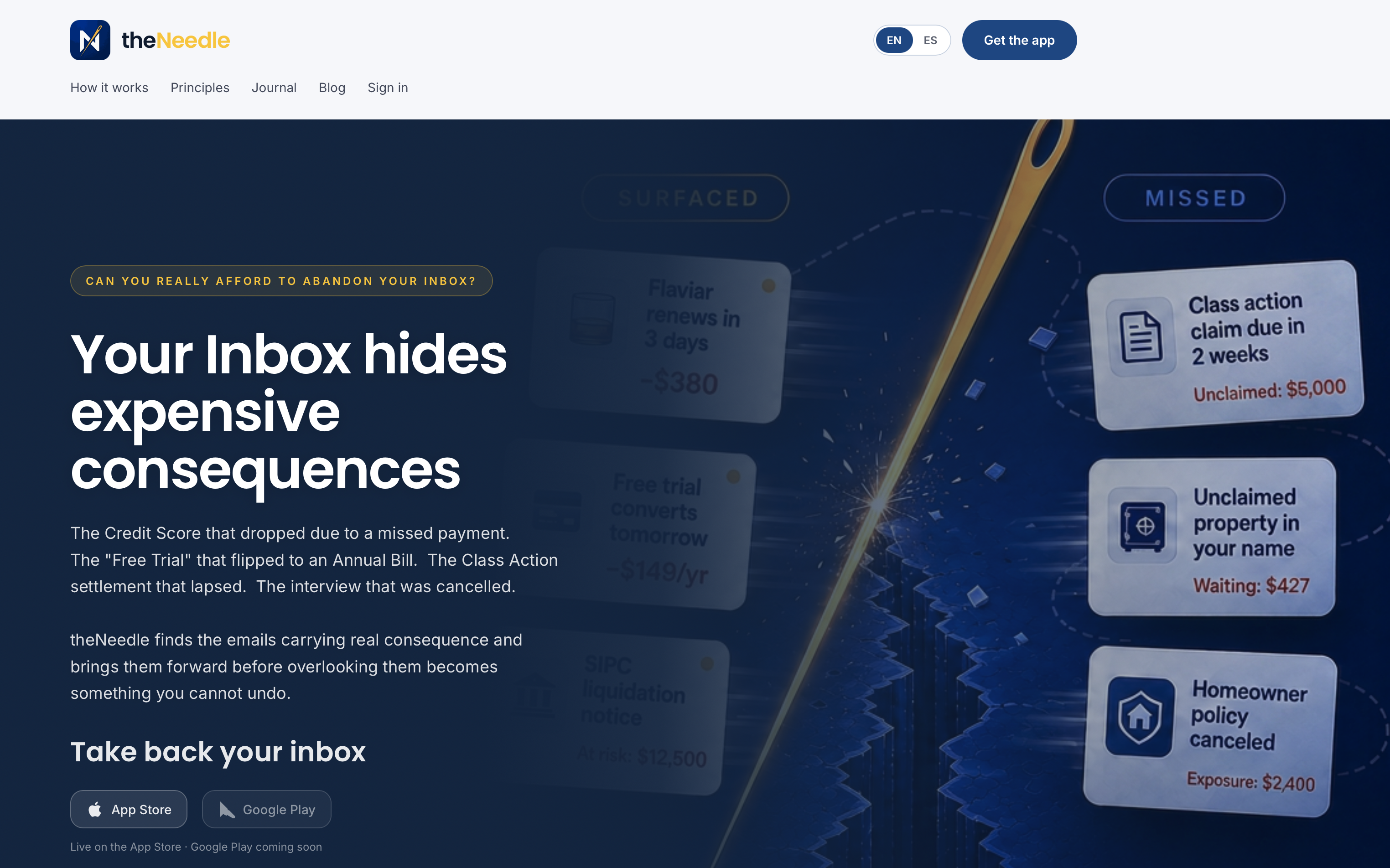
Categories tell you what an email is. theNeedle tells you what it costs if you miss it, and that’s the piece a manual taxonomy, no matter how well built, can’t do on its own. Where a category system depends on you noticing and tagging things correctly during triage, theNeedle scans automatically for deadlines, financial alerts, and unanswered messages that carry real consequences, then puts those in front of you before you even open the rest of your inbox.
| Manual Outlook categories | theNeedle as a complement | |
|---|---|---|
| Setup effort | Build taxonomy, Rules, Search Folders yourself | Connects to your inbox in minutes |
| What it catches | Whatever you remember to tag | Deadlines and consequences you might miss |
| Ongoing work | Requires quarterly review and rule maintenance | Runs continuously in the background |
theNeedle connects to Gmail, Outlook, Microsoft, Yahoo, and iCloud accounts, so it works alongside the category system you’ve just built rather than asking you to replace it. If you’re managing multiple inboxes and want to see which messages actually deserve your attention today, try theNeedle live and see what surfaces in your own inbox.
Sources
- Use categories in Outlook — Microsoft Support
- Master Outlook Email Organization with Categories and Color Coding in 2026 — Office Learner