Two Filters, Five Minutes: Filter Important Emails for Busy Pros

Set up two filters today: one for VIP senders, one for action-required messages, then spend five minutes teaching Gmail’s importance marker or Outlook’s Copilot what actually matters to you. That combination works on both major clients, with only minor menu differences between them. It matters because the average worker now receives 117 emails a day, and most of those messages carry zero consequence if ignored.
TL;DR:
- Building a small set of high-precision filters for VIP senders and action-required emails can significantly reduce inbox clutter and improve response times.
- Testing search criteria before creating filters ensures they catch the right messages, and applying filters retroactively helps clear existing clutter efficiently.
- Using machine-learning tools like Gmail’s importance marker and Outlook’s Copilot together improves email prioritization by combining manual rules with AI insights.
- Regularly editing, revising, or deleting outdated filters prevents rules from becoming noise and maintains filter effectiveness over time.
- Focusing filters on messages with real consequences, such as deadlines or financial impacts, offers more productivity gains than filtering by volume alone.
Table of Contents
- How Do You Create Email Filters That Actually Work?
- What Are the Best Filter Recipes for Important Emails?
- How Do Gmail’s Important Marker and Outlook’s Copilot Work?
- How Do You Edit or Remove a Filter Later?
- Why Isn’t Your Filter Catching the Right Emails?
- Why Volume Isn’t the Real Problem
- A Tool Built Around Consequence, Not Just Volume
- Sources
- FAQ
How Do You Create Email Filters That Actually Work?
Every email filter follows the same logic, whether you’re in Gmail or Outlook: define the criteria, test it against real mail, create the rule, choose what happens when it matches. Skip the testing step and you’ll end up with a filter that either catches nothing or catches everything, which is worse than no filter at all.
Here’s the general workflow, adapted for each platform:
- Define your search criteria. Decide what identifies an important email: a sender’s address, a keyword in the subject line, an attachment, or a combination.
- Test the search first. Type the criteria into the search bar and run it before building anything. If it returns the wrong emails, adjust before you automate.
- Create the filter or rule. In Gmail, click the small dropdown arrow inside the search bar (or “Show search options”), confirm your criteria, and select Create filter. In Outlook, run your search, then use the Rules option from the search results or from Settings to build the corresponding rule.
- Choose the action. Label, star, forward, mark as read, or move to a folder, depending on what “important” should trigger.
- Decide whether to apply it retroactively. Both platforms let you apply a new filter to existing matching messages, not just future ones.
That last step trips people up constantly. According to Gmail’s own filter documentation, a filter that forwards mail only affects messages that arrive after the filter is created. Your inbox history stays untouched unless you explicitly check the box to apply it to existing conversations. The same logic applies in Outlook: a rule built today doesn’t reach backward through your archive automatically.
On mobile, both apps let you view and toggle existing filters, but building a new one from scratch is clumsy on a small screen. Set up your filters on desktop, then let them run quietly in the background everywhere else.
What Are the Best Filter Recipes for Important Emails?
You don’t need dozens of rules. You need five or six that catch the messages with real consequences. Here are templates you can copy directly into the search bar of either client.
VIP senders. Catch anything from your manager, your biggest client, or your board chair before it gets buried under newsletters.
- Search:
from:(manager@company.com OR director@company.com) - Action: apply a “VIP” label, star it, and move it to the top of your priority view.
This pattern comes straight from Google Workspace’s own advanced filter guidance, which recommends chaining multiple addresses with OR rather than building a separate rule for each person.
Action-required and deadline emails. These are the messages that cost you money or trust if you miss them.
- Search:
subject:(deadline OR "action required" OR "due date") to:(you@company.com OR you+urgent@company.com) - Action: label as “Action Required,” flag it, and set a reminder if your client supports one.
Receipts and finance. Useful for tracking refunds, invoices, and billing disputes without digging through months of statements.
- Search:
subject:(invoice OR receipt OR refund) from:(billing@ OR noreply@) - Action: label as “Finance” and mark unread so it stays visible until handled.
Contracts and attachments. Anything with a signature request or legal document deserves its own lane.
- Search:
has:attachment subject:(contract OR agreement OR signature) - Action: label as “Contracts,” star it.
Newsletters and marketing. The opposite problem: mail that’s fine to receive but shouldn’t compete for your attention.
- Search:
unsubscribe OR "view in browser" - Action: skip the inbox, archive automatically, and unsubscribe from repeat offenders instead of just filtering them.
Pro Tip: Build the VIP and action-required filters first, apply them to existing mail retroactively, and watch how much smaller your inbox looks in sixty seconds. That’s usually enough to convince skeptics that filtering beats scrolling.
How Do Gmail’s Important Marker and Outlook’s Copilot Work?
Both Gmail and Outlook now layer machine-learning prioritization on top of manual filters, and understanding what feeds that model changes how well it performs for you.
Gmail’s Important marker watches behavioral signals: who you email most, which messages you open, reply to, or star, and how quickly you act on certain senders. According to Gmail’s importance marker documentation, you can hover over the marker on any message to see why Gmail flagged it, then toggle the marker manually to correct mistakes. Every correction feeds back into the model.

Outlook’s Copilot prioritization works differently. It evaluates thread participants and message content, then marks high-priority mail with an up arrow in the inbox list. Microsoft’s support documentation confirms you can teach and adjust this behavior under Settings → Copilot → Prioritize, refining which senders and topics get the arrow.
Combine the two systems instead of choosing one:
- Let manual filters handle absolutes (your boss’s email always gets flagged, no exceptions).
- Let the AI handle the gray area (a new client who hasn’t earned a VIP filter yet but sends messages that clearly matter).
- Correct mistakes as soon as you see them. Both systems retrain faster when you act immediately rather than letting bad predictions accumulate.
- Test any new rule against a few days of incoming mail before trusting it fully.
How Do You Edit or Remove a Filter Later?
Filters aren’t permanent commitments. Your job changes, your VIP list changes, and old rules quietly become noise if you never revisit them.
- Find your existing rules. In Gmail, go to Settings → Filters and Blocked Addresses. In Outlook, check Settings → Mail → Rules.
- Check for order conflicts. Rules run in sequence, and an earlier rule can intercept mail before a later one gets a chance to act. If a filter never seems to fire, check what’s positioned above it.
- Export or import when switching setups. Gmail lets you export your filters as an XML file and import them into another account, useful when you’re consolidating inboxes or setting up a new work address.
- Prune regularly. Delete rules tied to old projects, rename labels that no longer make sense, and retest everything after a big change to how you use email.
Labels and folders behave a little differently under the hood depending on the client and protocol you use, which matters if you’re ever exporting or scripting around your setup.
Why Isn’t Your Filter Catching the Right Emails?
Filters fail for a small, predictable set of reasons, and running through a short checklist solves most of them faster than rebuilding the rule from scratch.
- Run the exact search string first. If it returns zero results, the filter never had a chance.
- Check for typos in domain names or a stray space in a quoted phrase.
- Confirm you’re matching the actual sender field, not a display name that varies by campaign.
- Verify whether “also apply to matching conversations” was checked. Without it, most filters only catch new messages going forward.
For testing, lean on operators: OR for multiple senders, quotation marks for exact phrases, has:attachment for files, to: for aliases, and subject: to narrow by wording. Outlook’s search and filter training covers the same refinement controls if you’re working in that client.
One caution worth sitting with: content-based rules have limits on the sending side too. Modern spam filters weigh sender reputation and authentication far more heavily than individual keywords, so don’t assume a perfectly worded subject line guarantees delivery from every sender. Fewer, high-precision filters consistently outperform a sprawling pile of overlapping rules that fight each other for the same message.
Why Volume Isn’t the Real Problem
Most inbox advice treats every unread message as equally threatening, and that’s backward. The real cost isn’t the 117 emails that land in an average worker’s inbox each day. It’s the two or three among them carrying a deadline, a financial consequence, or a relationship you can’t afford to damage by going quiet.
Filters built around consequence, not volume, do something more valuable than tidying your inbox. They lower the mental tax of deciding, over and over, what deserves attention. That’s the real drain on a busy professional’s day, not the scrolling itself.
[[case study placeholder: theNeedle metrics on time saved]]
— Glen Bover
A Tool Built Around Consequence, Not Just Volume
Manual filters and AI markers get you most of the way there, but they still ask you to define “important” in advance. theNeedle takes a different approach: it scans your inbox for messages with real legal, financial, or deadline consequences and surfaces those first, whether or not you thought to build a rule for them.
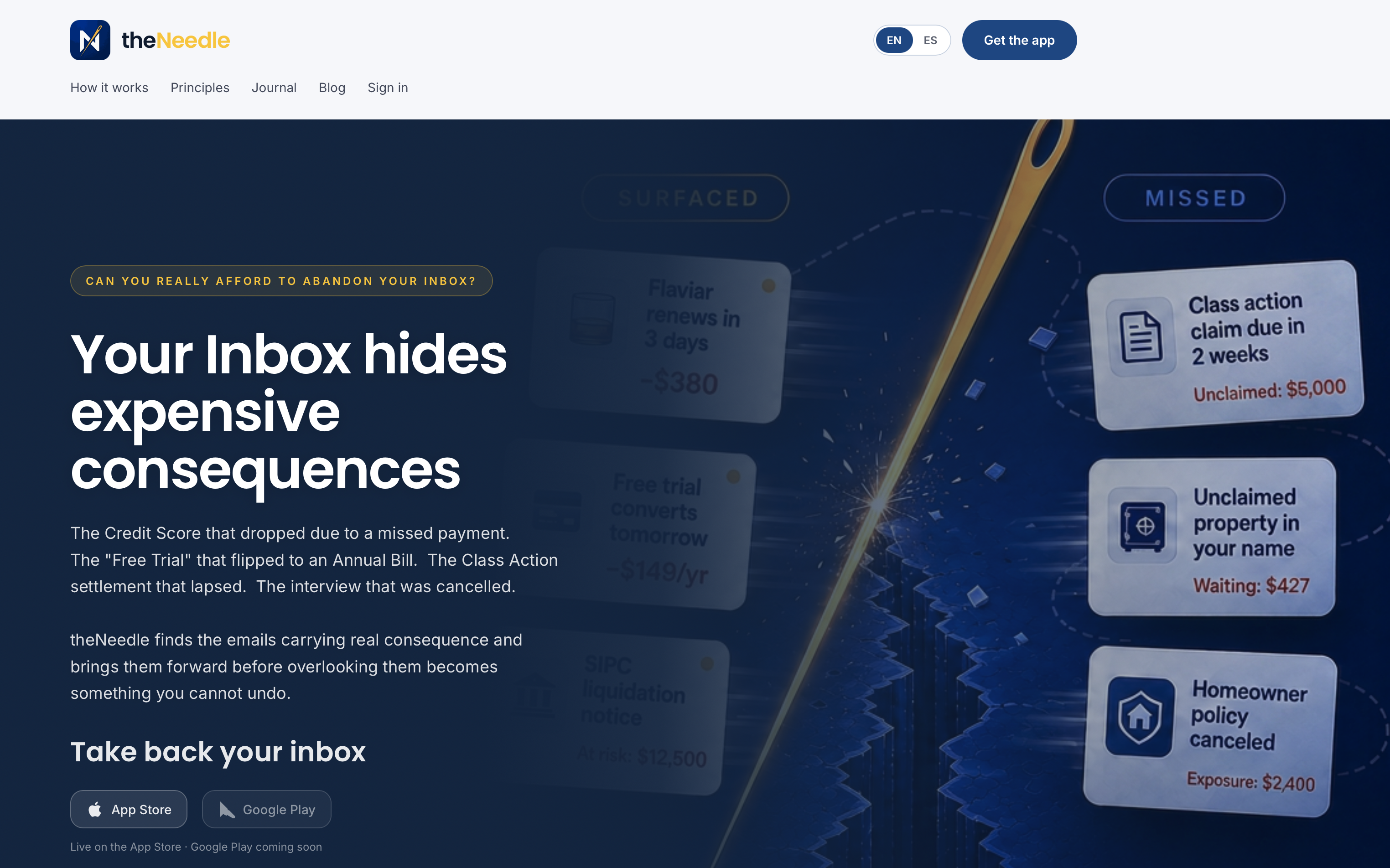
It’s built to complement everything covered above, not replace it. Keep your VIP and finance filters running, and let theNeedle catch the consequential message that slipped through a gap none of your rules anticipated. If you’re managing multiple inboxes across Gmail, Outlook, Yahoo, or iCloud and tired of manually deciding what deserves your attention, you can try theNeedle and see what it flags in your own inbox this week.
Sources
- Create rules to filter your emails - Gmail Help
- Prioritize my inbox - Microsoft Support
- Senderreputation
FAQ
How Do I Filter Important Emails in Outlook?
Search using operators like from:, subject:, or has:attachment, then convert that search into a rule through Settings → Mail → Rules. You can also let Copilot mark high-priority mail automatically with an up arrow, adjustable under Settings → Copilot → Prioritize.
How Do I Filter Important Messages in Gmail?
Use the search bar’s “Show search options,” test your criteria, then click Create filter and choose an action like labeling or starring. Gmail’s own filter guide walks through each step, including how to apply the rule to existing mail.
How Do I Find My Important Emails?
Search is:important in Gmail to see everything the importance marker has flagged, or check messages marked with an up arrow in Outlook. If a tool like theNeedle is connected to your inbox, it surfaces consequential emails automatically without requiring you to search at all.
Why Do My Emails Go to Important Instead of Inbox?
Gmail’s Important marker relies on machine-learning signals such as who you email most and how you interact with specific senders, including opens, replies, and stars, according to Gmail’s importance marker documentation. If it’s tagging the wrong messages, toggle the marker manually on a few examples to retrain it.