15 Minute Email Risk Detection for Busy Professionals

Email risk detection means flagging the handful of messages whose absence causes real damage: a missed deadline, an unpaid invoice, an unanswered client who quietly walks away. The right move is not to file or delete faster. It is to enable consequence-driven surfacing, whether through a rule you build yourself or a tool like theNeedle, and check that “Act-now” queue twice a day. Workers get 117 emails daily on average. Almost none of them matter this much.
TL;DR:
- Consequence-driven email detection prioritizes messages with real deadlines, financial implications, or unresolved client replies, filtering out irrelevant clutter.
- Setting up effective detection requires only minutes to connect your inbox, enable deadline extraction, and test on a few sample threads for accuracy.
- A three-tier triage system (Act-now, Today, This-week) ensures urgent issues are addressed immediately while lower-stakes items are batched for review.
- The system works best when integrated with existing email providers and focuses on tracking missed deadlines and response times to evaluate effectiveness.
- Proper configuration and ongoing monitoring, including tracking missed deadlines and stress levels, are essential to ensure the system reduces risks without creating overload.
Table of Contents
- What Does Email Risk Detection Actually Surface?
- What Signals and Techniques Actually Catch Consequential Emails?
- How Do You Set Up Detection In 15 Minutes?
- Building a Triage System That Doesn’t Interrupt You Constantly
- Is Your Detection System Actually Working?
- How theNeedle Applies Consequence-Driven Detection
- What Kinds of Email Risks Get Detected?
- Signature Rules vs. Pattern Recognition: Two Different Playbooks
- Does This Work With My Existing Email Setup?
- What About Privacy When a Tool Reads Your Inbox?
- What Does This Look Like in a Real Inbox?
- Why Most Inbox Advice Misses the Real Problem
- Try theNeedle Free and Stop Losing Track of What Matters
- Sources
- FAQ
What Does Email Risk Detection Actually Surface?
Consequence-driven detection is not a spam filter with a new name. It is looking for the messages that carry a real world attached to them, the ones where ignoring the email changes something outside your inbox.
Here is what that looks like in practice:
- An invoice with a due date and a late fee clause buried in paragraph two.
- A renewal notice with a cancellation window (“respond by March 14 to avoid auto-renewal”).
- A refund or credit offer that expires (“use this code within 10 days”).
- A client’s second message asking, “did you get my last email?” after 48 hours of silence.
- A contract amendment requiring signature before a specific date.
Compare that against the emails eating your attention for no good reason: newsletters, product announcements, “just checking in” marketing sequences, internal FYIs nobody will follow up on. Those emails have volume. They do not have consequence, and that distinction is the entire point of this approach, backed by research on email load as a work stressor that finds communication clutter, not task-related mail, drives most of the overload people feel.
Run a quick self-audit. Scroll your last 48 hours of inbox and count how many messages had a real deadline or dollar amount attached. Now count how many of those you actually acted on inside 24 hours. The gap between those two numbers is your risk exposure.
What Signals and Techniques Actually Catch Consequential Emails?
Detection systems look for explicit textual signals, not sender reputation or subject line guesswork. The strongest ones include:
- Date phrases: “by Friday,” “within 5 business days,” “no later than March 20.”
- Invoice and billing patterns: dollar amounts paired with due dates or late fee language.
- Contract keywords: “amendment,” “sign by,” “terminates,” “renewal.”
- Action-window phrases: “expires,” “limited time,” “final notice.”
On the technical side, named entity recognition (NER) pulls out dates and time expressions from unstructured text, while transformer-based classifiers, the kind built on architectures like DistilBERT, learn to rank urgency based on phrasing patterns rather than keyword matching alone. A 2026 study on smart email sorting describes exactly this kind of hybrid pipeline: regex catches obvious date formats, NER catches the fuzzier ones (“end of next week”), and a transformer model scores the overall intent.
Rule-based filters (“if sender contains ‘billing,’ flag it”) break the moment a vendor changes their email template. Machine learning based approaches adapt because they read the sentence, not the sender field. Industry voices covering inbox management have made the same argument: manual rule filtering falls short for busy professionals, because static rules cannot learn from what you actually do with your mail.
One clarification worth making plainly: this is not phishing or malware detection. Email risk detection, in this sense, looks for consequence, not for malicious intent. A legitimate invoice from your accountant carries just as much risk as a scam email if you miss it.
How Do You Set Up Detection In 15 Minutes?
You do not need a security team or a week of configuration. Here is the fast path:
- Connect your inbox. Link Gmail, Outlook, or another provider through OAuth. This grants read access without handing over your password, and you can revoke it anytime from your account settings.
- Turn on calendar integration if offered. This lets detected deadlines convert directly into calendar events instead of living only in an inbox label.
- Enable deadline extraction or build an “Act-now” label. If your tool has consequence detection built in, turn it on. If not, create a manual label and commit to tagging anything with a date or dollar amount attached.
- Test it on three threads. Pick one invoice, one client reply awaiting response, and one renewal or subscription notice. Confirm all three get flagged correctly.
- Set two review windows. Morning and late afternoon. Nothing more.
- Adopt one processing rule. Anything in Act-now gets handled within four hours of the review window, no exceptions.
Pro Tip: Before trusting any detection system with your full inbox, run that three-thread test first. If it catches the invoice and the renewal but misses the “did you see this?” reply, you know exactly where to tighten your rules or your tool’s settings before you rely on it for real.
Building a Triage System That Doesn’t Interrupt You Constantly
Detection only helps if what happens next is simple. The most durable structure is a three-tier queue: Act-now for anything with a same-day consequence, Today for things that need a response before end of day but won’t blow up if delayed a few hours, and This-week for lower-stakes items with a longer runway.
- Act-now items get an immediate notification. Everything else waits for a batch review.
- Today and This-week items get checked at your two scheduled windows, not every time your phone buzzes.
- Unhandled-reply tracking flags client messages that went unanswered for 48 hours or more, a category people lose track of constantly.
- Calendar sync turns a detected deadline into an actual event, so the consequence lives somewhere besides your memory.
A freelancer juggling four clients might check Act-now at 8 a.m. and 4 p.m., batch Today items right before lunch, and clear This-week items once on Friday. A team lead managing delegated threads benefits from the same batching logic paired with structured escalation rules so nothing consequential sits unanswered because it got handed off and forgotten.
Outcome-based triage beats chasing inbox zero. Inbox zero measures how empty your inbox looks. This measures whether anything expensive slipped through, which is the number that actually matters.
Is Your Detection System Actually Working?
Three metrics tell you if this is helping or just adding noise: missed deadlines avoided, time-to-action on Act-now items, and a subjective stress read (are you checking email compulsively, or on your own schedule?).
Watch for the failure modes too:
- Over-alerting. If everything gets flagged Act-now, you have built a louder inbox, not a smarter one.
- Misclassification. A missed invoice teaches you what phrasing to watch for next time.
- Privacy overshare. Any tool reading your inbox should explain exactly what it accesses and why.
Run a 30-day test. Track missed deadlines in week one before changing anything, then again in week four. Longer email sessions correlate with higher stress and slower recovery after interruptions, so a shrinking number of “emergency” catch-up sessions is itself a useful sign your system is working.
How theNeedle Applies Consequence-Driven Detection
theNeedle builds directly on the idea that inbox overload is a consequence problem, not a volume problem. Instead of sorting by sender or subject, it looks for the deadlines, financial alerts, and unresolved threads that carry real stakes, and surfaces those above everything else.
That distinction matters given how communication-heavy email load actually is: most of what floods a modern inbox is noise, not task-critical content, and separating the two is the whole exercise.
During a free trial, test theNeedle the same way outlined earlier: feed it one invoice, one unanswered client reply, and one renewal notice. Confirm it catches all three and check whether the unhandled-reply tracking flags the thread you forgot about last week.
What Kinds of Email Risks Get Detected?
Consequence-driven detection, as described throughout this guide, focuses on financial and deadline-based risk: unpaid invoices, expiring offers, contract deadlines, and silent client threads. That is a distinct category from email security threats like phishing, malware, and data leaks, which are handled by different tools entirely (spam filters, email gateways, endpoint security).
It is worth knowing the difference so you are not expecting one tool to do both jobs. Phishing detection looks for spoofed domains, suspicious links, and impersonation patterns. Malware detection scans attachments and executable content. Data leak prevention watches outbound mail for sensitive information leaving the organization. Each of those problems has its own specialized defenses, typically bundled into enterprise email security suites or built into your provider’s spam filtering.
Consequence detection sits in a different lane entirely: it assumes the email is legitimate and asks whether ignoring it will cost you something. An invoice from your actual accountant is not a security threat, but it is a risk if you miss the due date. That is the gap this guide, and tools like theNeedle, are built to close. If your goal is stopping scams and malicious attachments, you need a security product alongside your consequence detection, not instead of it.

Signature Rules vs. Pattern Recognition: Two Different Playbooks
Security tools and consequence tools borrow from two different technical traditions, and understanding both helps you evaluate any product claiming to “detect risk” in your inbox.
Signature-based approaches work by matching known patterns: a known malicious link format, a known phishing template, a known spam phrase. This is fast and cheap to run but brittle. It only catches what it has already seen, which is why it belongs to the security side of email management, not the consequence side.
Anomaly detection flags anything that deviates from a learned baseline, useful for spotting an account takeover attempt or unusual login behavior, but it is a security concept, not a consequence one.
For consequence detection specifically, the more relevant approach is closer to intent classification: reading the actual content of a message to determine what kind of action it demands. A hybrid pipeline that layers regex for obvious date formats, NER for fuzzier temporal language, and a transformer classifier for overall urgency scoring outperforms either signature matching or simple keyword rules, because it reads meaning rather than matching strings. That is why static “if subject contains ‘invoice’” rules keep breaking every time a vendor changes their email template, while models trained on phrasing patterns keep working.

Does This Work With My Existing Email Setup?
Consequence detection tools are designed to sit on top of your existing provider, not replace it. theNeedle connects to Gmail, Outlook, Microsoft accounts, Yahoo, and iCloud through standard OAuth permissions, the same authentication method your provider already uses for other third-party apps.
This matters because it means you are not migrating anything or changing how mail arrives. Your provider’s own spam filter, phishing protection, and malware scanning keep running exactly as before. Consequence detection layers on top, reading what makes it through that first filter and re-sorting it by financial and deadline stakes rather than by sender or arrival time.
The practical benefit shows up when you have multiple inboxes. A freelancer running a personal Gmail account and a client-facing Outlook account does not want two separate security systems and two separate triage habits. A single consequence layer across both means one Act-now queue instead of two half-checked inboxes, which is often where missed deadlines actually happen: not because nobody saw the email, but because it was sitting in the “other” inbox nobody checked that day.
What About Privacy When a Tool Reads Your Inbox?
Any system detecting deadlines or financial language has to read your email content, which raises a fair question: where does that data go, and who else sees it?
Look for a few concrete answers before trusting a tool with inbox access. Does it use standard OAuth permissions rather than asking for your actual password? Can you revoke access instantly from your provider’s account settings, not just from the tool itself? Is there a clear answer to what happens to your data if you cancel? A tool that cannot answer these plainly is not one you want reading your invoices and contracts.
Practitioners in this space also point out that many consequential emails come from generic system addresses (billing@, noreply@, accounts@) rather than a recognizable human sender. That means any detection system worth using has to parse the body of the message, not just the sender field, which is one more reason inbox-reading permissions are unavoidable for this category of tool. The tradeoff is real: you are granting read access in exchange for not missing a $400 late fee. For most busy professionals, that trade is worth making, provided the access is scoped, revocable, and transparent about what it does with what it reads.
What Does This Look Like in a Real Inbox?
Picture a freelance designer running three client accounts through one inbox. A vendor invoice arrives with a due date fifteen days out. A client sends a one-line reply asking about a revision, then goes quiet when the designer does not respond within a day. A software subscription sends a renewal notice with a ten-day cancellation window before the price jumps.
None of these look urgent by subject line alone. “Invoice #4471,” “Re: revision,” and “Your subscription is renewing” all read as routine. Under a consequence-driven system, though, each one carries a real number and a real date, and that is exactly what should pull it into the Act-now queue instead of a general folder.
The pattern generalizes past freelancers. A small-business owner juggling supplier contracts faces the same problem with renewal clauses buried in dense legal language. A remote employee managing internal approvals faces it with sign-off deadlines that arrive disguised as routine internal mail. In every case, the risk was never that the email got lost. It arrived, sat in an inbox with 116 other messages, and lost the fight for attention. That is the fight consequence-driven detection exists to help you win, one flagged thread at a time.
Why Most Inbox Advice Misses the Real Problem
The productivity industry has spent a decade obsessing over inbox zero, and I think that obsession has quietly made things worse. Chasing an empty inbox rewards speed, not judgment. It teaches you to archive fast, not to notice which messages actually carry consequences. Enable consequence detection, build the Act-now habit, and expect to spend the first week tuning what counts as urgent. That tuning is the real work, and it pays off.
— Glen Bover
Try theNeedle Free and Stop Losing Track of What Matters
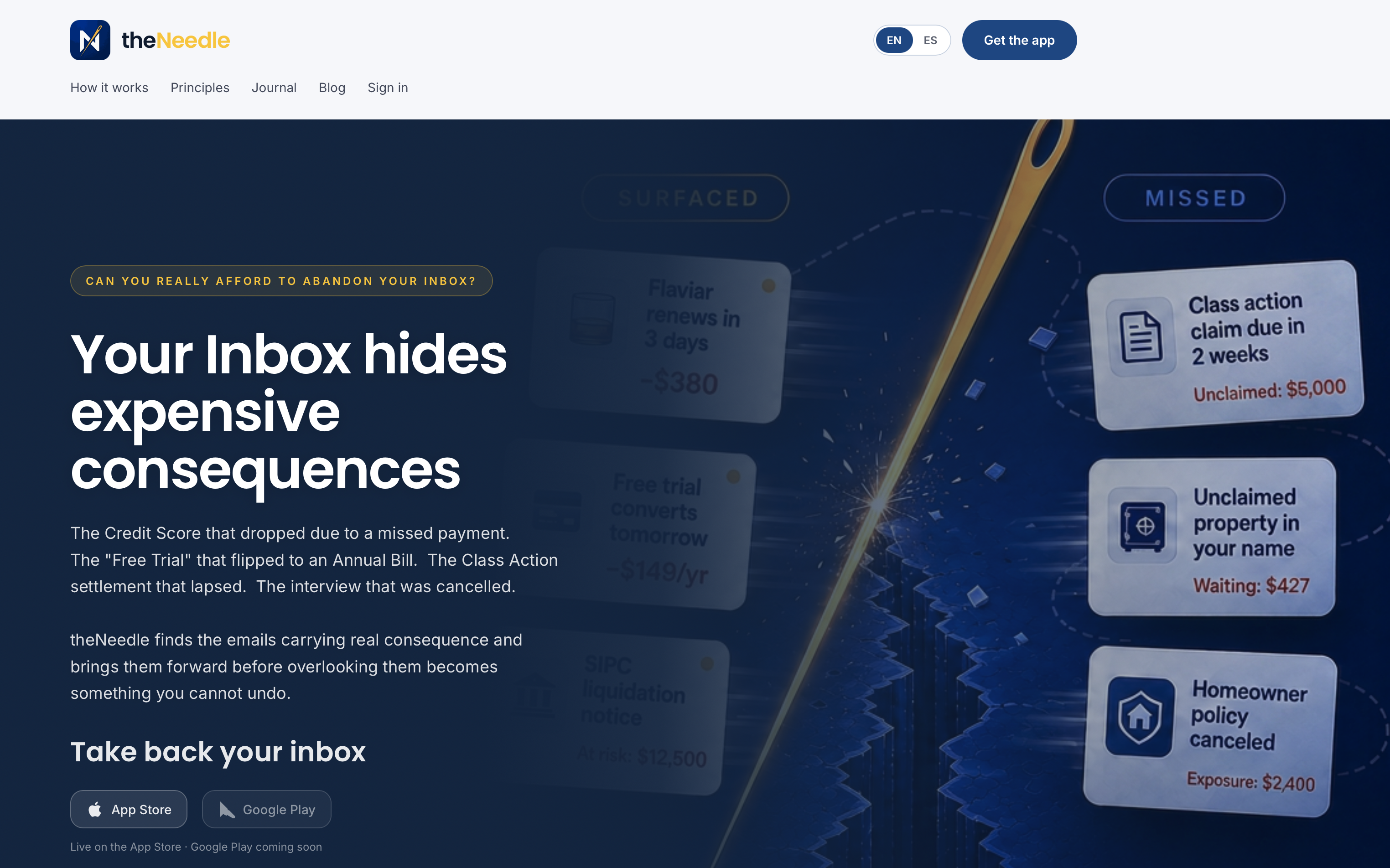
theNeedle is the alternative to manually re-reading every inbox looking for what actually matters. Instead of sorting by sender or subject, it surfaces overdue and urgent messages, tracks unhandled replies so client threads stop going cold, flags opportunities like credits or refunds before they expire, and includes a built-in unsubscribe for the senders who keep flooding your inbox anyway. Its one-at-a-time focus mode is built with ADHD-friendly workflows in mind, so you work through consequence, not clutter.
During your trial, run the same three-thread test from earlier: one invoice, one unanswered client reply, one renewal notice. Confirm theNeedle catches all three before you commit. theNeedle Monthly runs $9.99 per month, or $99.99 per year on the annual plan. Start the trial today and see what your inbox has been hiding.
Sources
- Kern et al. (2024) — email load and urgency bias (PubMed)
- Practical365 — Prioritize my inbox (Tony Redmond, 2025)
- Email duration, batching and self-interruption: patterns of email use (CHI)
- Drowning in emails: email classes and work stressors (PMC)
- Smart Email Sorting System (DistilBERT) — DOI 2026
FAQ
What Is Email Risk Detection?
Email risk detection, in the consequence-driven sense, means identifying messages tied to deadlines, billing, contracts, or unanswered replies so they don’t get buried under routine mail. It focuses on real-world stakes rather than sender or subject line alone.
How Is This Different From Spam or Phishing Filtering?
Spam and phishing filtering catches malicious or unwanted mail using signature matching and anomaly detection. Consequence-driven detection assumes the email is legitimate and asks whether ignoring it would cost you money, time, or a relationship.
Can I Set This Up Without IT Help?
Yes. Connecting an inbox through OAuth and enabling deadline extraction or a manual Act-now label typically takes under 30 minutes, and testing it on three sample threads confirms it’s working before you rely on it.
What Does theNeedle Cost?
theNeedle Monthly costs $9.99 per month, with an annual plan available at $99.99 per year. Both plans include a free trial period to test detection accuracy first.
How Do I Know If Detection Is Actually Working?
Track three things over 30 days: missed deadlines avoided, how quickly you act on flagged items, and whether your daily stress around email checking has dropped. A shrinking number of last-minute catch-up sessions is a strong practical signal.