Fix Email Overwhelm at Work in 30–90 Minutes With a Three Part Triage

Email overwhelm at work comes down to three fixable problems: too much coming in, no fixed time to process it, and no system for deciding what matters. Fix the inflow with unsubscribes and filters, batch your checking into two or three windows a day, and sort what remains into a simple three-part triage system. Do those three things and the panic that comes from an unread count in the thousands starts to fade, whether you use a tool like theNeedle or build the system by hand.
TL;DR:
- Sending bulk filters and unsubscribes can significantly reduce inbox inflow, cutting daily volume by removing newsletters and promotional emails.
- Organizing emails into three folders—Action, Waiting, and Reference—enables effective triage and prevents messages from lingering unprocessed.
- Setting fixed inbox checking times, combined with archiving old unread emails, helps regain control and prevents overload.
- Automating sorting with filters and applying the two-minute rule streamlines responses and keeps inbox management efficient.
- Using tools like theNeedle surfaces urgent messages tied to deadlines and avoids burying critical emails among newsletters.
Table of Contents
- Quick Wins to Cut Email Overwhelm at Work This Afternoon
- Build a Triage System That Turns Email Into a Work Queue
- How to Clear a Flooded Inbox Without Losing a Week
- Fixing Email Volume at the Team Level
- Templates and Batching Habits That Save Real Time
- Where Automation Helps and Where It Can Hurt You
- The Research Behind This System
- Email as a Systems Problem, Not a Willpower Problem
- How theNeedle Fits Into This System
- Sources
- FAQ
Quick Wins to Cut Email Overwhelm at Work This Afternoon
You don’t need a weekend to feel the difference. Most of the relief comes from a handful of changes you can make in under an hour.
- Unsubscribe aggressively. Use Gmail’s or Outlook’s built-in unsubscribe button, or a bulk tool, to strip out newsletters and marketing mail you never read. Cutting incoming volume is one of the highest-leverage fixes for email overload.
- Kill nonessential notifications. Leave alerts on for three to five people whose messages genuinely need your attention, and mute the rest.
- Declare email bankruptcy on old mail. Archive anything unread and older than 30 days. You’re not deleting it. You’re removing visual debt from your screen.
- Set two or three fixed inbox windows (say, 9 AM, 1 PM, and 4 PM) and close the inbox in between.
Pro Tip: Archive, don’t delete, when you clear out backlog. It removes the clutter without the risk of losing something you’ll need in three months.
Build a Triage System That Turns Email Into a Work Queue
A durable system needs three folders, or labels if your inbox works that way: Action, Waiting, and Reference. Action holds anything that needs a response from you. Waiting holds anything you’re expecting back from someone else. Reference holds anything you might need to search for later but never need to act on. That three-way split, paired with regular batching, is what turns email into a queue you control instead of a stream you react to, according to Calendar.

Inside each processing window, apply the two-minute rule: if a reply takes less than two minutes, write it immediately and archive the thread. Anything longer goes into Action for a dedicated block later in the day, since deep replies during a rapid triage session break your rhythm and slow down everything behind them.
Filters do a lot of the sorting before you even open your inbox. A few worth setting up right away:
- Route newsletters and promotional mail into a “Read Later” folder.
- Send receipts and shipping confirmations straight to Reference.
- Move app and system notifications out of the main inbox entirely.
- Flag CC-only mail with a label so you know at a glance it doesn’t need a reply.
Anything that turns into a real task belongs in your task manager or on your calendar, not sitting in Action for a week. Harvard Business Review’s guidance on cutting email time makes the same point: routines beat willpower, and moving action items out of the inbox is part of the routine.
How to Clear a Flooded Inbox Without Losing a Week
“Email bankruptcy” means you accept that you will never read everything sitting in your inbox and you archive it in bulk instead of scrolling through it. It’s appropriate once your unread count is high enough that scanning it manually would cost you more time than the messages are worth, usually somewhere past a few thousand.
Here’s the order that actually works:
- Set your filters first, before you touch the backlog, so new mail doesn’t add to the pile while you’re cleaning.
- Bulk-archive everything older than 30 days that you haven’t already flagged as urgent.
- Process what’s left into your Action folder, applying the two-minute rule as you go.
- Schedule follow-ups for anything in Waiting so it doesn’t silently drop.
Budget two to three hours for a genuinely bad backlog. The inbox-zero method works the same way at smaller scale: every email gets one of five decisions (remove, delegate, reply, defer, or do) so nothing lingers in limbo. Once you’re through it, your batching windows keep the backlog from rebuilding.
Fixing Email Volume at the Team Level
Individual habits only go so far when your teammates keep looping you into threads you don’t need. Team norms fix the volume problem upstream, before it ever reaches your inbox.
- Agree on To versus CC: if someone is on To, they’re expected to act; CC means read-only, no reply required.
- Push back on reply-all as the default. Most updates need one recipient, not twenty.
- Publish response-time expectations so people stop expecting instant replies. Cornell research on workplace email found that setting expectations lowers perceived urgency and stress for everyone involved.
- Move fast coordination, like “are you free at 3?”, to Slack or Teams instead of email.
- Escalate to a shared inbox or assignment tool once a role, not a person, owns certain messages, like support or billing.
Templates and Batching Habits That Save Real Time
Build templates for the replies you send over and over, like scheduling requests, status updates, or “thanks, got it” acknowledgments. A good template needs three parts: a one-line answer, any context the recipient needs, and a clear next step.
- Batch similar replies together inside your processing window instead of answering them in the order they arrived.
- Use scheduled send to space out replies so you’re not training people to expect answers at midnight.
- Take anything with more than two or three back-and-forth replies off email and onto a call.
Pro Tip: Save your three most-used templates as canned responses in your email client. That alone can shave minutes off every processing window.
Where Automation Helps and Where It Can Hurt You
Server-side rules do the sorting work before you even see a message. Microsoft’s guide to setting up Outlook rules walks through auto-routing by sender, subject line, or keyword, and Gmail’s filters do the equivalent job.
AI tools can summarize long threads and flag what looks urgent, which helps when your inbox is genuinely overwhelming. A platform like AmmarAI’s productivity workflows shows how automation can handle drafting and summarizing without taking over judgment calls entirely.
- Never let AI auto-send a reply without your review.
- Watch what you feed into third-party tools if messages contain sensitive or financial information.
- Treat AI triage as a first pass, not a final verdict, on what’s urgent.
Rising volume makes this harder than it used to be. Missive’s analysis of AI-generated email noise points out that automated outreach tools have pushed inbox volume up across the board, which is exactly why filtering before reading matters more now than it did five years ago.
The Research Behind This System
The average worker now receives around 117 emails a day, a volume that makes unmanaged inboxes functionally impossible to keep up with. Every open, read, and re-read costs a context switch, and those switches are the hidden tax behind “I was busy all day and got nothing done.”
- theNeedle was built around this exact problem: surfacing deadlines, financial alerts, and unhandled replies instead of ranking mail by arrival time.
- theNeedle’s journal covers more on inbox organization and information overload.
- This article was written by Glen Bover, drawing on published research from Cornell, Harvard Business Review, and Microsoft rather than proprietary internal data.
Email as a Systems Problem, Not a Willpower Problem
If you’ve tried to “get better” at email and failed, that’s not a character flaw. It’s a sign the system was broken, not you. Fix the structure, upstream volume, batching, and triage, and the stress usually follows. Try it for two weeks before judging whether it worked.
— Glen Bover
How theNeedle Fits Into This System
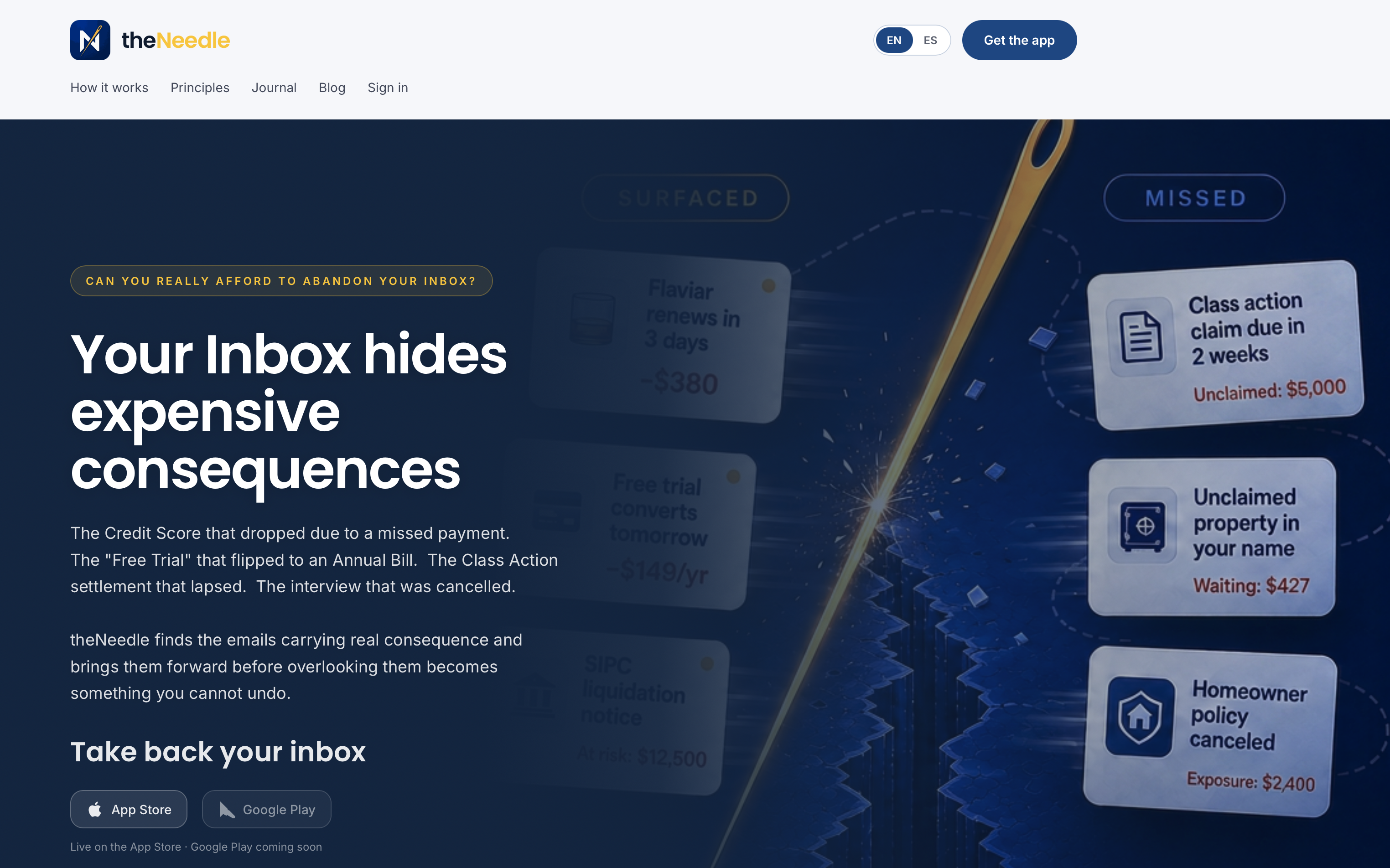
theNeedle is built for the exact gap this system leaves open: once your filters and folders are in place, you still have to figure out which of the messages left in Action actually carry consequences. Instead of ranking mail by when it arrived, theNeedle surfaces the emails tied to deadlines, financial alerts, overdue replies, and tracked opportunities like credits or refunds, so a bill due Friday doesn’t get buried under twenty newsletters you already tried to unsubscribe from. It also includes built-in unsubscribe support for the senders who keep coming back, and one-at-a-time focus for anyone who finds a crowded inbox genuinely hard to think through.
If the 30 to 90 minute rescue above got your inbox under control, theNeedle is what keeps it that way without daily manual triage. Connect your Gmail, Outlook, or iCloud account and try theNeedle to see which of your current unread messages actually need you today.
Sources
- Set expectations to reduce email stress — Cornell News
- How to set up rules in Outlook — Microsoft Support
- How to spend way less time on email every day — Harvard Business Review
- Calendar
- Monday
FAQ
How Do I Deal With Email Overload at Work?
Cut incoming volume with unsubscribes and filters, check email in two or three fixed windows instead of constantly, and sort what remains into Action, Waiting, and Reference folders.
How Do I Professionally Say I’m Overwhelmed by Email?
Tell colleagues directly that you’re working through a backlog and will respond within a set window, rather than apologizing repeatedly; setting that expectation is one of the more reliable ways to lower response pressure on both ends.
What Is the Two-Minute Rule for Email?
If a reply takes less than two minutes to write, do it immediately during your processing window instead of filing it away; anything longer goes into your Action folder for a dedicated block later.
Do People With ADHD Struggle More With Email?
Many people with ADHD find a crowded, unsorted inbox especially hard to process because every message competes for attention at once; tools built around one-at-a-time focus, like theNeedle, are designed specifically to reduce that load.
How Many Emails Does the Average Worker Get Per Day?
A high volume of emails each day makes unmanaged inboxes functionally impossible to keep up with without filters and batching.