Don’t Ignore Email: 5 Minute Triage for Busy Professionals

“Don’t ignore email” means one thing when the stakes are real: surface and act on messages carrying deadlines, financial penalties, legal exposure, or overdue commitments, before they escalate. The single move to make right now is a five-minute scan of your inbox previews for anything with a date, a dollar sign, or a contract attached. Flag it. That’s the whole system in miniature, and the rest of this guide builds on it.
TL;DR:
- Prioritize scanning your inbox for emails with dates, dollar signs, or contract-related words to quickly identify messages that could have financial or legal consequences.
- Verify the legitimacy of urgent-looking emails by checking sender details, hover links, and contacting trusted sources before taking any action involving money or sensitive information.
- Schedule three to four focused email checks daily at natural breaks to stay alert without constant interruptions, ensuring consequential messages are caught effectively.
- Use consequence-driven tools like theNeedle to surface important emails based on deadlines and alerts, rather than relying solely on sender or subject line filters.
- Delegate or automate the handling of non-urgent messages to prevent inbox overwhelm and reduce decision fatigue, especially in high-volume email environments.
Table of Contents
- Why Consequence-First Prioritization Matters
- A 5-Minute Triage Checklist for Consequential Emails
- How Do You Verify an Urgent-Looking Email Is Real?
- When Should You Check Email to Catch What Matters?
- Which Tools Actually Surface Consequential Email?
- Strategies for Effective Follow-Up and Reminders
- Delegating Consequential Emails Without Losing Control
- Why Do We Avoid Important Emails, Even When We Know Better?
- When Vigilance and Focus Compete: A Workable Trade-off
- Try theNeedle for Consequence-Driven Email Surfacing
- Sources
- FAQ
Why Consequence-First Prioritization Matters
The average professional receives roughly 117 emails a day, and buried somewhere in that volume is the one message that actually costs you money or standing if you miss it. Research on email interruptions backs up why this is so easy to get wrong. A study in MIS Quarterly found that email hurts performance differently depending on fit: messages “congruent” with your current task barely register as disruptive, while incongruent ones spike cognitive load and drag down effectiveness. A consequential email rarely announces itself as urgent in the subject line. It just sits there, congruent-looking, until the deadline passes.
The scale problem compounds this. MIT Sloan Management Review argues that teams need shared practices, and increasingly AI-assisted sorting, to separate high-value messages from noise, because manual triage breaks down once volume crosses a threshold most inboxes crossed years ago. Meanwhile, UC Irvine research shows that reactive, notification-driven checking amplifies stress rather than catching more of what matters. Volume alone isn’t the enemy. Missing the wrong message is.
A 5-Minute Triage Checklist for Consequential Emails
You don’t need a new system, just a fast pass that catches what matters before it becomes a problem. Run this once now and again at your next natural break:
- Scan previews for trigger language. Look for dates (“due by,” “expires,” “final notice”), dollar amounts, and words like “contract,” “invoice,” “overdue,” or “action required.”
- Flag anything that qualifies, immediately. Star it, label it, or move it to a dedicated folder. Don’t trust yourself to remember it on a second pass.
- Mark uncertain items for verification, not dismissal. If something looks consequential but feels off (unfamiliar sender, odd formatting), set it aside for the verification steps below rather than ignoring it outright.
- Schedule a 15-minute block within the next 24 hours to actually resolve what you flagged, not just look at it again.
Pro Tip: Marking an email “seen” is not the same as marking it “handled.” For readers who deal with ADHD-related task initiation gaps, this distinction matters most: create a visual or app-based marker for “action taken” separate from “read,” or the flagged item quietly becomes another thing you meant to do.
How Do You Verify an Urgent-Looking Email Is Real?
Consequential-looking emails are exactly what scammers imitate, so verification has to come before action, not after. The IRS states plainly that it does not initiate contact by email and will never request banking details that way. Any “urgent tax notice” in your inbox fails that test automatically.
The FTC’s guidance on phishing makes a broader point worth internalizing: scammers manufacture urgency specifically to short-circuit your verification instincts. That’s the tell. The more panicked an email wants you to feel, the more slowly you should move.
Before you click anything:
- Inspect the sender’s actual email address, not just the display name, for mismatched or misspelled domains.
- Hover over links to preview the destination URL rather than clicking directly.
- Contact the company or agency through a phone number or website you already know is legitimate, never one supplied in the email itself.
- Forward suspicious messages to your provider’s abuse address or the IRS’s official reporting channel if it claims to be tax-related.
If money or account credentials are involved anywhere in the request, confirm through an independent channel before you transfer a cent or type a password. One phishing study on high-volume inboxes found that workers who build security checks into their normal triage, rather than treating them as a separate chore, catch more fraud with less friction.
When Should You Check Email to Catch What Matters?
Vigilance and focus don’t have to compete if you schedule the vigilance. UC Irvine’s research on email habits found that choosing when to check email, rather than reacting to every notification, lowers stress and still catches what’s consequential, because you’re scanning with intent instead of getting interrupted mid-thought. Constant notification checking also carries a real cost: each context switch can take several minutes to recover from.
A workable rhythm for most freelancers and professionals:
- Check at three to four fixed points daily, tied to natural breaks (after a meeting, before lunch, end of day), not every buzz.
- Batch routine and promotional email into a single sweep; don’t let newsletters compete for attention with a contract deadline.
- Handle flagged, consequential items one at a time in a dedicated block, rather than skimming several at once between other tasks.
- Set a calendar reminder the moment you flag something with a deadline, so the follow-up doesn’t depend on remembering to check again.
This isn’t about checking less. It’s about deciding when you check, so the checking works for you instead of hijacking your day. For a deeper look at building this into a daily habit, theNeedle’s guide on organizing your inbox for calm walks through the routine side of it.
Which Tools Actually Surface Consequential Email?
Most inboxes already have the raw materials: filters, labels, snooze functions, and starred views. Used deliberately, they go a long way. Set a filter for invoice-related keywords, a label for anything from legal or HR, and a rule that snoozes newsletters until your batch-processing window. That alone catches a meaningful share of what deserves attention.
The limitation is that filters and rules are static. They sort by sender or keyword, not by actual consequence, so a first-time vendor invoice or a one-off legal notice slips past a rule built for recurring senders.
This is the gap consequence-driven prioritization is built to close. Instead of asking “who sent this” or “how many people are on this thread,” it asks “what happens if this gets ignored.” TheNeedle applies that lens directly: it connects to Gmail, Outlook, Microsoft, Yahoo, and iCloud, then surfaces messages tied to deadlines, financial alerts, contracts, and unanswered replies, while tracking overlooked opportunities like credits or refunds. It also includes a built-in unsubscribe option for persistent senders cluttering the batch you’re trying to ignore.
The design leans into single-focus handling, showing one consequential item at a time rather than a stacked list, which lines up with the one-thing-at-a-time approach that works especially well for ADHD-friendly workflows. As MIT Sloan’s research on email management notes, AI-assisted sorting that predicts relevance and consequence outperforms sender-based rules alone, because it adapts to messages your filters were never built to catch.
Strategies for Effective Follow-Up and Reminders
A flagged email that never gets a follow-up date is just a flagged email you’ll forget twice instead of once. The fix is treating every consequential message as a task with a due date, not a note to revisit “later.”
The most reliable method is converting the deadline the moment you see it. If a client email says payment is due in ten days, put that date on your calendar immediately, with a reminder two to three days ahead so you have room to act if something goes wrong. Don’t rely on the email itself as your tracking system; inboxes are built for storage, not for surfacing time-sensitive obligations on their own.
For anything you’re waiting on a reply to, build a simple follow-up rhythm: if you haven’t heard back in three to five business days on something consequential, send a short check-in rather than waiting indefinitely. Overdue replies are one of the most common ways opportunities quietly die, not because anyone decided to ignore them, but because nobody set a trigger to notice the silence.
A recurring weekly review works well as a backstop. Once a week, scan flagged items and ask: what’s still open, what’s overdue, and what did I forget to follow up on? This catches the items that slipped through daily triage, especially during busy weeks when even the best system gets rushed.

Delegating Consequential Emails Without Losing Control
Not every consequential email needs to be handled by you personally, and trying to be the sole checkpoint for everything is a fast route to burnout or missed deadlines. The key is delegating the task, not just the message.
If you work with an assistant, bookkeeper, or team member, give them explicit criteria for what counts as consequential in your world: specific senders (your accountant, key clients, your landlord), specific keywords (invoice, contract, deadline, legal), or specific email accounts they should monitor directly. Vague instructions like “let me know if something important comes up” put the judgment call back on someone who doesn’t have your full context.
When you do delegate, set a clear escalation rule: what gets forwarded to you immediately versus what gets handled and simply logged. A late invoice from a reliable vendor might get a standard response from your assistant. A cease-and-desist letter should reach you within the hour, not at the next check-in.
For freelancers and solo professionals without staff to delegate to, the practical version of this is building the delegation into your tools instead of a person. Filters, forwarding rules, and consequence-based surfacing do a version of the same job: they decide what deserves your direct attention so you’re not manually re-evaluating every message that lands.
Why Do We Avoid Important Emails, Even When We Know Better?
The most common barrier isn’t laziness. It’s a specific kind of dread: opening an email that might confirm bad news (a rejected invoice, a missed deadline already in motion, a difficult client conversation) feels worse than not knowing yet. Psychologists sometimes call this “ostrich behavior,” and it’s remarkably common among freelancers managing their own contracts and payments.
A second barrier is sheer decision fatigue. After sorting through dozens of low-stakes messages, the mental energy needed to properly evaluate a genuinely important one is often already spent, so it gets a quick glance and a mental “I’ll deal with this later” that rarely arrives on schedule.
Overcoming both starts with lowering the cost of looking. If checking an email doesn’t require deciding what to do about it right then, just flagging it and moving on, the avoidance instinct loses its grip. Separate the act of acknowledging a message from the act of resolving it. That single shift, borrowed from the triage checklist earlier, turns a dreaded inbox into a short list you’ve already agreed to face on your own schedule, not the sender’s.

When Vigilance and Focus Compete: A Workable Trade-off
Security-first thinking and deep-focus work pull in opposite directions: one wants you scanning constantly, the other wants you undistracted for hours. The honest answer is that you don’t get both at full intensity, and trying to leads to either missed deadlines or burned-out attention.
The trade worth making is scheduled vigilance over constant vigilance. Pick your checkpoints, run the triage checklist at each one, and let the rest of your day stay uninterrupted. With 117 emails arriving daily for the average professional, waiting for a scheduled check rarely costs you anything real.
Test it for seven days. Flag consequential items at each checkpoint, act on them in a dedicated block, and see what actually would have slipped through versus what your anxiety told you might slip through. Most people find the gap between those two numbers is smaller than expected.
— Glen Bover
Try theNeedle for Consequence-Driven Email Surfacing
theNeedle is the alternative to manually re-scanning 117 emails a day looking for the one that actually matters. Instead of sorting by sender or subject line, it connects to Gmail, Outlook, Microsoft, Yahoo, and iCloud and surfaces the messages tied to deadlines, financial alerts, contracts, and overdue replies, one at a time, so you’re never juggling a dozen flagged items at once.
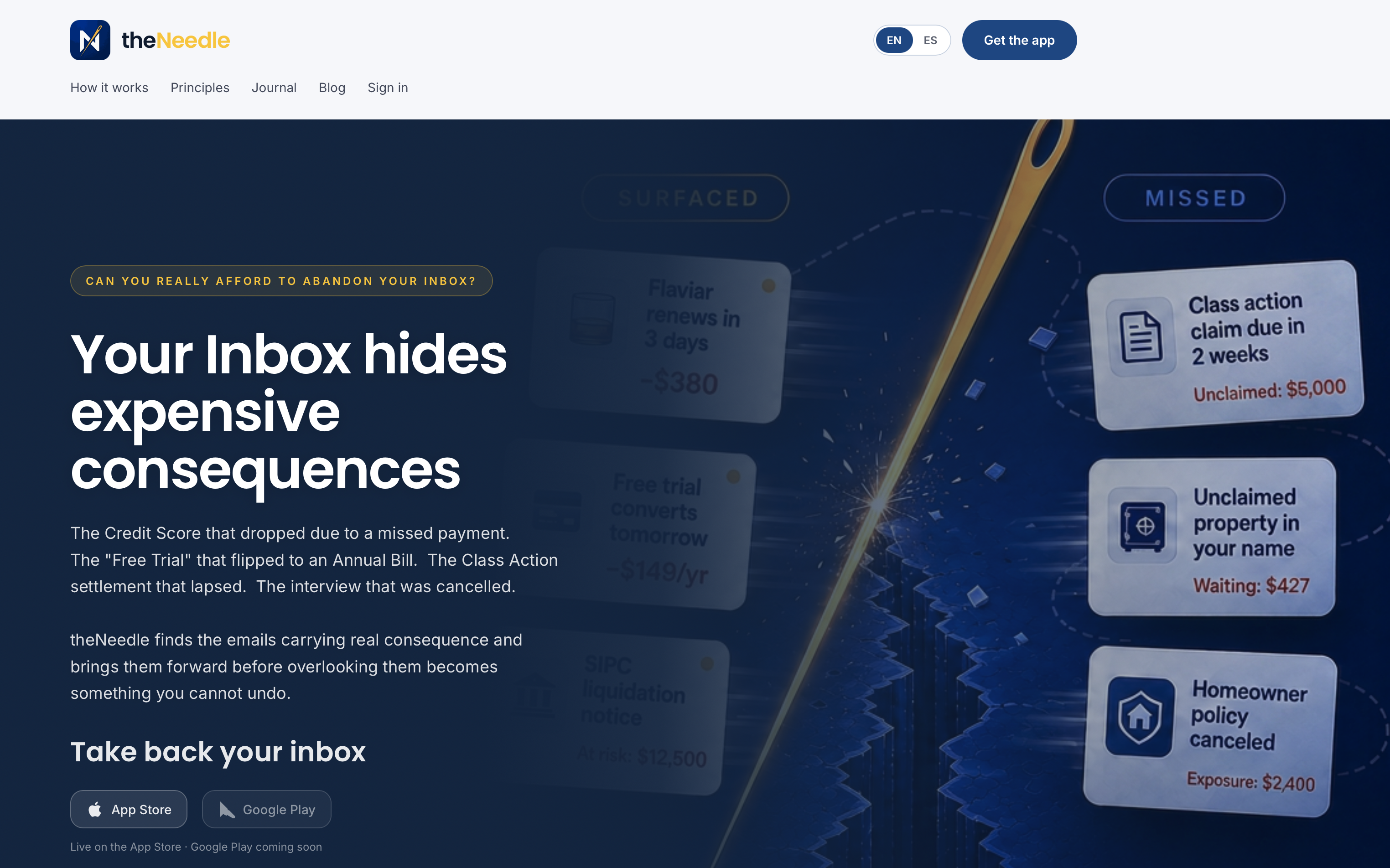
It also tracks opportunities you’d otherwise miss, like unclaimed credits or refunds, and includes a built-in unsubscribe tool for the senders cluttering your batch window. The approach is built for exactly the ADHD-friendly, single-focus workflow described earlier in this guide: no stacked lists, no competing priorities, just the next consequential thing.
You can start a trial and see what your inbox has been hiding through theNeedle’s live signup page, or read more about the full approach on theNeedle’s main site. Monthly and annual subscription plans are available; current prices can be found on the pricing page.
Sources
- E‑Mail interruptions and individual performance (MIS Quarterly)
- Email duration, batching and self-interruption: patterns of email use on productivity and stress (UC Irvine / CHI)
- Converting email from drain to gain (MIT Sloan Management Review)
- Report fake IRS, Treasury or tax-related emails and messages (IRS)
FAQ
What Does “Don’t Ignore Email” Actually Mean?
It means treating messages with deadlines, financial consequences, legal exposure, or overdue replies as a priority category separate from routine email, not reading every message the instant it arrives. The goal is catching the few emails that carry real stakes, not achieving inbox zero.
How Do I Tell a Consequential Email From a Routine One?
Scan for concrete triggers: dates, dollar amounts, contract language, or the words “overdue” and “action required.” A promotional email or internal update rarely carries those markers, while an invoice, legal notice, or client deadline almost always does.
Is It Safe to Click a Link in an Urgent Financial Email?
Not without verifying it first. The IRS confirms it never initiates contact by email, and the FTC warns that manufactured urgency is a core phishing tactic. Verify through a known phone number or website before clicking anything.
How Often Should I Check Email to Avoid Missing Deadlines?
Three to four scheduled checks a day at natural breaks, rather than constant notification checking, catches consequential items while reducing stress, according to UC Irvine’s research. Pair each check with the triage checklist so nothing flagged gets forgotten.
Can a Tool Automatically Find My Most Important Emails?
Yes. theNeedle connects to Gmail, Outlook, Microsoft, Yahoo, and iCloud and surfaces messages by consequence, deadlines, financial alerts, contracts, overdue replies, rather than by sender or keyword alone. Plans start at $9.99 per month, with details available on theNeedle’s live page.