Stop Missed Deadlines: Evidence Based Consequence Tracker for Busy Pros

A consequence tracker automatically finds emails with legal, financial, or deadline consequences and surfaces them before you lose the chance to act. It works by scanning for signals like due dates, refund language, or contract terms, then ranking those messages above the noise of your other 100-plus daily emails. The payoff: fewer missed deadlines, fewer forfeited refunds, and a smaller, calmer queue of things that truly need your attention. One purpose-built option runs on this exact model.
TL;DR:
- Consequence trackers focus on signals like deadlines, refunds, and contract language rather than urgency, reducing false positives and decision fatigue.
- They prioritize monitoring metadata such as dates, monetary terms, and reply threads, only scanning content deeply when necessary for accuracy.
- Setting up filters for common consequence signals and gradually integrating automated tools helps ensure reliable detection with minimal false positives.
- Tools should be tested with real deadlines, refund notices, and overdue replies to confirm they surface critical emails within a few hours.
- Proper permissions and periodic review of connected apps are essential to protect privacy and maintain control over sensitive inbox data.
Table of Contents
- How Does a Consequence Tracker Actually Work?
- Why Does Consequence-First Beat Urgency-Based Sorting?
- How Do You Set Up Consequence Tracking in Gmail or Outlook?
- What Permissions Should You Grant a Tracker?
- How Do You Test a Consequence Tracker Before Trusting It?
- A Publisher’s Perspective on Building Consequence Tracking
- Try theNeedle’s Consequence Tracking Free
- Sources
- FAQ
How Does a Consequence Tracker Actually Work?
Most inbox tools sort by sender, subject keywords, or how recently something arrived. A consequence tracker asks a different question: what happens if you ignore this message? That shift in logic is the whole point.
The detection layer looks for a specific set of signals rather than a single “urgent” flag:
- Explicit dates and deadlines — “due by,” “expires on,” “renew before”
- Monetary terms — refund, invoice, chargeback, late fee, payment due
- Contract language — renewal, termination, cancellation notice, breach
- Reply and overdue threads — messages where you owe someone a response and haven’t sent one
- Calendar invites and attachments — signed documents, statements, or scheduling requests tied to a specific action
Detection can run on metadata (sender, subject line, dates found in the header or preview) or on full content scanning when deeper accuracy is needed, such as spotting a termination clause buried in paragraph three of a vendor email. The best systems lean on metadata first and only dig deeper when a message clears an initial threshold, which keeps both processing and privacy exposure lower.
The result is a queue, not a pile. Instead of 117 emails competing for attention, which is roughly what theNeedle says the average worker receives daily, a handful of consequence-flagged items sit at the top. That smaller list is what actually gets acted on, because decision fatigue drops sharply once you’re choosing from five items instead of five hundred.

Why Does Consequence-First Beat Urgency-Based Sorting?
Urgency and consequence are not the same thing, and treating them as interchangeable is where most inbox systems go wrong. Research published in the Journal of Computer-Mediated Communication found that “important” email and “important-and-urgent” email are distinct constructs, and both independently predict work-role overload. A tax notice with a deadline six weeks out carries no urgency cues at all, yet it can cost you real money if ignored.
Volume itself is part of the problem. A Frontiers in Psychology study found that communication-related emails, things like broadcasts and notifications rather than task requests, have a notably stronger link to email load and strain than task-based messages do. Filtering that noise out of the active queue is not a nice-to-have; it is where most of the relief comes from.
Combine those two findings and the practical benefits become clear:
- Fewer missed deadlines, because consequence gets ranked separately from urgency
- Less time lost to context switching between low-stakes and high-stakes messages
- A cleaner action queue that reflects what actually matters, not just what arrived last
How Do You Set Up Consequence Tracking in Gmail or Outlook?
You don’t need to rebuild your entire inbox to start catching consequential emails. Start small, then layer in automation as you confirm what’s working.
- Build three filters first. In Gmail or Outlook, create rules that flag messages containing date patterns (“due,” “expires,” “renewal”), money terms (“refund,” “invoice,” “balance due”), and reply-request phrasing (“awaiting your response,” “please confirm by”). Label or flag matches instead of archiving them.
- Check your connector permissions before linking anything. Whether you’re authorizing theNeedle, a Zapier flow, or a calendar sync, Gmail’s own guidance recommends reviewing exactly what access an app requests, read-only, search, or full modify rights, before you approve it.
- Map signals to your existing folder structure. If you already use labels in Gmail or folders in Outlook, this guide to mapping Gmail labels and IMAP folders is a useful reference for keeping consequence flags consistent across accounts instead of building a parallel system.
- Go advanced with a dedicated consequence-tracking app once the manual filters prove the concept. A centralized tool can pull signals across Gmail, Outlook, and iCloud simultaneously, then push calendar reminders or SMS alerts for anything flagged as highest-consequence.
- Tune for false positives weekly. Newsletter promos that say “expires soon” or automated shipping notices with fake urgency will slip through early filters. Adjust keyword thresholds as you spot patterns, and don’t be afraid to narrow the rule rather than scrap it.
Pro Tip: Set your reply-thread filter to trigger only after 48 hours of silence. That single tweak eliminates most of the false positives from routine back-and-forth threads while still catching the reply you genuinely forgot.
What Permissions Should You Grant a Tracker?
Any tool that reads your inbox needs some level of access, and understanding what you’re granting matters more than most people realize. A “read-only” scope lets an app see messages without changing anything; “modify” access can move, label, or archive mail on your behalf.
- Check linked apps periodically through your Google Account’s connected apps settings and revoke anything you no longer use.
- If you’re on a managed work account, confirm with IT whether admin policies restrict third-party linked apps before you connect one.
- Favor tools that offer metadata-only detection where possible, since scanning headers and subject lines for consequence signals carries less exposure than full content parsing.
- Ask what retention policy applies to any content a tracker does read, and whether you can delete that history on demand.
How Do You Test a Consequence Tracker Before Trusting It?
Don’t take a tool’s word for it. Run it through a short trial with real stakes before you let it replace your own vigilance.
- Check detection accuracy on the signals that matter most. Feed it a real contract renewal notice, a refund confirmation, and a client thread you’ve been ignoring for a week. It should flag all three.
- Count the false positives. A tool that flags every marketing email as “urgent” isn’t saving you time, it’s adding a second inbox to manage.
- Confirm cross-inbox coverage. If you run Gmail for client work and Outlook for internal communication, the tracker needs to surface consequence items from both without you checking separately.
- Measure notification latency. A flagged deadline that reaches you six hours later than it should isn’t much better than no flag at all.
- Test the one-at-a-time focus. If the tool supports ADHD-friendly single-item presentation, confirm it actually narrows your view instead of just adding another highlighted list.
Pro Tip: Accept a tool only if it catches all three test cases, contract deadline, refund or credit, and overdue reply, within your first session. If it misses one on a controlled test, it will miss more in the wild.
A Publisher’s Perspective on Building Consequence Tracking
Most inbox tools chase volume, sorting faster instead of asking what actually matters. That’s backwards. One tool was built around consequence signals, one-at-a-time focus, and overdue tracking precisely because urgency cues alone miss the quiet, high-stakes emails. No detection system catches everything; automated flags still need a human glance before you act.
— Glen Bover
Try theNeedle’s Consequence Tracking Free
One tool is built to answer one question every time a new message lands: what happens if you ignore this? It scans across Gmail, Outlook, Microsoft, Yahoo, and iCloud for deadline, financial, and contract signals, then hands you one flagged item at a time instead of a competing pile, an approach that fits the ADHD-friendly focus many freelancers specifically need.
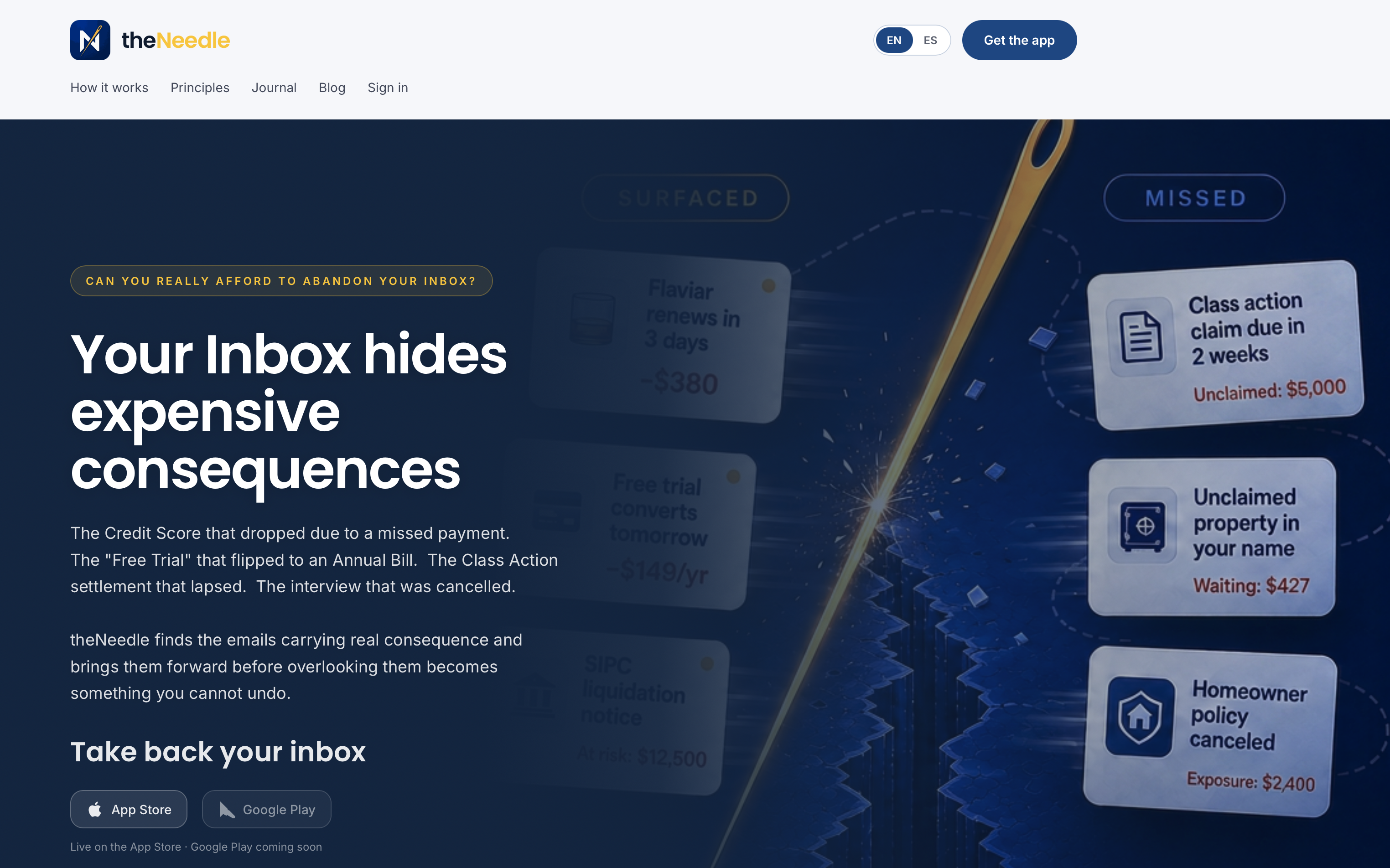
Run your own trial using the three test cases from the evaluation checklist above: a contract deadline, a refund or credit notice, and an overdue reply thread. Watch how quickly each one surfaces and whether the SMS alerts for high-consequence items reach you fast enough to matter. Start the Theneedle and see how many consequential emails have been sitting unflagged in your inbox this week.
Sources
JCMC, Frontiers in Psychology, CHI/ICS email research, Gmail permissions guidance, and how to organize your inbox for deeper reading.
- Measurement of Perceived Importance and Urgency of Email: An Employees’ Perspective | Journal of Computer-Mediated Communication
- Drowning in emails: investigating email classes and work stressors as antecedents of high email load and implications for well-being | Frontiers in Psychology
- How Gmail protects your privacy & keeps you in control - Gmail Help
FAQ
What Is a Consequence Tracker in Simple Terms?
A consequence tracker is an inbox feature that finds emails with real-world stakes, deadlines, refunds, contract terms, and surfaces them above routine messages. Some tools apply this model across Gmail, Outlook, and iCloud to reduce the risk of missing a financially or legally significant email.
How Is a Consequence Tracker Different From a Priority Inbox?
A priority inbox typically ranks by sender familiarity or urgency cues like “ASAP.” A consequence tracker ranks by outcome, so a non-urgent tax renewal notice can outrank an urgent but low-stakes meeting reminder, a distinction JCMC research confirms matters for reducing work-role overload.
Does theNeedle Cost Anything to Try?
theNeedle offers a free trial, and current subscription pricing is available on theNeedle’s site rather than published elsewhere. You can test consequence detection across your connected inboxes before deciding on a paid plan.
Can a Consequence Tracker Read My Private Emails?
It depends on the permissions you grant. Some detection runs on metadata alone, like subject lines and dates, while deeper accuracy may require content scanning, so review Gmail’s linked-app permissions before authorizing any tool.
Will a Consequence Tracker Catch Every Important Email?
No automated system catches everything, and false negatives can happen with unusual phrasing or unfamiliar senders. That’s why testing a tool against real cases, a contract deadline, a refund notice, an overdue reply, before relying on it fully is worth the ten minutes it takes.