Match Your Failure Mode to the Right Accountability App, Six Filters

Pick your accountability app by mechanism, not marketing. If you ignore soft nudges but respond to money on the line, a commitment contract works better than a habit tracker with a mascot. Research on nudged commitment devices shows they help many people stick to goals, but they are not universal. The sections below give you the criteria and a short trial plan to find out which mechanism actually holds you accountable.
TL;DR:
- Apps with financial stakes are most effective if you respond to loss aversion and choose verification methods like synced data or photos; avoid high stakes that cause resentment.
- Human coaching works best for complex or emotionally charged goals, but requires vetting for quality and matching the coach’s approach to your pace and needs.
- Body doubling is suited for task initiation, especially when starting is difficult, but is less helpful for deep, sustained focus over long periods.
- Gamified trackers increase app engagement but do not necessarily improve goal completion, so pair them with external verification for meaningful results.
- Device-monitoring apps track usage rather than goals and should only be used if your objective is to reduce screen time, with attention to privacy and consent issues.
Table of Contents
- What Kind of Accountability App Actually Works for You?
- How Do You Choose the Right Accountability App?
- Financial-Stakes Apps: How Commitment Contracts Work and How to Use Them Safely
- Human Coaching and Paid Check-Ins: When Personal Accountability Needs a Person
- Body Doubling: Why Working Alongside Someone Helps You Start
- AI Accountability Partners and Gamified Trackers: What They Deliver and Where They Fall Short
- Device-Monitoring Apps Aren’t the Same Thing as Accountability Apps
- Evidence Summary: What Trials and Reviews Show About Accountability Interventions
- Editor Perspective: The Mistake Almost Everyone Makes on Their First Try
- A Complementary Fix for the Accountability Gap Email Creates
- Sources
- FAQ
What Kind of Accountability App Actually Works for You?
Every accountability app is really a delivery system for one of five underlying mechanisms. The app’s interface, price, and marketing copy are just packaging. What matters is the “teeth” behind it: what happens when you don’t follow through.
Here’s the honest breakdown of each lane and who tends to thrive in it.
- Financial-stakes / commitment contracts. You pledge money, and it gets forfeited or donated if you miss your goal. This works well for people who respond to loss aversion more than encouragement, but it requires real tolerance for risk. If the thought of losing $50 makes you anxious rather than motivated, skip this lane.
- Human coaching / paid check-ins. A real person reviews your progress on a schedule and asks follow-up questions. This suits complex, multi-step goals where you need judgment calls, not just a checkbox. It costs more and depends heavily on the individual coach’s skill.
- Body doubling / live coworking. You work alongside another person, in person or on video, without them necessarily doing your task. This helps most with task initiation, the moment where you stall out before starting, which makes it a strong fit for people who struggle with ADHD-related activation problems.
- AI partners and reminders. A conversational bot checks in, remembers your stated commitments, and nudges you at set times. These apps are consistent and available at 2 a.m. when no human coach would be, but they rely entirely on your self-reported honesty. There’s no verification layer unless you build one in yourself.
- Gamified habit trackers. Streaks, points, badges, and leaderboards turn the habit into a small game. These are excellent at keeping you opening the app, which is not the same as achieving the underlying goal.
- Device-monitoring apps. These track screen time, location, or app usage rather than a self-defined goal. They solve a different problem than most people searching for an “accountability app” actually have, and they raise separate privacy questions covered later in this article.
On the free versus paid question, most mechanisms offer a stripped-down free tier: a basic tracker, a handful of AI check-ins, or a public pledge board. What you typically lose on the free tier is verification. Paid versions of financial-stakes apps often use a referee or automated proof (a synced fitness tracker, a photo, a receipt) to confirm the goal was actually met, not just claimed. That verification layer is usually the single biggest reason a paid version outperforms a free one, more than any added feature.
How Do You Choose the Right Accountability App?
Before you download anything, run through six practical filters. They take less time than reading a single app’s onboarding flow.
- Goal clarity. Can you state your goal as a number with a deadline (“run three times this week by Sunday”) rather than a vague intention (“get healthier”)? Vague goals defeat every mechanism equally.
- Verification preference. Do you want a human, a device, or your own word to confirm you did the thing? Your honest answer here rules out entire categories fast.
- Acceptable stakes. What’s the largest financial or social consequence you’d tolerate without resentment building up? Set this number before you see an app’s default settings, or the app will set it for you.
- Platform fit. Does the app run on the device you actually carry, and does it integrate with tools you already use, like a calendar or a fitness tracker?
- Privacy tolerance. How much access are you willing to grant, location, screen time, health data, and who else can see the reports?
- Cost and trial availability. Does the app offer a real trial period, or does it lock verification features behind a paywall you can’t test first?
Three diagnostic questions cut through most of the noise. First: do I respond better to consequences or to company? That separates financial-stakes and coaching from body doubling. Second: is my problem starting the task or sustaining it over weeks? That separates body doubling from long-horizon coaching or trackers. Third: would I actually tell a real person if I failed? If the honest answer is no, skip mechanisms that depend on self-report and pick one with outside verification instead.
Pro Tip: Run your trial on a goal you’d attempt anyway, not a New Year’s-style overhaul. You want to isolate the app’s effect on your behavior, not test willpower and a new mechanism at the same time.
A seven-day trial plan works better than a monthly subscription commitment. On day one, write down one measurable goal, your chosen verification method, and a plain-language success criterion (“logged three gym visits, confirmed by app sync”). Run the mechanism daily for a week without switching apps midweek. On day seven, compare your actual behavior against the written criterion, not against how motivated you felt. If you hit the target and the process felt tolerable, extend the trial to thirty days before paying for anything long-term. If you missed the target, the more useful question isn’t whether the app failed. It’s whether the mechanism itself, not this specific app, ever fit how you operate on a bad day.
Financial-Stakes Apps: How Commitment Contracts Work and How to Use Them Safely
A commitment contract follows a simple flow: you set a goal, choose a stake, pick a verification method or a referee, and the app enforces the consequence automatically or through a third party. Some platforms let a friend act as referee; others use synced data, like a fitness app or a check-in photo, to confirm completion without a human judge.
The research on this mechanism is genuinely encouraging, with a caveat worth taking seriously. A large randomized trial of commitment contracts found that participants nudged toward longer commitment contracts were more likely to meet their pre-stated exercise goals than those on shorter contracts. That’s a real behavioral effect, not a marketing claim.
The same researchers caution that nudges and commitment devices can reduce welfare for some participants, meaning the psychological cost of a harsh penalty can outweigh the benefit of the achieved goal.
That’s the part most accountability apps leave out of their landing pages.
Use these safeguards before you set a stake:
- Set an amount you’d genuinely regret losing but that wouldn’t strain your finances if you did.
- Where the app allows it, choose device-based or photo verification over pure self-report; automated proof removes the temptation to fudge results.
- Look for an appeal or forgiveness rule for a single missed day caused by illness or an emergency, since rigid enforcement breeds resentment fast.
- Watch for two red flags: persistent anger at losing stakes, or stakes so high they’re affecting bills. Both mean the mechanism, not your willpower, is the wrong fit.
Behavioral-economics research on calibrating commitment contract penalties backs this up directly: stronger penalties can raise adherence, but they also raise regret, and people often set harsher stakes for others than they would tolerate for themselves.
Human Coaching and Paid Check-Ins: When Personal Accountability Needs a Person
Coaching-driven accountability usually runs on a weekly or biweekly cadence, with a real person reviewing what you committed to and asking why something didn’t happen. That question, asked by a human who remembers last week’s conversation, is the whole value proposition. No automated system replicates it well yet.
This lane earns its cost for complex or emotionally loaded goals, career changes, chronic health management, business decisions, where a checkbox can’t capture whether you’re actually making progress. A coach adjusts the plan itself when the plan turns out to be wrong, which no app-only mechanism does.
The limitations are real, though. Coaching is the most expensive lane by a wide margin, quality varies enormously between individual coaches, and there’s a dependency risk: some people outsource their judgment to the coach rather than building their own.
Before paying for a subscription, vet a coach or coaching app against this list:
- Ask for a sample check-in format before committing to a full engagement.
- Confirm the cadence matches your goal’s actual pace, weekly for habits, less often for slower structural goals.
- Check whether the coach adjusts plans based on results or just repeats the same script regardless of your progress.
- Look for a short trial engagement, two weeks with two or three concrete deliverables, rather than a long contract upfront.
A two-week micro-engagement is the cleanest way to test this. Define two specific deliverables (a finished draft, a completed workout block) and see whether the check-ins genuinely changed your behavior or just added a scheduled conversation.
Body Doubling: Why Working Alongside Someone Helps You Start
Body doubling solves a narrower problem than most accountability apps claim to solve: task initiation, not sustained motivation. If you can start easily but lose steam halfway through, body doubling won’t help much. If you stall before you even open the laptop, it often does.
Sessions typically run in twenty five to fifty minute blocks, with a brief check-in at the start (“what are you working on right now”) and a short wrap-up naming what got done. The structure matters more than the company itself; a silent stranger on a video call who simply exists in the same time window is often enough.

The mechanism behind this isn’t vague. A 2025 dyadic-intervention trial found that just-in-time prompts aimed at both a participant and a partner increased measured physical activity, while generic collaborative planning without that timing element did not consistently help. Timing and targeting the prompt to both people, not just one, made the difference.
That finding lines up with clinical guidance on ADHD-related activation problems, where scheduled presence is a commonly recommended strategy specifically for getting started, not for grinding through hours of sustained focus.
- Best use: writing a first draft, starting paperwork, opening a spreadsheet you’ve been avoiding.
- Weak fit: multi-hour deep work sessions where you need silence and zero social presence.
Pro Tip: Book three body-doubling sessions in a single week and track just one number: minutes elapsed between sitting down and actually starting the task. That’s the metric body doubling is built to move.
AI Accountability Partners and Gamified Trackers: What They Deliver and Where They Fall Short
AI-based accountability partners have gotten genuinely useful. Modern versions hold a running memory of your stated commitments, follow up conversationally rather than with a flat push notification, and are available at any hour a human coach never would be. Gamified habit trackers, meanwhile, layer streaks, points, and leaderboards on top of basic logging to keep you opening the app.
Here’s the caution that most reviews skip. Research on gamification and app engagement consistently shows that gamification improves retention and engagement far more reliably than it improves actual outcomes. A thirty-day streak tells you the app is sticky. It doesn’t tell you the underlying goal, weight lost, manuscript finished, debt paid down, actually happened.
- AI partners excel at consistency and low-friction daily check-ins, but every claim you report is self-verified unless you add outside proof.
- Gamified trackers excel at making the app itself enjoyable to open, which matters for adherence but says nothing about the goal’s completion.
- Neither mechanism includes real financial or social stakes by default, which is exactly why they’re the easiest lane to abandon quietly.
The best practice for anything higher-stakes than a casual habit: pair an AI or gamified layer with a verification step or an external consequence. Use the AI partner for daily nudges, but attach a monthly financial stake or a human check-in for the goal that actually matters. A fair trial is fourteen days tracking one concrete behavior metric, workouts completed, pages written, calls made, not app opens or points earned.
Device-Monitoring Apps Aren’t the Same Thing as Accountability Apps
A lot of searches for “accountability app” actually land on device-monitoring software, and the two solve different problems. A goal-accountability app tracks whether you completed something you chose (a workout, a savings target, a writing session). A device-monitoring app tracks how you use your phone or computer, screen time, specific app usage, sometimes location, often for a parent, employer, or partner rather than the user themselves.
If your actual goal is reducing your own screen time, a monitoring app can be the right tool. If your goal is finishing a project or hitting a fitness target, monitoring software measures the wrong thing entirely.
For anyone still considering a monitoring tool, run this privacy checklist first:
- Confirm the person being monitored consented and understands exactly what’s tracked.
- Check the scope: does it log everything, or only the specific apps and hours you set?
- Ask how long data is retained and whether it’s ever shared beyond the report recipient.
- Confirm who actually sees the reports and how often.
Less invasive alternatives often deliver the same accountability without the surveillance: scheduled check-ins with a coach or friend, photo proof of a completed task, or automated verification through health-data syncing rather than raw activity logs.
Evidence Summary: What Trials and Reviews Show About Accountability Interventions
The NBER randomized-contract study remains the strongest single piece of evidence for financial-stakes accountability. Longer, nudged contracts increased goal adherence in a trial of thousands of participants, though the authors flag welfare costs for people who chose penalties too harsh for their own tolerance.
Timing and targeting decide whether an accountability intervention works at all. Generic planning prompts underperform just-in-time nudges aimed at both a participant and their partner.
That’s the core finding from the 2025 dyadic-intervention trial, and it’s the strongest evidence behind body-doubling’s effectiveness for task initiation specifically.
On gamification, the caution holds across multiple reviews: engagement metrics rise, but outcomes don’t automatically follow. A related trial on persuasive design and social support found the same pattern, increased engagement with specific tasks, without a matching rise in full program completion.
The synthesis for your own trial: pick a mechanism with real teeth for anything that matters, use just-in-time prompts over generic reminders, and measure the goal itself rather than app activity.
Editor Perspective: The Mistake Almost Everyone Makes on Their First Try
Most people fail their first accountability app not because the app was bad, but because they picked the wrong mechanism, set stakes too high on day one, or let verification slide after week two. Start with one goal, one mechanism, and a one-week trial before you touch financial stakes at all.
The real failure modes are predictable: choosing coaching when you actually needed body doubling, setting a stake you’d resent losing, or trusting self-report when you already know you’ll round up. Escalate to combining mechanisms, or bring in a coach, only after a plain trial tells you where the gap actually is.
— Glen Bover
A Complementary Fix for the Accountability Gap Email Creates
None of the mechanisms above catch the accountability failure that happens quietly in your inbox: the deadline reminder, the refund window, the reply someone’s waiting on, buried under whatever else landed today. TheNeedle is built specifically for that gap. Instead of sorting mail by sender or volume, it surfaces the messages that carry real consequences: deadlines, financial alerts, unanswered replies, and opportunities like credits or refunds you’d otherwise miss.
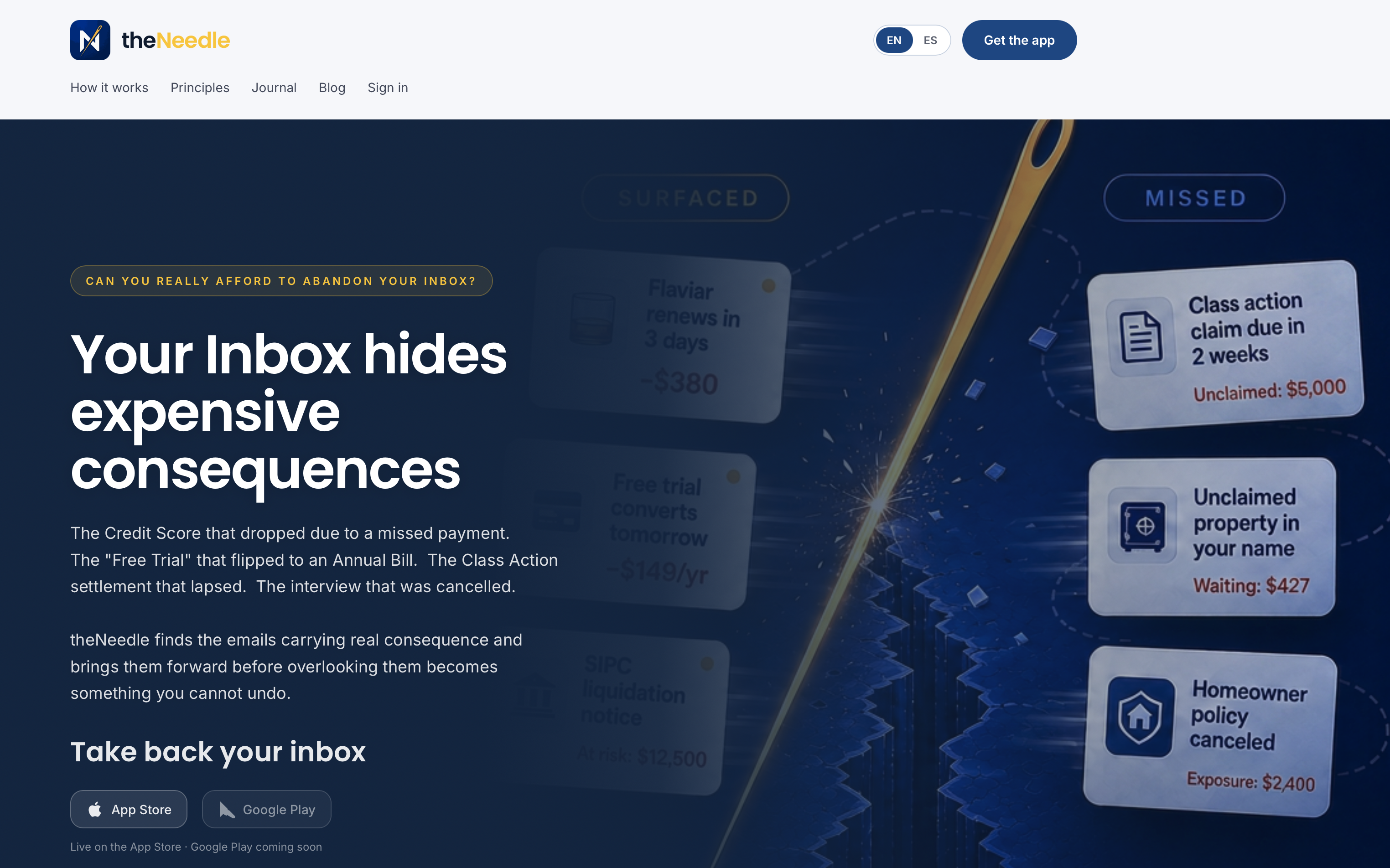
An accountability app keeps you honest about a goal you chose. theNeedle keeps you honest about the obligations that arrive whether you chose them or not, which matters most when a missed reply or an overlooked deadline quietly undoes the progress your accountability plan was tracking. If you’re juggling coaching check-ins, contract deadlines, or referee confirmations by email, that’s exactly the kind of message an email prioritization tool can help flag first. You can preview how it prioritizes your inbox and see whether it catches something you’d have missed this week.
Sources
- Nudges and commitment contracts randomized trial (NBER working paper)
- Dyadic-intervention trial showing importance of just-in-time partner prompts (PMC)
FAQ
What Is the Best Free Accountability App?
There’s no single best free option, since the right pick depends on your mechanism, not the price tag. Free tiers of habit trackers, body-doubling communities, and AI check-in apps all exist, but most lose the verification layer (referees, synced proof) once you leave the paid tier.
What Is an Accountability App?
An accountability app is any tool that helps you stick to a goal by adding an external consequence, check-in, or witness to your progress, ranging from financial stakes to human coaching to simple gamified tracking. The mechanism behind the app, not the interface, determines whether it actually changes your behavior.
What Is the Best iPhone Accountability App?
iPhone compatibility isn’t the deciding factor for most people; the mechanism is. Whether you choose a financial-stakes contract, an AI check-in partner, or a body-doubling app, confirm it syncs with your Health app or calendar if verification matters to you, since that integration affects how well the app can confirm you actually did the thing.
What Is the Best Accountability App for Losing Weight?
Weight-loss goals tend to respond best to mechanisms with built-in verification, like device-synced tracking or financial-stakes contracts tied to logged workouts or weigh-ins, rather than pure self-report. The NBER commitment-contract trial specifically found longer, nudged contracts improved exercise-goal adherence, which is the closest direct evidence for this use case.
How Do I Know if an Accountability App Is Actually Working?
Judge it against the written success criterion you set before the trial, not how motivated you felt during the week. If you hit the number you defined on day one, whether that’s workouts logged or pages written, the mechanism fits; if you didn’t, the honest question is whether the mechanism itself, not the specific app, matches how you operate on a low-motivation day.